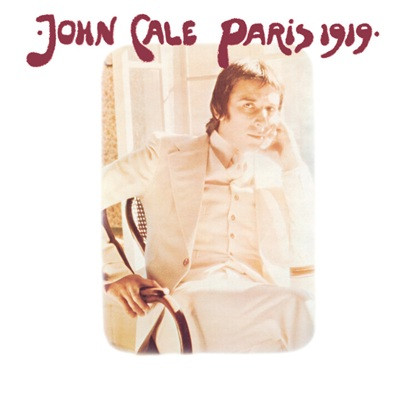
There’s no denying that John Cale’s landmark album Paris 1919 marked a departure from his previous two albums where he wanted to prove himself that he was more than just his collaboration with Lou Reed and as a bassist / violinist for The Velvet Underground. With its chamber, orchestral pop-orientation, and collaborating with Little Feat guitarist Lowell George and drummer Richie Hayward, followed by Houston-based saxophonist Wilton Felder, his third studio album is a true gem that gives the proper recognition it deserves.
Originally released on the Reprise label and reissued on the Domino label, this isn’t the first time Paris 1919 had been reissued. It was reissued nearly 19 years ago on the Rhino label featuring the original album remastered and bonus tracks which was called; Sketches & Roughs for Paris 1919, containing outtakes, alternate versions, rehearsals, piano mix, instrumental versions, and string mixes.
Cale was way ahead of his time when it comes to going from experimental music (Vintage Violence and The Academy in Peril), collaborating with Terry Riley (Church of Anthrax), but taking it a step further into the orchestral pop arrangements with fellow producer Chris Thomas, who had worked with bands such as Procol Harum, Badfinger, Roxy Music, Pink Floyd, and then later on, the Sex Pistols only debut album; Never Mind the Bollocks, Here’s the Sex Pistols.
Playing through this 2-CD set, you get a sense of Cale reflecting back his childhood years in the Welsh countryside. From the tribute to Dylan Thomas’ ‘A Child’s Christmas in Wales’, it’s mournful Hammond organ, sliding guitar, acoustic Bowie-like guitar melodies from the Hunky Dory-era, and nods to Dave Mason’s time with Traffic, there’s a loss of reflecting the time of innocence and how we can go back to our families and have one more Christmas before it disappears into the night-blue sky.
And while Cale puts on his platform boots with a Glam-Rock driven proto-punk orientation of ‘Macbeth’ it shows that he’s having a blast to step into the world of not just Bowie, but a chamber version of Marc Bolan and T. Rex, followed by Slade with Harry Nilsson handling the production levels during the recording sessions.
Cale goes back to his time with working on Nico (The Marble Index, Desertshore), channeling her lyrical textures in the forms of an acoustic letter to his love and cherished beauty of ‘Andalucia’ in the styles of ‘The Fairest of the Seasons’ and Badfinger’s ‘Day After Day’. It has a west-coast vibe to serve up the imagery John portrays in the song before delving into a droning mix which is featured in the second disc of the Domino reissue of ‘Hanky Panky Nohow’ which features a meditated violin texture than the harpsichord version on the original album and the guitar mixes on the bonus track.
Then, its winter-time as the snow drops down with strings hitting the moment for the beginning of the title-track to start. There are different orientations of what the song is about. Some think it’s about a wedding gone wrong during the first world war, or the feeling of people who went through the war after it was over, but the struggles of P.T.S.D. (post-traumatic stress disorder) kicks in as if they bring the war at home.
Cale’s lyrical textures of that time frame, reflects the loss of innocence, the struggles of moving forward as he describes in the second verse; “The Continent’s just fallen in disgrace/William William William Rogers put it in its place/Blood and tears from old Japan/Caravan and lots of jam and maids of honor/Singing crying singing tediously”.
It’s the song that refuses to die. Not only it hits home, but the way John pours his heart and soul behind the song that burst through the flood gates which he brings back in a darker trance version of the piece entitle ‘Fever Dream 2024: You’re a Ghost’.
On the closing track from the second disc, Cale returns to the palace which has now been an abandoned location, frozen in time, with ambient scenery, you could feel a dystopian pin dropping momentum that Cale brings the ghost of that time frame to life to dance one final time before disappearing off into the night.
He then goes into a wacky approach of the Ska / Reggae influences with one of the leading novelists of the 20th century by having tea with the legendary ‘Graham Greene’ with the weather going from winter to spring momentum with a joyful approach before going into a mournful country-rock, west-coast approach for ‘Half Past France’.
Lowell George lays it down in his sliding guitar textures to go upwards and downwards as he watches John giving him signals to float into the heavenly sky in the bridge and walking in between ‘The Endless Plain of Fortune’ and the whispering ‘Antarctica Starts Here’ as Cale reveals his John Howard approach on Kid in a Big World that comes to mind, honouring the unsung hero from searching for Gold in the 1910s to honouring a silent movie star who achieved stardom in the roaring ‘20s before sound came in.
Nearly 52 years later, Paris 1919 is one of those albums that’ll be played for a long, long time and keeping the sound, vision, and wonders John brought to the table with its storytelling and poetic structures that is like a movie set in the 1950s with gorgeous and chamber-like arrangements. This is an album that as I’ve mentioned about in the title-track, that refuses to die.
If you’re very new to the world of John Cale, this album, is a starter. “You’re a ghost la la la la la la la la la / I’m the church and I’ve come / To claim you with my iron drum / la la la la la la la la la”.