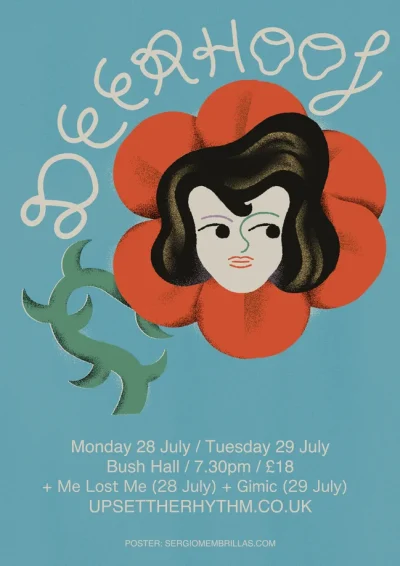
Deerhoof at Bush Hall
Support: Me Lost Me| GimicJuly 28, 2025 at Bush Hall
Promoter: Upset The Rhythm
In Steven Hall’s 2007 novel The Raw Shark Texts, in amongst the chains of binary code, data, thought, art, economic transactions and more travelling in the non-physical space of the information stream, life is born. This ‘sea’ of knowledge, intelligence and enlightenment shared between users in the physical realm, gave birth to a new type of evolution – the beauty of new, unusual life swimming in the currents of zeros and ones.
With all life, in every instance where we have found and studied it (and therefore extrapolated by Hall), there is an ecosystem. A delicate one. In the novel, the fearsome Ludovician (a shark of no dimensions), preys skilfully in the digital realm before proving to have evolved further by finding a way to cross into our world and ‘eat’ helpless, unaware minds in the four dimensions of our realm. As it consumes, it grows larger, more dangerous, and eventually disrupts the balance that brought its very existence about.
Why am I referring to the plot of a novel almost twenty years old, you might ask? Well, because I couldn’t shift the image of a hungry digital shark feeding mercilessly on a wounded animal from my mind as I read Liz Pelly’s book, Mood Machine, on Spotify and the streaming industry’s effect on local, regional, national, and international music ecosystems. Spotify is the music industry’s Ludovician. It doesn’t need tagging or tracking; it doesn’t need to be caught and held within tightly controlled borders. None can hold it. For survival it must be killed. The green orb with slashes of sound along it must be made extinct.
Deerhoof have led the charge recently, making a stance by deleting their catalogue from the app, as have fellow avant-garde indie weirdos Xiu Xiu. In their wake, many have followed, most notably Australian sonic chameleons, King Gizzard and the Lizard Wizard. Not enough by any means, but a growing number, choosing to divest any association with the glowing green eyes of the Swedish company. Some have chosen to remove themselves from streaming entirely, such as the audacious and excellent screamo band Massa Nera.
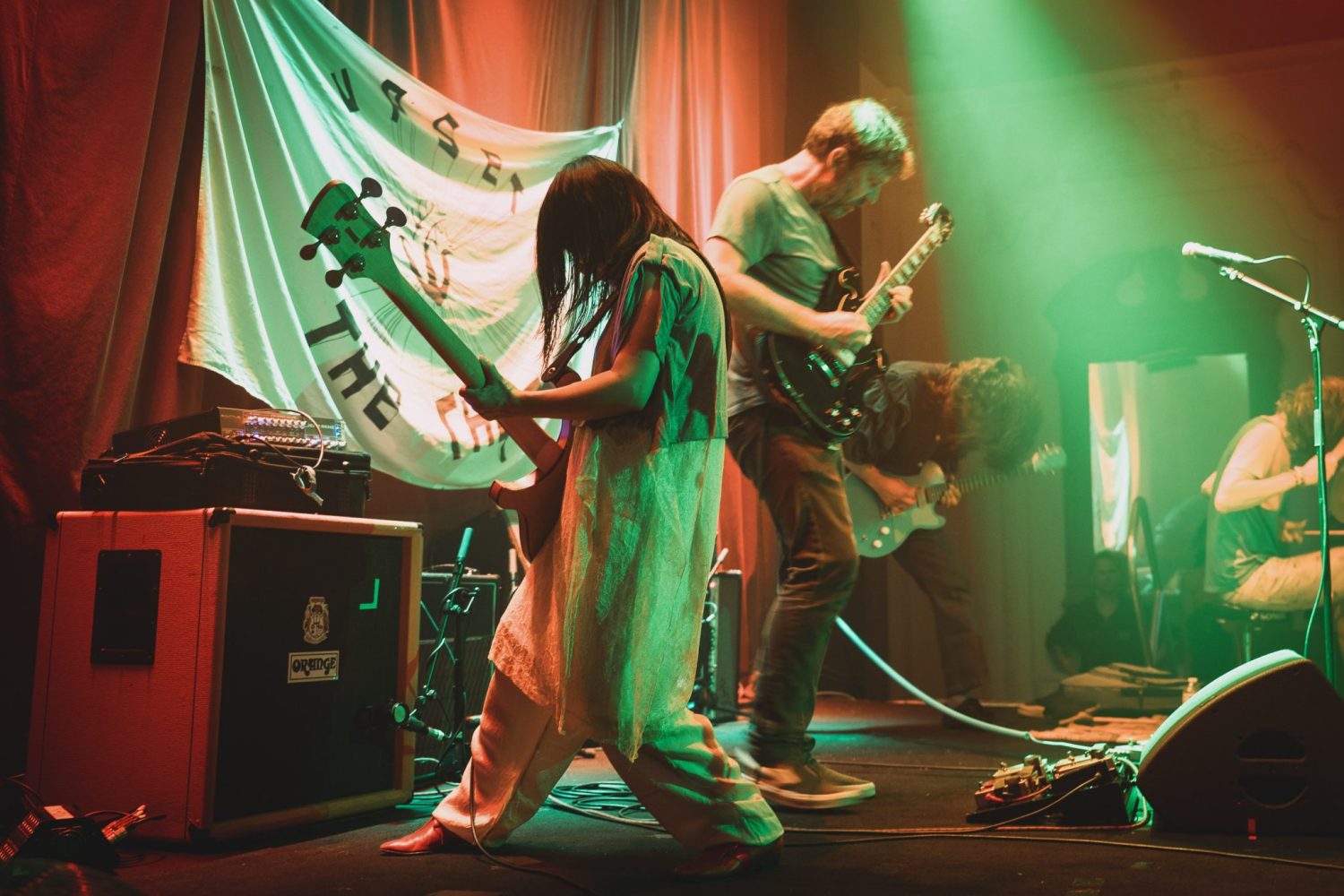
Deerhoof • Bush Hall, London • Photo: Diana Revell
Many now solely point new and old listeners alike to Bandcamp, and preferably independently owned platforms such as Ampwall. Of course, the best thing one can do is attend live gigs and buy physical merch, resisting any and all digital lure, instead being caught on the fishing line of vinyl, CDs, cassettes, clothing, and other mementos of the band and of your night, be it patches, stickers or posters.
Rather handy that in this maelstrom of media mentions and vociferous vileness directed towards bands such as them making a stand (not only on this, but even more important real-world issues, such as freedom for Palestine and pointed critical commentary on Trump’s purposeful tearing-up of the American constitution), Deerhoof find themselves where they always prefer to be, and where their artistic prowess and the medium for their undefined, mesmerising music is at its strongest. That is – on the road; playing live gigs; and supporting their latest release (this time, their new album, the particularly fabulous and aptly-named, Noble and Godlike in Ruin).
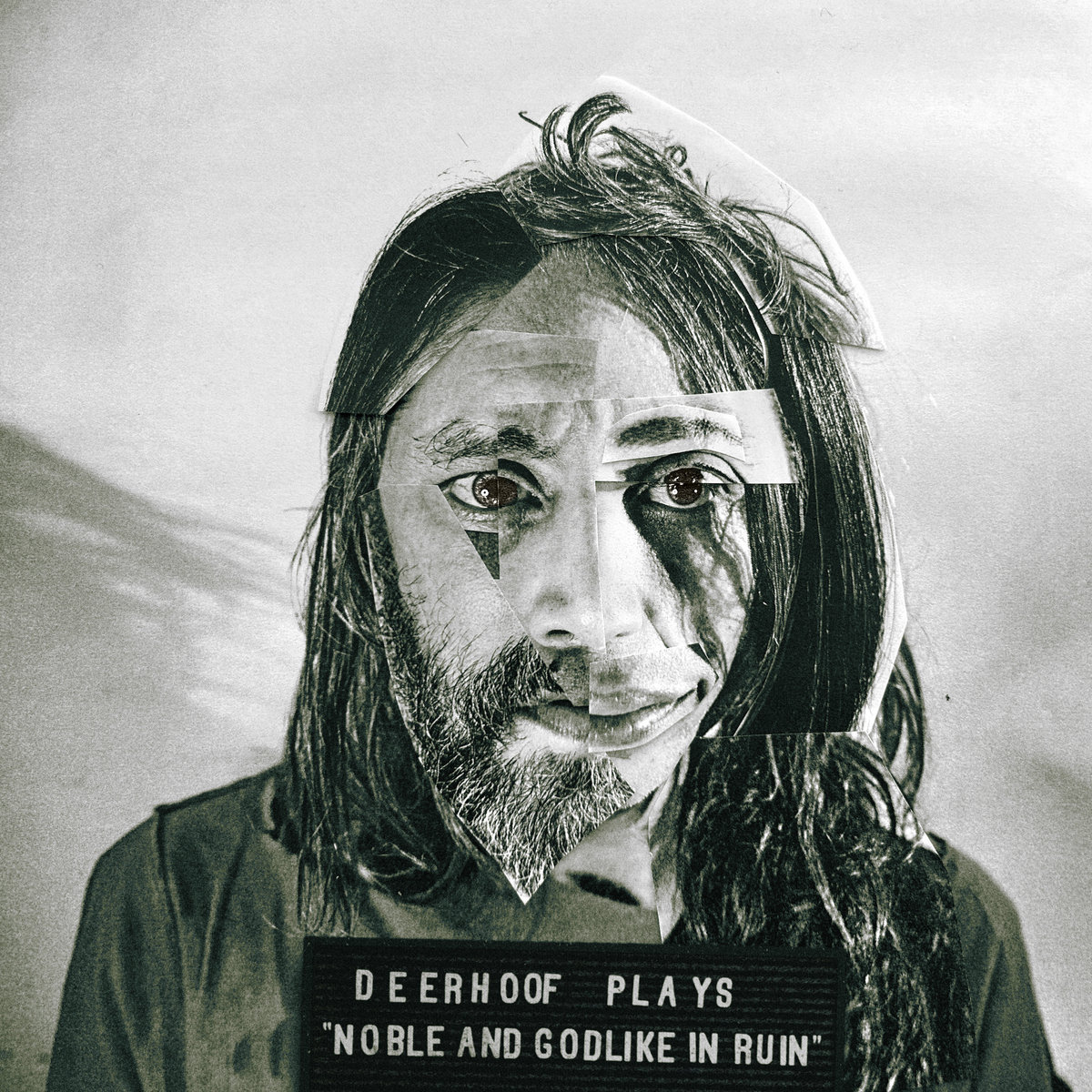
The quartet are treating London to a pair of gigs at Bush Hall – two completely different sets – promoted by the wonderful Upset the Rhythm (another apt name!) and supported by handpicked wonderful artists on each evening; Me Lost Me (Jayne Dent) a rising star of uneasy folktronica from Newcastle who recently released her own new album This Material Moment (another apt name!) and Gimic, a Bristol hardcore-punk band with little to no social media presence and a seven-inch from last year titled We are Making a New World (more apt positions and titles… who knew?!)
Me Lost Me begins the first evening with a mesmerising set of haunting beauty. Tonight, she is completely solo – unlike the live band performance promised for her official album launch – but it still sounds rounded and robust, nonetheless.
In the changing lights of the evening, her colour-coded pre-sets merge, so we get a unique performance where ever-so-different tonalities might exist from those intended. That acknowledged, the new songs and old alike sound magical. I was a little upset so few people seemed to be present at the beginning of the support slot, but by the time her second song finished, the applause was much louder and vociferous, and upon turning, I noticed quite how much the venue had filled up since Jayne took to the stage.
Seemingly effortless vocals erupt from her, as the music bellows and blossoms to her whim, loops create a swirling dreamlike effect on the listener, only ever momentarily cut across from her warm-hearted banter between songs. We are treated to an Old English hymn, reflections on the medium of artistic intention versus result in Medieval painting (or is it a shield for the song’s true purpose and message?), and more and more twists and turns. A wonderful set that gets rightfully applauded by Deerhoof themselves later on, and Me Lost Me surely gains quite a lot of new fans.
On the second night, a completely different vibe is ushered forth by Gimic. No less visceral in terms of elicited reaction, the band inspire immediacy of rage and frustration, rather than Jayne’s reflective poignancy. The band are a shot in the arm – rifling through an armoury of old-school British punk sounds, replete with snarling vocals and a buoyancy of riff, never allowing them to trespass into truly heavy territory. Gimic are definitely on the punk side of the scale when it comes to their brand of hardcore punk.

Gimic • Bush Hall, London • Photo: Diana Revell
Their energy is contagious, with a largely demure Bush Hall audience on the second night starting to move and nod to their thrashing rhythms and the simple but mesmeric drumming. Even those in the crowd likely not all that into these heavier reaches of the audio constellation can’t keep their eyes off the band as they whip relentlessly through their set.
In fine hardcore punk tradition, the band fill a relatively short slot with a myriad of different songs, each with their own flavour but with a consistency of tone and attack, keeping the energy up. As they close out their set, a few whoops from the crowd let them know they’ve shot some adrenaline into a muggy Tuesday evening in London. A band to look out for, hopefully with new recordings on the way.
Across the two evenings I believe Deerhoof play thirty-five songs. Of those only three appear on both nights. Quite incredible and a testament to their glowing, growing and somehow still criminally underrated history – even among some of their fans (including me). The two nights have been refined and curated thoughtfully and thoroughly, giving a different flavour of the band to those lucky enough to attend both.
The first evening feels as if it has more levity, a taste of the band at their irreverent best, the setlist skewing into the more poppy territory of their considerable catalogue. It’s a set to dance and jump to; to delight in your friends’ reactions and quietly cheers some beer, as the quartet launch into another undulating, mischievously technical, yet delightfully soft and shimmering, song. Deerhoof, for quite some time on this inaugural night, seem possessed and unrelenting – with song after song spilling out of them, with little sign of any breaks whatsoever, and only a quick glance between them signposting any need for them to communicate the synchronised start of the next dizzying onslaught of bright riffs, peppy vocals and mellifluous yet veering-on-deranged drumming.
Eventually, Greg Saunier, Deerhoof’s irascible and irrepressible drummer, takes the mic, delivering a winding speech, light on meaning and high on mirth, a glimpse into an alternative dimension where he might be a popular avantgarde stand-up comedian. As he returns to his kit, the band launch into another zigzagging, wordless string of tracks, holding the crowd in the palm of their collective hoof.

Deerhoof • Bush Hall, London • Photo: Diana Revell
We are treated to one more break of winding speech, and a chat from Satomi, as they incorporate Me Lost Me’s name into their own, the crowd delightfully enthused by this oddball participatory aside. The band no sooner leave the stage than they reappear to play a wonderful two-song encore, before waving goodbye to louder cheers than I’ve ever heard at Bush Hall. Stunned, while leaving, I can’t wait to be back at the venue in less than twenty-four hours’ time.
Following Gimic on the second evening, Deerhoof are in no less playful mood, but they’ve added a challenging element into the mix, perhaps knowing they would be following a sonically heavier act (if not in tonality, then in genre and volume!). Tonight is Deerhoof stepping into their noise-rock skin, flexing their prowess as a band for the strange, the jarring, and the complex.
The pace of the evening too is subtly different; more precise, measured, and purposeful that the wild care-free vibes-based evening before. The songs are mostly slightly longer in length than those previously played on the Monday, and so this change of atmosphere is echoed in a lack of Saunier stand-up, aside from one protracted period where he covers for Satomi breaking a string – the thick top ‘E’ string of all strings – much to the mirth of the rest of the band.
With mock amazement at this unusual snap and break in their momentum, Saunier narrates the pressured replacement of the string with languid detail, while the audience looks on a mixture of awe, bewilderment, and glee at what might happen or be said next.

Deerhoof • Bush Hall, London • Photo: Diana Revell
Once fixed, the quartet seem to start as a tabula rasa, launching straight back into their set, the moment before expunged from memory. Across both evenings, despite Satomi’s impeccable vocal delivery and wonderful bass and guitar playing and Saunier’s mesmeric drumming, it’s hard not to marvel at Ed Rodriguez’s guitar playing, and especially John Dietrich’s jaw-dropping double-duty, primarily on guitar and sometimes magnetically on bass.
Both are technically gifted players of the highest degree, fluid together as only years of writing, practising, and touring can result in (and even then, I’d argue there’s some luck in the stars aligning for the chemistry to fuse). It’s difficult to tear your eyes away from them once they’ve hit a groove, effortlessly entwining in tone, before moving to call-and-response riffs, or devilishly divine harmonics.
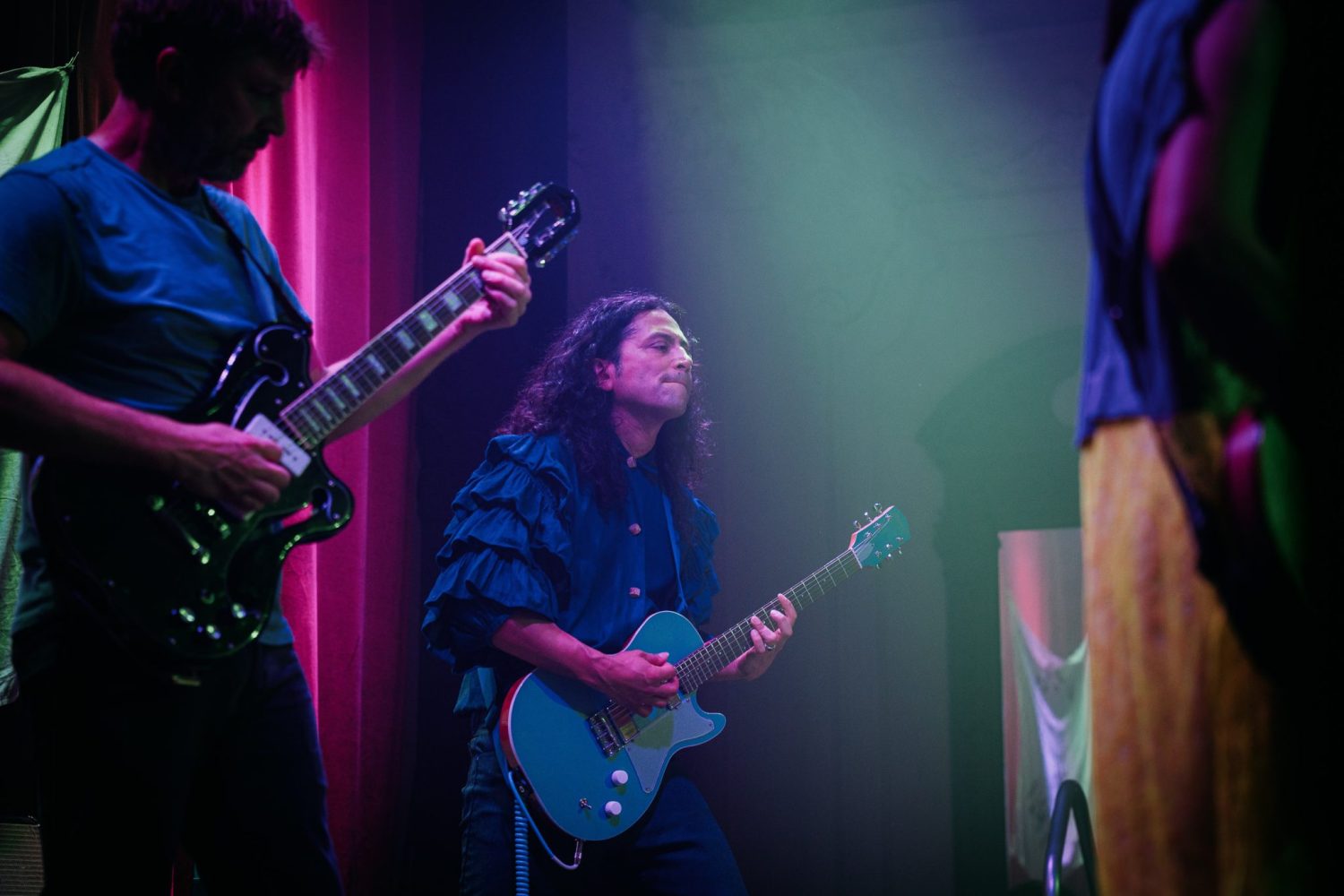
Deerhoof • Bush Hall, London • Photo: Diana Revell
The grit and harshness of some of the songs ring out around Bush Hall, almost pushing the audience back with the dynamics, occasionally reminiscent of the best prog and psych bands playing with all the ways they can tease, lure, and baffle their fans. As the final notes ring out on this second evening, sans encore to hammer home the triumphant finale, Deerhoof rids themselves of the interest, smile, wave, and disappear backstage. The venue erupted into rapturous applause, dazed, and hesitant to walk into the evening air.
Another concept in The Raw Shark Texts is that of unspace: places of protection, with a lack of data ensuring them safe zones to travel and stay in. Bush Hall is an unassuming (yet lovely, I should add!) venue in the cultural melee of Shepherd’s Bush – an unspace, if you will, in that busy and bustling location. A place of solace, a place of art for art’s sake, away from the retail and the food and drink in one of London’s busiest districts.
As they play, Deerhoof created a Faraday Cage of audio, shepherding away the sharks outside. Hall’s novel is deeply influenced by a 2000s icon of experimental literature, namely Mark Z. Danielewski’s House of Leaves. An off-kilter horror novel that likely needs no introduction, not only because so many rock and metal bands have referenced it in years gone by; see earthtone9, The Fall of Troy, Circa Survive and Johnny Truant, among others. His second novel even gave its name to a Biffy Clyro album title – Only Revolutions.
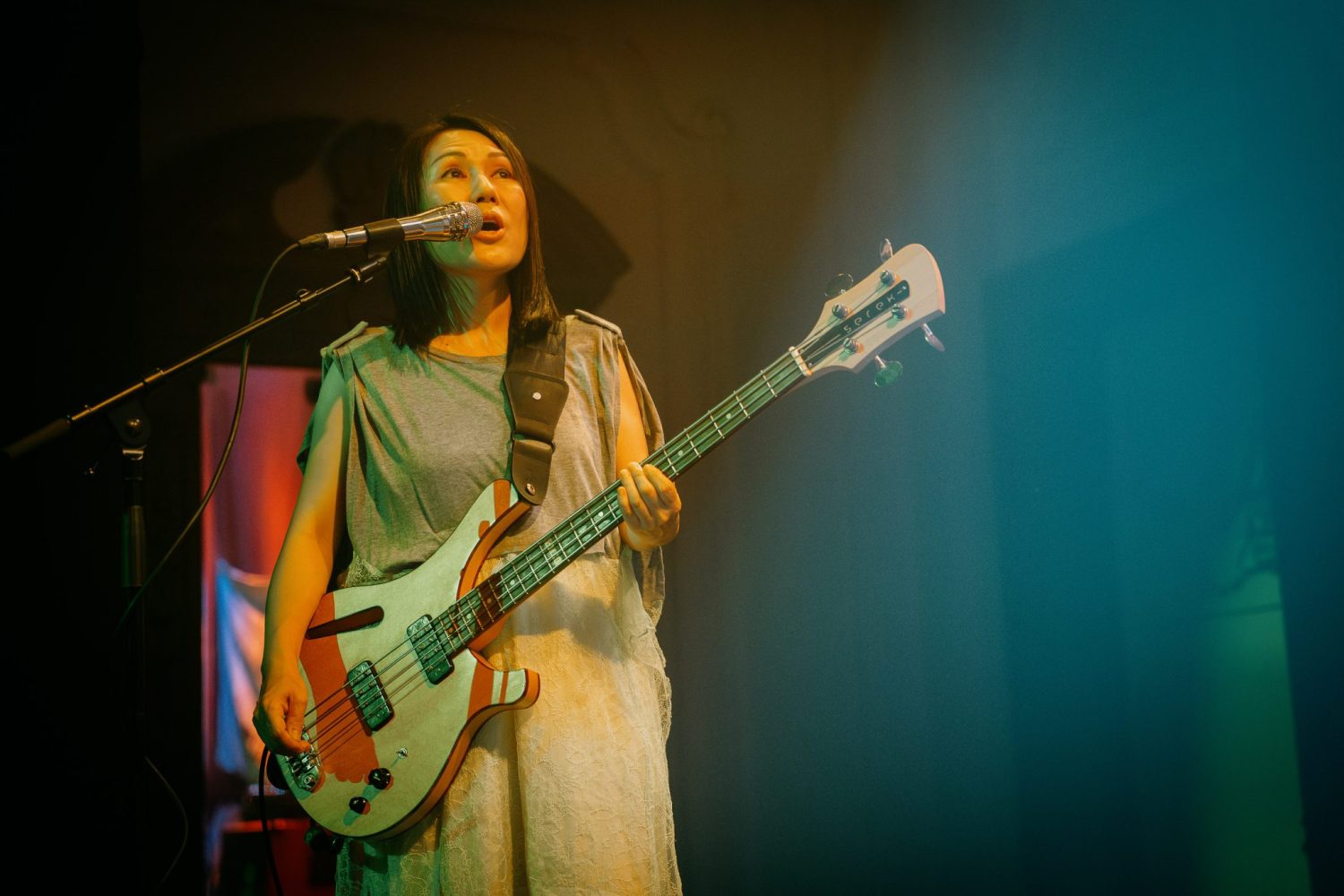
Deerhoof • Bush Hall, London • Photo: Diana Revell
Revolution seems to be stirring in art once again, and very much so in the independent music scene’s long-overdue fight against monopolistic streaming and the investment those companies make in the wider world. Only revolution will do.
Deerhoof are leading that charge, that gallop, into the future. One where the predatory unseen shark with that glowing green eye lays wounded, perhaps mortally so eventually, but where new life continues to spring forth, protected in a better environment, luxuriating in unspace, in an underground scene that nurtures and remains true to its own internal logic and principles. The world is what we make it.
With eyes anew, shifted from being caught in that sickly green stare, the old-world bends to our vision of what it ought to be.

Deerhoof • Bush Hall, London • Photo: Diana Revell
All photos are from the Tuesday 29 July performance.