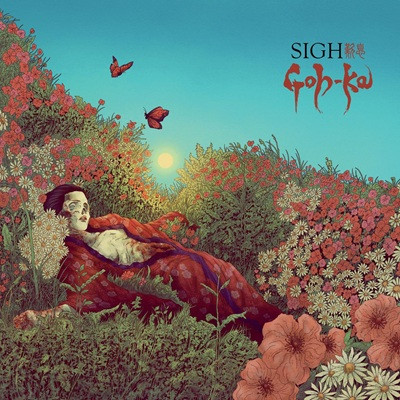
For 37 years, Sigh have stood as one of the pioneering bands from the Land of the Rising Sun, having been among the first Japanese acts signed to Euronymous’ legendary Deathlike Silence Records. From the beginning, they helped bring the uncharted territory of avant-garde black metal to life, pushing the boundaries of extreme music in ways few could have anticipated.
Since their 1993 debut, Scorn Defeat, Sigh has released 13 studio albums, continually reinventing their sound along the way. Their latest chapter, Goh-Ka, follows the 2025 re-recording and reimagining of their 2007 album Hangman’s Hymn, released as I Saw the World’s End.
Sigh have always been about more than just the extreme metal sounds for which they are known. Their musical identity encompasses psychedelia, symphonic arrangements, progressive rock and metal, and traditional Japanese music.
With multi-instrumentalist and founding member Mirai Kawashima at the helm, you never quite know what to expect next. Despite numerous lineup changes and musical shifts throughout the years, Kawashima has kept Sigh’s creative spirit alive, showing no signs of slowing down or abandoning the adventurous approach that has defined the band.
Now, with the release of Goh-Ka through Peaceville Records, Kawashima takes listeners deep into the heart of Japanese history, mythology, and horror. This is an album into which he has clearly poured his heart and soul.
Inspired by the central themes of Buddhist hell paintings (Jigoku-zoshi) and Kusōzu, which depict the nine stages of bodily decay and decomposition following death, Goh-Ka is certainly not for the faint of heart. Once you press play, prepare yourself for an unsettling journey into the darker corners of the human imagination.
The entire album feels like the soundtrack to an action-packed motion picture, a twisted 1970s giallo film, or something ripped straight from the Japanese horror genre. Sigh place you right in the middle of the terror, creating an atmosphere that sends chills down your spine. From the moment ‘Kuso-shi 1, 2, and 3’ begins, robotic synthesizers establish a disturbing atmosphere, preparing you for the nightmare about to unfold.
The sound of the shamisen, Japan’s traditional three-stringed instrument, helps transport you into this haunting musical landscape. Meanwhile, the thunderous double-bass drumming and Queen-like guitar arrangements of ‘Procession’ add an epic dimension to the experience.
There is an almost cinematic sense of impending danger lurking throughout these compositions, as though something sinister is slowly making its way toward you. The Hammond organ, snarling vocals, heavenly choruses, and intensely layered riffs immediately caught my attention.
At times, the arrangements even took me back to the first time I discovered Magma’s music on ProgArchives in 2005. That is how impressive Sigh can be. They pull you apart, bone by bone and flesh by flesh, while demonstrating just how masterfully they can construct these elaborate musical arrangements.
The gentle, folk-oriented ‘Anzenshokon’ takes a completely different direction, venturing into the outer limits of space and time. Its cosmic atmosphere recalls Black Sabbath’s ‘Planet Caravan’, particularly through its Leslie-speaker-treated vocals, flute, percussion, and acoustic guitars.
There is also a distinctly Celtic flavour woven into the arrangement. However, this peaceful passage doesn’t last forever. Sigh gradually shift gears, introducing heavier instrumentation and building toward what feels like the preparation for an impending battle.
The unsettling combination of shamisen and synthesisers that introduces ‘Jinmenhushin’ immediately brings to mind Italian maestros Goblin and their legendary soundtrack work for Dario Argento’s ‘Suspiria’. However, Sigh take that cinematic horror foundation and inject it with their own black metal sensibilities, making everything considerably darker, heavier, and more disturbing. Blistering guitar riffs, ominous keyboards, and machine-gun-like drum patterns create an intensely unsettling atmosphere, delivering another unexpected twist in the album’s constantly evolving musical narrative.
With ‘Kushukankyo’, Sigh venture into spaghetti-western territory, incorporating a waltz-like rhythm alongside percussion, the shakuhachi (a traditional Japanese end-blown flute), acoustic guitars, and Mellotron textures. There is also an extensive nod to James Last and Gheorghe Zamfir’s 1977 composition ‘The Lonely Shepherd’, from their album Memories of Russia. It is another fascinating example of how Kawashima can take seemingly unrelated musical influences and bring them together into something uniquely Sigh.
By the time the ‘Kuso-shi’ movements reach their seventh, eighth, and ninth instalments, all bets are off. The music takes an increasingly surreal turn, with watery, synthesiser-driven textures and an almost otherworldly atmosphere.
At times, the arrangements venture into territory reminiscent of Tool, while other passages evoke the electronic experimentation of Jean-Michel Jarre. It’s almost as though Jarre had produced one of Tool’s early demos in a parallel universe, with Sigh acting as the architects of this bizarre musical collision. The results are unpredictable, challenging, and completely fascinating.
Like an elaborate motion picture unfolding inside your head, Goh-Ka takes you through a series of disturbing, beautiful, and downright bizarre musical landscapes. It may not be an album for everyone, and it certainly isn’t for the faint of heart. It might even take several listens before everything begins to fall into place. But that’s part of Sigh’s appeal. Their music has never been about taking the easy route or delivering something predictable.
There is no argument that Sigh’s approach is challenging, but that is precisely what makes them so rewarding. Their combination of in-your-face extreme metal, progressive arrangements, symphonic passages, psychedelic experimentation, and traditional Japanese instrumentation creates an experience that refuses to be confined to any one genre.
Mirai Kawashima once again proves that his imagination knows few boundaries. Goh-Ka is a dark, cinematic, and adventurous statement from a band that continues to defy expectations. Surrender to its strange and unpredictable world, and Sigh will take you somewhere you won’t soon forget. And if you need further convincing, just listen to Opeth’s Mikael Åkerfeldt, who makes a guest appearance on the album.