Jo Quail opens proceedings, alone on stage playing a first piece ‘White Salt Stag’, moving from long-bowing overtones to a skritchy, late-night-in-the-woods hint of mysterious pagan pipings. Glinting and wisping off-the-bow tones like steam off a lake, the subtle effects drift around the cello string work. It occurs that the best stuff done with loop pedals is where the performer responds to the repeated sounds almost as if in dialogue with a strange collaborator who sometimes surprises or heads off in unexpected directions, rather than as if playing back a fixed version of yourself. I saw a crazy example of this in Acid Mothers guitarist Kawabata Makoto, who one night played in a duo with Jean-Francous Pauvros, and the next did a solo set where his loops and delays instantiated a weird ghost version of Pauvros, channelling through his own control of loops and delaying a new version of what his collaborator had done before. Here too Quail seems to be magickally invoking a sonic interlocutor for purposes of divination or some such, certainly suggesting more ethereal music-making spirits on stage alongside her. She then introduces a new piece, apparently “like a box of Lego pieces”, which starts in deep mind-body concentration, audibly whispering “six” counts, timing the hits and whacks on various parts of the instrument. It’s a brilliant exploration of the possibilities of the whole instrument (clonking and clacking its resonant skeleton body), together with its organic-cyborg technical extensions, in weird temporal prosthetic tentacles of loops and delay. For a while I sat in a nook under the stairs, and the sweeping lights crossing through the slats give a classic Bladerunner feel, while again the loops become sentient with their own mechanoid momentum, human musician producing alchemical robot melodies. The last piece, ‘Gold’, makes this even more explicit, with an intro of heartbeat and breath, more obvious organic-life signals which are then processed and re-channelled, becoming sector-sweeping rhythms, and a gentle slashing, finale with creepy creaking sweeping lyrical calls. A rich introduction to an evening promising more crushing uses of sound.
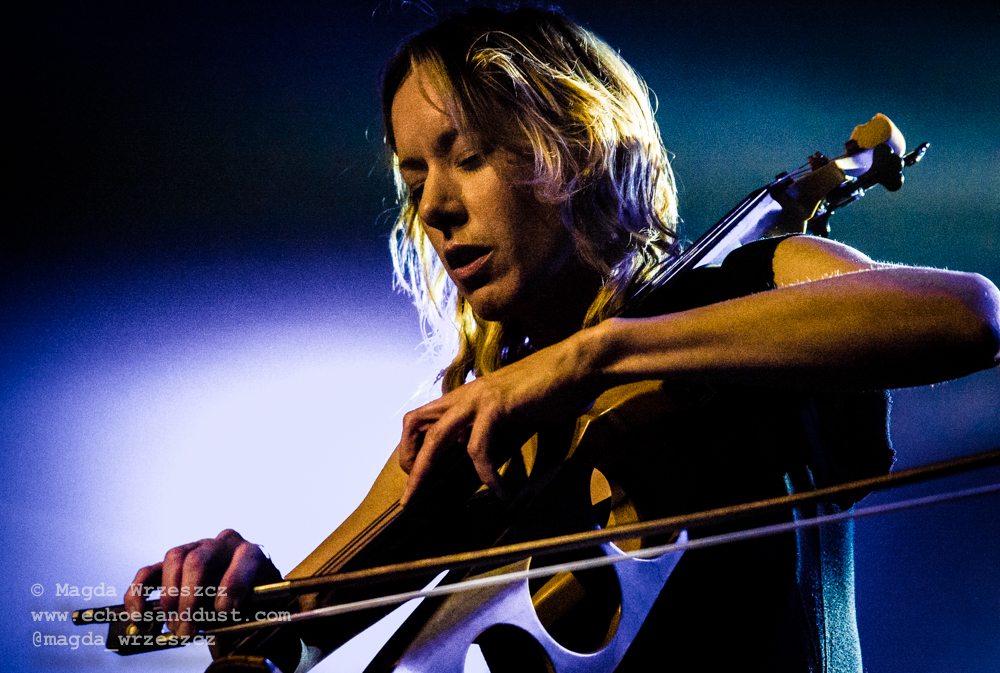
Jo Quail – “Magickally invoking a sonic interlocutor…” Photo: Magda Wrzeszcz
Twenty minutes before they even take the stage, the presence of Boris is hinted at by a beautiful array of big square Orange amps, a double-necked guitar silently glinting manically, drum kit right up in the front of the stage, and a great big gong. Currently quiet but looming, soon to erupt… I wasn’t sure what to expect really. Their first record, Absolutego, now more than two decades old, is a landmark statement in drone metal, and a CD that blew my head off when I grabbed it on a whim on a trip to Camden in the 90s. I also love bits of other early records like Flood, while the track ‘Leviathan’ that opens the third instalment of The Thing which Solomon Overlooked is a stunningly beautiful wash of deep drone guitar. However, I sort of lost track of their albums once they started including more than five tracks or so, and I think I’ve only seen them in a half-mangled way, turning up late to a Desertfest show, and leaving annoyed by the Electric Ballroom. Anyway, that was happily righted tonight with a full set. The band come on to some oddly angled hurdy-gurdy questioning, before this momentary peculiarity is completely and utterly devastated by the sheer physical exhilaration, the entertaining absurdity of massive amplification controlled and directed at your body. Marvellous. Having no real sense of most of their albums (hardly easy in any case, with the befusing and confuddled nature of their discography, using the same titles for different records and generally playing anarchic hell with attempts to sort it all out) I couldn’t tell you what songs they played, there was just a profound assault of thick drone that was almost literally stunning, giving their shorter faster songs a thick opaque underlining of iron and allowing the abstract in-between bits to flower and unfurl. The fog and strobes added to this why-the-fuck-not turning up to 11, playing up to and exploding rock stereotypes with careless precision in joyful detonations of light and smoke and heavy-hitting sound. Then Wata pulls out the accordion, and from it pulls out long tendrils of reedy melancholy over bashes and rustles out of the gong. There’s even an air of sombre sadness in parts, yet always underpinned with, again, the devastating power of bass distortion. It’s wildly powerful. Halfway through, evidence appears to suggest that someone farted near me. . . they probably had no choice. The noise must be bothering the trains above, vibrating them off their rails. There’s a long piece with a massive, massive dinosaur riff that unfolds across dimensions before the comet-smash apocalypse comes in towards a wailing, shredding conclusion. They end with a flailing, crackly horrific sludge distortion splurge. Delightful!
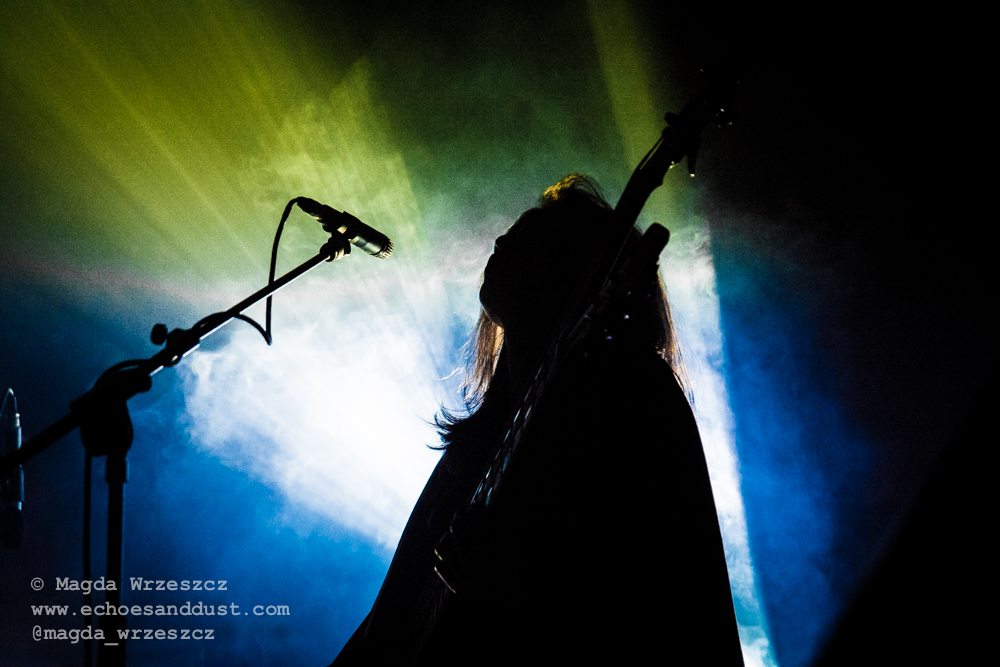
Boris – “Sludge distortion splurge…” Photo: Magda Wrzeszcz
There’s a whiff of the sage incense around Amenra‘s beginnings, a silhouette of a cross-legged figure whacking a sort of metal-cowbell-clanging summons, illuminated with a sharp spear of a spotlight. Before long this is built up into a shuddering, rhythmic cacophony of pulsing washes of ultra-gravity post metal. It’s instantly clear that this double headline tour is a masterstroke, with Boris and Amenra representing contrasting traditions of wielding astonishing heaviness, the former through their mastery and excessive explosions of rock power, and the latter on the other hand slowly building up the metronomic layers to the point of unstoppable raging power, as in the fire, thunderstorms, and volcanoes they depict on their monochrome video backings. Just when you’re thinking how to describe the rumbling torrents of noise they produce, oh there’s a black and white video of a waterfall providing the metaphors for you. All of this moody, grainy harsh nature business meant I had to remind myself they’re not Icelandic, though the island of new black magma could certainly have birthed Amenra, and the vast plains of scar-inducing, skin-grazing, unforgiving sound certainly seem to bear an affinity with that kind of landscape. Actually, I’d say that there were some moments where some of the coordinated rhythm changes were ever so slightly mistimed, not completely in sync, though tiny quibbles with what was a supremely powerful set. The pummelling and pulses demanded slow assent, the alternative gravity commanding you neck-first to a thudding transformation of bodily consciousness, with occasional pushes out into an abyss of harmonic chords. Before long, Colin van Eeckhout has his shirt off, as ever displaying his thick-lined tattooed back to the audience while raging along to the sounds. It reminded me oddly of the iconic Metropolis scene of the manic worker in front of the dial, in this instance perhaps a figure for the desperate attempt to guide the noise or depict the human inside that machine chaos. The tight chaos is wrenched ever further into the red, producing a cracked-boiler catharsis until at once we’re all let out like pressured steam into the cold night. Industrial-strength ritual metal noise underground heaven, indeed.
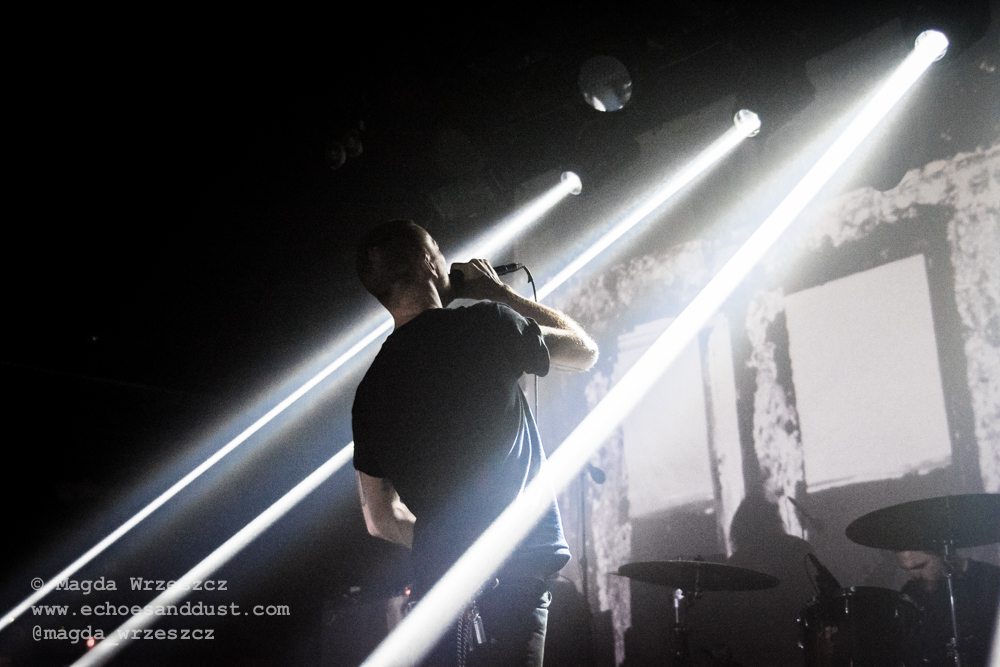
Amenra – “Metal noise underground heaven…” Photo: Magda Wrzeszcz