By Gilbert Potts
Helen Money - Facebook
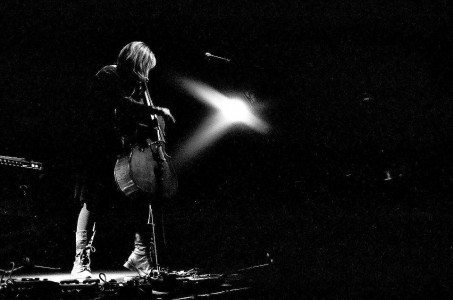
Alison Chesley writes dark, moody music for her cello then loops and distorts it to create unique experimental metal. She is the only member of her band Helen Money and took some time from her tour of new album Arriving Angels to talk to us about her music.
(((o))):Most of us have defining moments that are milestones in our musical adventures. What was your earliest, and what was your most recent?
AC: Earliest is probably listening to the Dvorak Concerto when I was a kid. That had a big impact on my conception of sound. Most recent is probably finishing my third record as Helen Money. That has been a goal of mine for a while.
(((o))):What are some of the techniques you use that separate Helen Money from classical cello?
AC:I don’t use as intense a vibrato. I don’t play as many notes – I like to pare things down to their essence if I can. I also stand when I play.
(((o))): Do you think some of the great classical composers through history would use those techniques if they were available at the time?
AC: I think great composers have always pushed players to stretch their technique. As someone who writes, I think it’s just the result of searching for something new – a new way to express something.
(((o))): Arriving Angels is aggressively violent at times and always dark and captivating. By taking away the vibrato that gives cello its familiar character in classical music you could expect it to sound flat and emotionless but that's not the case. What do you put this down to?
AC: Well, it isn’t totally without vibrato. And I do think the effects pedals are expressive in their own way. But I think it’s the compositions. Hopefully I’m writing material that is anything but flat and emotionless.
(((o))): When composing do you tend to imagine sounds in your head and try to recreate them, or do you play around with the gear you have and see what you can discover? Do you only do this within the context of composing or do you experiment for the sake of experimentation?
AC: I try to find a sound that evokes a feeling and then see where I can take it. Build a structure out of it. I don’t usually have melodies in mind. I will sometimes have a feel or an image in mind. I think when I sit down with my cello I’m always thinking about new material – always searching for something to develop into a song.
(((o))): In Arriving Angels you use real drums rather than programming, yet you loop and distort your cello considerably. Then again you don’t use an electric cello. Where does the balance lie for you in the jumble of acoustic and electronic sound?
AC: Actually there is both drum programming and live drums on the record. And I do think that amplified sound can be warm and beautiful. Think of Jimi Hendrix. As far as combining the two, one of the things I discovered on this record was how well the grand piano works with the amplified cello. Something I wouldn’t have thought. So it’s important to keep an open mind about all this.
(((o))): I was thinking about why cello fits so well in metal and heavy rock and whether in part it's because it fills that gap between guitar and bass even when guitar is down-tuned. Why do you think it fits in so naturally?
AC: I think it’s the nature of the instrument. The range. Very similar to the human voice. It’s compelling and dark – and visceral, I think. All qualities that I think the best metal music has.
(((o))): Rock and metal have come together with classical instruments for decades but very often it's an arrangement of a rock or metal song originally written for rock instruments. Less often it’s a rock or metal song written to include classical instruments and rarer still to be metal written for classical instruments. What are the barriers that keep our minds closed to the endless possibilities, both as composers and listeners, classical and rock?
AC: I think it’s human nature to try to categorize things. My hope as a player and composer is that the song itself communicates to the listener. That I am saying something of substance. The cello is my way of expressing what I’m saying, but I think ultimately I have to be saying something worth hearing.
(((o))): If music like yours was far more common and even mainstream, would you still be making it or is the search for something new more important?
AC: I think I’ve always been drawn to whatever is outside the norm. So perhaps I would try to blaze a new trail. It’s hard to say. I don’t see myself doing something just to be different – just to make a statement. Really what I want to do is make music that is saying something of substance.
(((o))): What do you hope people get from listening to your music?
AC: I hope it makes them feel something – that I’m able to communicate something that resonates with them. Something that is genuine and heartfelt and human.
(((o))): What's in store for you in the next six months?
AC: More touring and promoting of this record. And beginning to think about the next step. Not sure yet what that will be, but I’m looking forward to finding out.