Interview: Miserere Luminis
We feel our music strives to explore and evoke something deeper and greater about the human experience, something profoundly within, surrounding and above our human selves. Wearing masks serves a similar purpose, fading the footprint of our individual personalities and giving more space to the meaning, the emotions and the art itself. When we wear masks, we become echoes of ourselves.
Formed in 2008 as a live collaboration for the trio behind Québécois black metal mainstays Gris and Sombres Forêts, Miserere Luminis released one solid slice of atmospheric black metal a year later and that was seemingly all she wrote. Come 2023, they made a surprise return from the wilderness with Ordalie, a stunning exploration of black metal’s most stirring and expansive reaches, and they’ve outdone themselves again this year with Sidera, a companion piece to its predecessor as well as one of 2026’s most ambitious and exquisitely executed metal albums. David Bowes spoke to guitarist/bassist/lyricist Neptune about everything that has gone into the record’s creation.
E&D: Thank you so much for giving me your time, and for creating such a wonderful album. It’s a stunning record, so broad and emotive. I understand that it is to be viewed as a companion piece or follow-up to Ordalie. What were your goals for Sidera in terms of sound and atmosphere and how did you strive to tie it in with Ordalie?
Neptune: My pleasure! Thanks for your appreciation of Sidera, it means a lot, we’ve put a lot of effort and love into it. Yes, Ordalie and Sidera are the two halves of a single conceptual whole, mainly lyrically, but also musically Sidera closes the loop left open by Ordalie. I’m not sure we had very specific goals in mind while working on Sidera; as with every album we did, we only try to make the best music that we can with the ability and vision we have in that moment. Although, one direction we had was to lean a bit more heavily on the arrangements and the sonic textures in the songs and between the songs, like a sort of glue to hold the rest of the music together.
E&D: A lot of time passed between your debut and Ordalie, but the gap was thankfully much shorter this time around. Did that sense of immediacy and momentum put you in a different headspace for working on the new songs?
Neptune: Yes, it was important for us not to let so many years pass before releasing a new album, to keep the momentum going as you suggest. Fortunately, most of the songs on Sidera were written in the same time period as those found on Ordalie. The time gap between the two albums was mainly determined by the time that was invested for the live performances and the production process of Sidera. And, as far as immediacy and momentum goes, we are already discussing ideas and working on material for potential future albums.
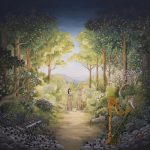
E&D: You worked with Adam Burke again for the cover art and it is a beautiful piece. Was there much discussion on what you wanted for the art? Was it important that you work with Adam again given Sidera’s connection to Ordalie?
Neptune: It is a beautiful piece indeed. Personally, I like having some sort of consistency from album to album, I love when parallels can be made between different works of art, and since Ordalie and Sidera form a single poetic arc, yes it made perfect sense for us to work with Adam again for Sidera.
E&D: There feels to be a real sense of balance between opposing forces or tones (light vs dark, melody vs dissonance etc.) on Sidera. How much of that was a specific goal for the record and how much was it just what you naturally gravitate towards?
Neptune: I feel that is completely what we naturally gravitate towards. In our process, I think creation is based on intuition and raw emotion, and production is where intent and reflection unfolds, in the way we put the elements and the emotions together. And I don’t know if I think of this in terms of opposing forces, to me it’s more like contrast, to bend the journey in a certain direction, but it’s all one movement. Another possible explanation for this are the various musical influences we’ve had over the years, coming from wildly different genres, combined to the fact that we tend to have a maximalist approach to creation, that we want to incorporate ‘everything’ in what we are working on.
E&D: To what extent does spirituality influence your music and is there a ritualistic aspect to performing and composition?
Neptune: Spirituality is often a tricky subject, but I think it influences our music, and the way we approach the process of making music, to a great extent. I tend to define spirituality as something that instils a sense of purpose and meaning. And, to me, this is precisely what creating music does, it connects us to something greater, something somewhat undefined and mysterious, but to which others can connect as well, something beyond the boundaries of our individual experience of life. Music, or art, is spiritual because it can transfer individual pain or joy into the realm of the universal.
And there is clearly a ritualistic aspect to composing and performing music, in the sense that it is cyclic in nature and that it aims to bind you to something profound. To me it feels like repeating a dive into the vague and the unclear within, to reach something serene and chaotic at the same time, some core emotion or space that you can then mould into artistic expression.
E&D: In a similar vein, is there any symbolic significance to your wearing of masks and to their designs?
Neptune: Wearing our masks is definitely a symbolic and aesthetic choice. We feel our music strives to explore and evoke something deeper and greater about the human experience, something profoundly within, surrounding and above our human selves. Wearing masks serves a similar purpose, fading the footprint of our individual personalities and giving more space to the meaning, the emotions and the art itself. When we wear masks, we become echoes of ourselves. The design of the masks themselves is mainly the work of chance, randomness, and experimentation. Although we’ve done some tweaks to the finish of the masks over the years, we’ve kept their original design to this day.
E&D: What is the meaning of the album title? Am I right in thinking that this is the first time you’ve had a title in anything other than French for any of your projects, and if so is that significant?
Neptune: Sidera is a Latin word for stars. Stars, as a symbol, have always been a part of the conceptual universe of Miserere Luminis. Metaphorically, to me, they represent what is beyond ourselves, something we can perceive yet not fully comprehend, fragments of light in a beautiful and terrifying sea of darkness. Within the lyrics, I tend to refer to stars as the beacons of existence, entities that guide our purpose and map the fire within. We chose Sidera because it relates to that, semantically, and for the aesthetic value of the word itself.
It’s one of the first times we don’t use French in an album title; if you consider our eponymous album. But to me, it’s not significant at all, I’ve actually never thought about it before now. The important thing for me is that the album title suits the music, the art and the emotion we want to convey.
E&D: While the more metal and post-whatever elements are definitely strong on these songs, I was wondering to what extent classical composition is an influence. Do any of you have a background in classical or orchestral music?
Neptune: I don’t think purely classical composition has had an immense influence on our music compared to other genres, but to some degree it might have. Out of the three of us, Icare is the only one that has had classical music as a part of his musical education background, so it may show to some extent in his string arrangements, although I don’t feel this is where ‘his sound’ mainly comes from.
E&D: Your compositions are quite grand, not just in the length of the songs but also in how you layer your instruments. Do you always know when ‘enough is enough’ or is it sometimes not so clear?
Neptune: It is never clear, for me at least! And I think we barely know when “enough is enough”, and even further; when “this is too much”. I feel our tendency to want to put so much stuff and ideas into a single composition is sometimes a strength, sometimes a weakness, but that’s just who we are, and hopefully the end result is still listenable to people. But this is something we might want to work on and refine for future albums.
E&D: On a more immediate note, how is the tour going? Excited to get back to Europe?
Neptune: As of writing this, the tour has not yet started, but we are definitely excited to go play in Europe again! Every time we’ve visited European soil it’s been a great experience.
E&D: Given that Québec has such a strong association with black metal and has done for quite some time, do you see yourselves as being part of a greater movement? Do you have any theories as to why this region spawns so many BM bands?
Neptune: I think to understand the Québec black metal scene, you first have to understand the broader cultural context of Québec itself. We’re a French-speaking island in an overwhelmingly anglophone North American continent. Our culture, our language and identity had to be fought for, protected, maintained against constant erosion.
That creates a particular mentality. There’s a defiance here, a refusal to assimilate or disappear. And I think that finds its way into our art, into our cinema, our literature, and absolutely into our music. Black metal, with its themes of resistance, isolation, and uncompromising vision, feels almost naturally suited to the Québécois experience.
As for Miserere Luminis specifically, we’re absolutely part of that community. We’re in contact with the other bands, we support each other. But musically, we’ve always occupied a slightly different space. Our sound was never rooted in early ’90s Norwegian black metal the way a lot of the scene is. We’ve pulled from elsewhere, from other traditions and influences. So while we’re very much connected to the Québec black metal world, we’ve also carved out our own corner within it.
E&D: Apart from this record, do you have anything else in the works, either with Miserere Luminis or with Gris/ Sombres Forêts?
Neptune: Yes, we have some pre-production demos that are already done for a potential fourth album with Miserere Luminis. I also have many other ideas and themes for future Miserere Luminis albums, and I intend to start working on those as soon as we get back from our tour in April. After that, the time it will take to fully produce our next album still remains a mystery.
E&D: This will be your first record with Debemur Morti. How did you end up coming to work with Phil?
Neptune: We had been working with Sepulchral Productions from the beginning of our musical projects, they have helped us a lot along the way, but we were curious to try something new, to see what a ‘wind of change’ might bring for Miserere Luminis. Debemur Morti had been on our radar for a little while, so we took a shot and wrote to Phil, and luckily for us he was interested in working with us too. Our relationship with Debemur Morti is still young, but we can already feel how dedicated and professional they are, and how much care they put into their productions.
E&D: I know there are way too many to choose from, but what are your essential Debemur Morti albums?
Neptune: My 6 personal picks would be:
Ulcerate – Stare Into Death And Be Still, Ulcerate – Cutting The Throat Of God, Akhlys – Melinoë, Aara – Eiger, Aara – Triade III: Nyx, Martröð – Draumsýnir eldsins.