The Boy Who Spoke Clouds | facebook | twitter | bandcamp |
By: Gilbert Potts
There was a guy in Adelaide years ago who lived in a shed with his wife. They lived in the shed because the house was packed full of used and new parts for 1960s Chrysler Valiants that they had collected over the years. For this couple, Valiants were their whole life.
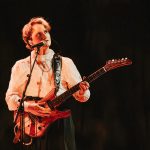
Visiting Adam Casey, otherwise known as The Boy Who Spoke Clouds, it’s clear that although he doesn’t live in his shed, his days are spent dedicated to the creation and love of art – most visibly music.
A drum kit is set up in one bedroom, mic leads all gathered in one corner leading back to the nerve centre. In the lounge room a desk sits in the centre, two beautiful huge ‘70s monitor speakers standing guard over the computer set in the middle. Instruments sit around the rooms where others would place ornaments – a hurdy-gurdy and autoharp on the mantelpiece, an old well-worn piano in the corner, and various guitars leaning here and there. It’s a warm and inviting place. It’s a place where music is treasured; part of everyday life. Above all it oozes creativity, and it’s one of the most uplifting and inspiring environments a music-loving non-musician like myself could find themselves in.
He’s in good spirits – he takes music seriously but he laughs a lot and speaks with the passion of someone far from the downward side of the hill. It’s clear there’s so much he wants to do with music and is excited about it.
Over the next hour and a half a picture emerges of an artist who starts with a thought, a feeling, then breaks it down into its raw elements before calling on sound, writing, touch and sight to bring those thoughts and emotions to life. It’s a process that’s not rushed – one record had sat on the shelves for ten years before he found the right space to complete it. Even then the book that the CD accompanies is hand made when one is ordered. He shows me the prototype. Its hand-made paper has a complex texture with soft, smooth, dimpled and rough surfaces created by an assortment of fibres and grasses. The printing and illustrations (also done by Adam) merge with the textures so they are not separate components, but interwoven facets of the same thing. You want to hold it, explore it, treat it with care.
The importance of each tiny piece to a complete picture is explained when I ask Adam about the most beautiful sound he’s heard.
“It’s probably the human voice. It’s funny because I do play a lot of instrumental music and love it, but I quite like music with a sense of voice even if it doesn’t have a voice in it. Like I’m interested in the guitar orchestras of Glenn Branca that used to have as many as a couple of hundred guitars, and it’s all guitars but when I listen to it it’s got a quality of voice to it. You know the vocal chords have millions of hairs so you’re listening to a multitude of vibrations when you hear someone’s voice, and when you start building up hundreds of guitars on top each other you get the kind of choral quality, like the millions of hairs of the vocal chords but in a very amplified way.
“When I record you might get a bunch of vocalists who aren’t great singers and you get five of them together and you get them to sing along to something altogether, it might not sound great, but then you get them to do it again on top of it and by the time you get to the fourth or fifth layer it doesn’t matter if they’re in or out of tune it starts becoming this sort of sound that defies what we know. So yeah voices are beautiful, but not so much in the traditional sense.
“And there are other sounds, like I have two children who both came out crying and that’s a beautiful sound and I hear that sound in other things.”
Making limited-appeal music certainly isn’t driven by profit motive, and when I ask about what keeps him going the story is one all of us have or will experience in some way – the quest to recapture something special but fleeting. While for many that can be a reason for despair, to Adam it’s an inspiration that fuels experimentation, exploration and adventure.
“One of the greatest moments in my life was when I was about thirteen and I’d been learning guitar and got together with a bunch of friends – you know, the usual story – and we were playing a bunch of Metallica songs, and it’s probably the greatest period of my life. It’s like ‘Holy shit! I’m playing and you’re playing, and when I do this and play these two notes you’re banging on the drum’ and so on. I’d never experienced it before and I didn’t know what it would feel like, and a lot of the shock – a good shock – the synchronicity of that moment had so much wonder in it and I’ve never forgotten it. It was such an addiction and we played all day and at the age of 15 I was touring around Australia and I’ve never stopped!
“I’ve never been able to reach that again, and I always feel like I’m trying to get back to that moment Now I’m nearly 40 and I’m always looking for new ways to sustain it. Running a recording studio is one of those ways, where literally every weekend I’m engaging with other musicians. Somehow I’ve worked out a way to make music feed into everything that I’m doing, and that’s a real thrill to me.”
That’s not to say he’s always starting from a peaceful place, and his album Salvation comes from a time of turmoil and despair as his marriage came to a turbulent end a few years ago. Just as a song can bring us all together to sing with one triumphant voice, in our sorrow we can find solace and a friend in music that feels our pain, and understands what we’re going through. In another manifestation of taking things back to base elements, he returned to his parents’ home to record the album, releasing it with this dedication:
“I held ‘Salvation’ close to my chest for 3 years, but now I happily let it go and hope you’ll consider it a gift to you. (I’d) like to dedicate it to my Mum & Dad, who held me once more in the time I needed it most. This album is a product of that time.”
Adam plays me a few samples and tracks from work he is recording and producing for others, like a solo project of Rob Allen (Encircling Sea) called Of Hearth and Home. I’d seen Rob and Adam play at The Public Bar, where Adam had added guitar, hurdy-gurdy, harmonies and some throat singing. There’s a real sense in talking with Adam of a sharing, communal way of creating music. Sure, Rob and others have to pay for the recording and production of his tunes, but it’s not simply some financial arrangement. There’s something that transcends the “music industry” paradigm, which is more down to earth and elemental, and is the beauty of the underground movement. It’s hard not to feel that beauty reflected in the acoustic instrumentation not only in Of Hearth and Home, but in much of Adam’s own work (like Salvation) and the work he is doing for others.
It gets Adam talking about the black metal and dark folk sounds coming out of North West USA, and he recalls his tour there in 2006 where he first heard a hurdy-gurdy (he now has two). The music’s had an influence, but he’s quick to add that he doesn’t feel constrained by any particular style.
“I feel like I don’t belong to any camp – people ask me what kind of music I play and I hate questions like that. If I’m with someone I’ll point to them and say ‘well you tell them what sort of music I make’. I feel if I try to describe it, it becomes the most pretentious thing, using metaphorical language…”
Talk soon turns to Cult of Luna and how heavy music with harsh vocals can be so soothing and peaceful. Adam feels an elemental, natural sound can work so well with a harshness that only modernization can bring, which leads to him playing some new stuff of his own from a file that will soon become a new album called Fields.
For Adam preparation is a vital part of composition and recording. Some of the tracks he records are improvisations that he will mix or build on, but he spends the time needed to get in the right space to allow the creativity to be free of influences other than what he wants them to be, so he’s left with that elemental inner self. There are technical aspects around setting up the recording space and getting instrumentation right, but also mental aspects like meditation to clear his mind, and it’s a process that can take some time. Years.
“That’s what always happens – I start doing something and then life gets in the way and I can’t finish it, so this is half finished, this record, but the idea behind it – it’s called Fields – every piece represents a blank, empty field and it’s really about my own personal wellbeing, a lot of it, and I would get up in the morning and I would sit and meditate and I would get really, really quiet, and once I felt I was in a state of nothingness I would just pick up an instrument and I would record it and it would be a complete improvisation. Once I finished it I would start orchestrating that improvised piece and I’d build it up different lines. Some are built up a lot but others, like one that’s just an electric guitar with loops, will probably stay that way.
“The challenge for me is to find some quiet and some space to finish it. That’s really the hard part for me – finding the time to juts go very quiet again, where I don’t feel the pressures of the world coming through me. I’m wanting to channel something that is not part of the bitterness of life”
I think we could all do with some of that.
Many thanks to Adam for inviting me into his house and sharing his thoughts so openly. This piece just scratches the surface of what we talked about.