Interview: VOID
Established in 1999, Jadjow is VOID’s fourth album, alongside four demos and EPs. Any attempts at pigeon-holing their music become quickly futile, although I’m fond of the band’s own description as “fringe metal”. The term seems to encapsulate the mixture of techno, spoken word, melodic black metal, frantic death metal, grindcore, D-beat, modernist poetry, transcendental science fiction, and D&B, which co-exist across their oeuvre. No-one else captures such a wildly gonzo vibe and makes it so feel coherent.
On a rainy winter’s night, Matt Jarman from avant garde mavericks VOID invited Joe Norman from Echoes and Dust into his London home-studio to discuss the creation of his band’s latest album, Jadjow. Sitting in the space where much of Jadjow was conceptualised and recorded, Matt and Joe discussed the album’s origins in the COVID-19 lock-downs, the freewheeling creative process that ensued, the bewildering array of conceptual ideas that it encompasses, and the future of extreme metal’s weirdest band.
Fringe Metal
Established in 1999, Jadjow is VOID’s fourth album, alongside four demos and EPs. Any attempts at pigeon-holing their music become quickly futile, although I’m fond of the band’s own description as “fringe metal”. The term seems to encapsulate the mixture of techno, spoken word, melodic black metal, frantic death metal, grindcore, D-beat, modernist poetry, transcendental science fiction, and D&B, which co-exist across their oeuvre. No-one else captures such a wildly gonzo vibe and makes it so feel coherent.
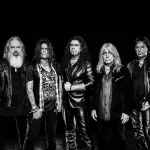
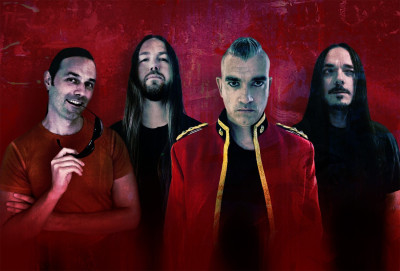
As fans can expect, Jadjow marks yet another development in their sound, introducing a cleaner production, clearer vocals, and an ear for stinging melody. More a revolving collective than a static band, Matt recruited a new line-up for Jadjow, featuring Camille Giraudeau (Dreams of the Drowned, Doedsmaghird), Lars Emil Måløy (Dødheimsgard, If Nothing Is) and Tariq Zulficar (Atramentum), with George Geegor Anagnostopoulos (Dødheimsgard’s live sound engineer) alongside regular collaborators, to co-write the album.
Strange Times
Juxtapositions and contradictions are at the heart of VOID’s sound, especially on Jadjow, as Matt explains: “There were these weird experiences where we’d have a death metal band rehearsing in one room and a church band in the other.” He’s describing the Tottenham studio Dissident Sounds in which he worked for a few years, prior to building his own—Bad Princess Productions—in his garden. “But there was really crap soundproofing. So I’d be doing the washing up and then the religious chant would intertwine with the metal riffing! And it was like, ‘Oh, my God, this actually sounds really good! Maybe it was an influence for what we did on Jadjow.”
It may not be the most obvious origin story for VOID’s fourth album, but—hearing Jadjow’s soaring vocals over unpredictable guitar-interplay—it makes sense. While Matt enjoyed recording other artists at the studio, he was able to make a steadier income from turning his side hustle in audio description into his main job, and VOID played the studio’s final show after pandemic lockdown restrictions lifted.
This followed a run of shows that the band had played pre-pandemic showcasing their magnificent concept album The Hollow Man, which featured a different line-up to Jadjow. They had intended to continue but “lockdown came along,” Matt explains, “and I wrote the song ‘Self-Isolation’.” So Jadjow began as simply the urge to create something during those strange times: “I had the enthusiasm to pick up the guitar again and new music started to come out. It was about creating new songs without any particular plan. I wasn’t sure whether that was going to be for VOID or not at the time.
“I still thought the guys from The Hollow Man line-up were going to continue,” says Matt sadly, “so it looked like it was going to be a new project. Lars and George got involved and then we thought, ‘Okay, well now we’ve got this line-up going we need another guitarist.’ So we got Camille involved because he was also connected to that Dødheimsgard live show that I did.
“He’s the ideal guy to be involved, as he was already involved in VOID: he mixed The Hollow Man. When we first heard his guitar on that song ‘Self Isolation’ we were like ‘We’ve got something special now; this is a great working group.’ And the riffs just started to come out really quickly.”
With his new band in place, Matt was still hoping to start working on a new VOID album with The Hollow Man line-up, and eventually to continue playing live, but with one member ill, and all geographically dispersed, this proved impossible: “It didn’t work creating it online as not all members had their own studios. So I kind of accelerated with the new guys and we left that that line-up behind. At a certain point I realised, ‘Well I’ve got one band with loads of new material but we can’t play live; and I’ve got another project where we can play live but we don’t have any new material.’ I decided that, if they are the same project, then it’s going to be a healthy thing: VOID will survive this era. Everybody agreed to it even though it meant that some of them weren’t gonna be on the new album—but they hadn’t written the stuff as well so that was okay.
“The idea was certainly to keep both of those line-ups going, but that’s not what happened in the end. But who knows what will happen in the future?” Matt asks smiling: “The future is long!”
Beginning to End
And this line-up brought with it a new writing dynamic: “Whenever I was writing new stuff in the old line-up, the way that The Hollow Man was done, I would record my things and then I would send them around and people would listen to it, and make comments. But right from the very beginning with the Jadjow line-up I was very clear that I was not gonna write anybody else’s part, and I wasn’t going to tab anything out and give anybody any instructions. That’s very different to The Hollow Man which was all done here, in this studio, building it up on the computer – that was a lot of fun.”
As Matt explains, with Jadjow, “one person from the band wrote a whole song and then everybody else took that and did whatever they wanted with it. For example: on ‘Oduduwa’s Chain’, Camille was like, ‘Okay, I don’t do djent; that’s just not my style.’ Eventually he came back with a new attitude and decided to play that song in his own way: I’m playing these chunky, chugging riffs and Camille’s doing something completely different.”
With The Hollow Man, Matt wrote the fundamental parts of each song with each member helping develop it live in the studio – writing “up and down”. But with Jadjow, the process was “beginning to end”: “Camille did ‘Only For You’ all the way through; then George programmed drums to that; and I added my parts on top.”
With this process proving productive, Lars suggested that every member contribute a song and Matt is quick to highlight the freedom this process allowed: “It’s amazing how much the songs changed through that process. Even if my guitar remains the same all the way through, what Lars and Camille did on top completely transformed it.”
White Noise on White Noise
“I think that Jadjow is the most accessible thing we’ve ever done,” argues Matt, “because it has melodic themes that are easier to grasp than other albums.” Certainly the vocals on Jadjow stand out from other VOID releases with Matt’s voice taking the lead, unaccompanied by other singers, for the first time. Matt explains that he initially sung all of the vocal parts on The Hollow Man, which Matt, Levi [Leblanc], and Laura [Weston] then added harmony and counterpoint to. But with Levi and Laura stepping back from the band at that point, and given that Matt “enjoyed doing the vocal so much in that process,” he decided to take over vocal duties completely for the next album.
Furthermore, on Jadjow Matt almost entirely eschews any harsh vocals: “I realised how much I was enjoying doing all the clean vocal and having to do the metal vocal for me was a pain in the arse. I’m not very good at it; I don’t enjoy it; I don’t really like the way it sounds. Often when metal is performed live, there’s such a cacophony of sound that it can be quite hard to discern what the riffs are doing—and then you get some guy barking over the top of it! It’s like adding white noise to white noise. So I removed almost all of the metal vocals.”
And Matt found the new line-up to be supportive of this decision: “The guys in the previous line-up are very talented guys,” he states emphatically, “but for them VOID was more of a metal band—they perform more traditional metal styles in their other projects—whereas the new guys’ projects are arguably more progressive, more weird. I didn’t have to justify singing clean.”
Explaining that layering vocal harmonies is “just about the most fun I can possibly have in music”, Matt reveals a surprising aspect of the mixing process: having sent several different vocal takes and harmonies, he “didn’t give instruction to Ralph Henry who mixed the album as to which one of those voices was going to be the main one—and he just came up with something really great.”
A Tentacle-Headed Rider
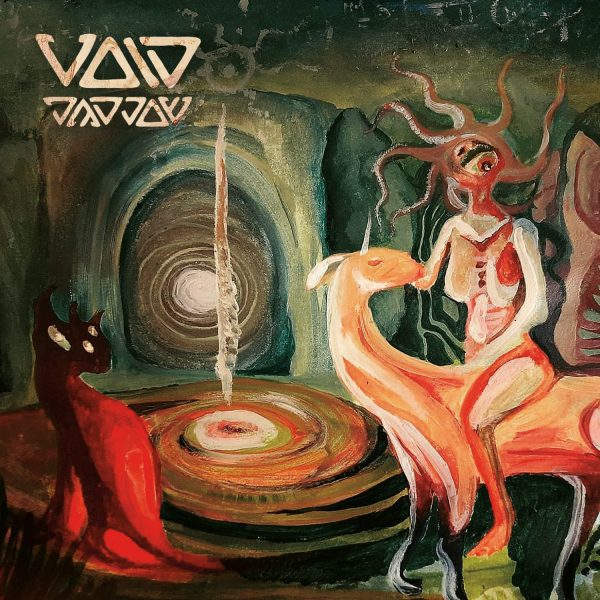
Jadjow features a highly distinctive painting for its cover, created by former VOID vocalist, Laura Weston. As Matt explains, Laura joined VOID to perform vocals on The Hollow Man but, for Jadjow, she “was stepping back as she’s been struggling with health issues. So, while she was enthusiastic to do more, she ended up contributing to this one by doing the artwork.”
Entitled ‘Wandus: I think therefore I am’, Laura’s painting uses broad brushstrokes to depict a tentacle-headed female figure riding a fiery-unicorn into a swirling, cavernous maelstrom. At the centre of this floats an untethered stalagmite/-tite, observed by a three-eyed feline creature. It is reminiscent of the great British-Mexican artist Leonora Carrington, and perfectly suggests the surreal melange of themes which form the record.
“She did do some artwork specifically for it,” Matt continues, “but the main parts of the cover were something that she had already done. I was glad that she was able to still be involved like that and I expect that she will be involved again.”
A Conceptual Playground
Matt likes to say that, “with this album, no idea was ever bad. And pretty much everything went in.” And, discussing the process utilised on Jadjow, it becomes clear that this was a truly collaborative one.
The album’s unusual title stems from a word that Matt’s daughter invented. “She used to say, ‘Daddy, Jadjow!” he explains, “that’s the way that she thought to say ‘playground’. So I put that as a working title, because of the idea right at the very start of the project that you can do whatever you want—let’s have fun!—let’s not feel like we need it to be any particular way. It was originally the title for the song ‘Fables from a Post Truth Era’, then it was the name for the whole project. Eventually it just became VOID, Jadjow. The title almost never got discussed.”
While the choice of title was a foregone conclusion, the band did explore the different possible meanings for the neologism. “’Jow’, I think, is another word for weed,” laughs Matt, while ‘jad’ can refer to spirituality. Lars wrote the song ‘Interdaementional’ and he created a character called ‘Jow’. Jow is a child who has become separated from his mother. He’s lost in a spiritual plane between realities. And he’s stuck in this playground. That’s why there’s that telephone call at the beginning – his mom is calling the police.”
These ludic themes were developed further when Matt and sound engineer George started experimenting with ideas based on photographs that George took at an abandoned playground in Bulgaria. Matt showed me some paintings he produced, inspired by a memorable dream of a “spiritual playground’, which was in turn inspired by these photos. And these paintings will become the basis for an animation featured in a forthcoming VOID music video, as Matt was excited to share: “it starts off with a nice sunset, then the playground is built. These buildings rise up, everything becoming industrialised, urbanised, then decaying.”
Pointing to a figure in his painting, Matt reveals “he was a character from my dream, drawn from a Fallout 4 character. He’s an android detective with the implanted personality of a human.” Apparently there is more to this narrative involving the boot of a car acting like a uterus and birthing a child, and I nod sagely.
So the album developed from this conceptual playground, in which all kinds of strange and idiosyncratic ideas could co-exist, cohering through the mind of Matt as project overseer. As such, Jadjow features lyrical contributions from several current and former members of the band, submitted from their geographically disparate contexts. And reading the album’s lyrics—published on the VOID Bandcamp page—is a pleasantly jarring and surreal experience, covering a wide range of subject matter, that reflects this creative process.
For example, the music to ‘Oduduwa’s Chain’ was initially developed from the rhythm of a piece of African music that Matt heard on the radio and loved. He explains that, “I stole that—the white guy!—so it’s got to be a song about cultural appropriation.” He then briefed former bass-player Gerardo [Serra]—an academic researcher specialising in African history— to write lyrics “about cultural appropriation with specific reference to the museums of Britain withholding African artefacts.”
As Matt explains, what Gerardo submitted “had references to the Ashanti Gong, the legend of Oduduwa’s Chain, the creation of the earth and desecration in Benin,” and Gerardo sent a second version with footnotes to explain these references to Matt. While the final lyrics provide some “cheeky” thematic juxtapositions, Matt allows himself a degree of poetic license, and ‘Oduduwa’s Chain’ is certainly a stand-out cut on the album.
But certain thematic threads do weave their way throughout. Matt explains that “there’s a lot about social tension on the album. The Pandemic itself frequently comes up. There’s a lot of talk about conspiracies. There were a lot of disagreements in that time—everybody experienced it—a lot of polarisation, conversations with friends started to go off on bizarre tangents. There’s a lot of that on the album. Sometimes these things started to really hurt relationships. That’s what the song ‘When Lucifer Dies’ is about – the result of what was occurring in the other songs ‘Fables’ and ‘Self Isolation’. ‘Only For You’ has a lot of references to conspiracy as well.”
Anyone familiar with VOID’s previous releases will know that—while narrating society’s apocalyptic decline may be their speciality—the VOID worldview provides hope also. Matt concludes stating that, “’Iniquitous Owl’ is about the end of an era, linked to the pandemic: the falling of man and so on. But I tried to make it fun and exciting – like a party or something? I tried to put in as much positivity as I could.”
Leaving Matt in his VOID-ian grotto, I stroll off into the night with many thoughts rattling around my brain; the most prominent being, what else would one wish to listen to at the party of the Falling of Man other than the UK’s No. 1 fringe metal collective? And will I be invited?
The latest iteration of VOID are currently reading themselves to bring their new material to the stage, and Jadjow is available now on CD and digital through Brucia Records.