Interview: Uniform
If we're going as big as possible, then I should try to make this about something that haunts me and plagues me. I should put all of myself into this.
Uniform have just released their stunning latest album American Standard and it is an intense and harrowing experience but also an immense and powerful one that sees the band demonstrating the full potential of their music in breathtaking fashion with vocalist Michael Berdan baring his soul throughout and opening up about living with an eating disorder. Gavin Brown had the privilege of talking with Michael about American Standard, how it was created and more in an interesting and informative interview with the creator of one of this year’s best albums.
E&D: Your new album American Standard is out now. Was this a difficult album to make due to the subject matter it deals with and did it feel cathartic to make?
Michael: It didn’t feel cathartic to make, it feels cathartic now, which is strange, but basically, how this went about was, we started working on this in 2022, and it was during a period of time where our guitar player, the main songwriter Ben, had a bunch of health problems, and on top of that, our old management had kept us from touring and we were just at, potentially, our lowest morale point. It was one of those, are we going to break up moments? Should we break up? We figured that if we were going to break up, and if nothing mattered, we should just put everything that we have into a record that was meaningful to us. We should not worry about things that would serve an algorithm, or fit in neatly with any kind of genre niche, if we’re going to break up, let’s make something that we’re really proud of first. Ben got to writing the music, which was incredibly labour intensive, and I got to feeling like, if we’re going as big as possible, then I should try to make this about something that haunts me and plagues me. I should put all of myself into this, and if I’m not going to get anything out of it commercially, then I need to get something significant out of it, artistically. What’s the thing that eats me the most, no pun intended, it’s this eating disorder that I’ve had since I was 12, if not earlier and it’s the last thing I ever wanted to talk about, the last thing I ever wanted to write about, it’s something that only my wife and my family and people who’ve lived with me or traveled with me really know about because I can’t hide it very well if you’re around me. So making it felt really disarming and really uncomfortable, and that’s largely where having B.R. Yeager and Maggie Siebert helping me with the thematic side of things came in handy, because they kept me honest. They kept me from holding back. Anytime I wanted to dial it down, or felt a little too naked, they would push me further into the realm of discomfort, so it wasn’t cathartic, if anything, it just made me feel overexposed. But then as the album cycle hit and I started talking about the themes more openly, especially with the essay that I wrote for The Quietus, the response was so shocking. I figured that it would resonate with some people, but that most people just wouldn’t want to talk about it, but people didn’t fit into the traditional gender stereotypes of those with eating disorders, wrote to me en masse and that made me feel, kind of for the first time in my life, like I’m not alone in this. Another strange thing with it was just like the mechanics of launching the press campaign for this, the making of the record, and the physical side of the record, when you have to talk about things economically and deal with the nuts and bolts of creating a physical product that’s available for for consumption. It becomes depersonalised, and when I got that kind of distance from this deep malady and it’s turned into an object that was weirdly liberating. At this point, talking to you about this, with this kind of candour, isn’t something I would have been able to do six months ago. But having been trained now to discuss it, I feel liberated, and it is easier, and there has been a degree of release with that.
E&D: Have you had a lot of messages of support about the album and the essay?
Michael: Yeah, this is not the kind of thing that, l was ever really able to sit one on one with a casual acquaintance, or even a close friend or family member without cringing and trying to duck away, and now, it’s not like a badge of honour or anything. It’s not cool butI have the ability to discuss it like it’s just another facet of my life and that takes away a lot of its psychic and spiritual power over me, and I found that with that, I’m less inclined to relapse. Oddly enough, since that, it’s the kind of thing that’s always in the back of my mind but since this cycle started, it’s been much less of the case.
E&D: Was the essay a difficult thing to to write or was it easier because of the album?
Michael: Because of the album, that was easier and odd, the genesis of that essay was kind of strange. Geoff Rickly from Thursday, who’s a good friend and a fantastic author, was writing the album bio, so I put the essay together for him to go by honestly, it was initially just like, here’s some bullet points that I want Geoff to be able to touch on so that he has reference when putting the pieces together and something coherent. We were talking after the fact, and he’s like, you should really do something with this thing. I hadn’t thought about it, he’s like, I think people will get something out of it. and it could be important for you to just lay this bare to a wide audience, just like you did for me. I thought, do I want to lay this bare for thousands of people, but we wrote a fucking record about it, so I might as well. That’s kind of how all of that happened.
E&D: What does the title American Standard refer to?
Michael: It’s a company that manufactures plumbing supplies, at least in the States. If you look at your toilet bowl, chances are you will see this shitty blue script that says American Standard on it. It’s a sardonic play on words of the American Songbook.
E&D: You mentioned B.R. Yeager and Maggie Siebert earlier, how did you get with them to be involved and work on American Standard?
Michael: I’ve been in contact with them for a few years now. I am very into independent horror. I feel that I get out of independent horror, what I used to get out of extreme music. I find that these are people who are willing to confront uncomfortable topics, and willing to explore themselves in unsettling and profound ways in the same manner that Whitehouse used to do but less vitriolic and more introspective. If Whitehouse were introspective, as opposed to antagonistic, it would be like what a lot of these people do, so in both the cases of Maggie and Ben Yeager, I just followed them on Twitter, years ago, and they both, independently DMed me and tikd me, they liked my shit, like, I’m a fan of your band. Maggie lives here, so we become in person friends, and she’s also an incredible musician. She does this power electronics project called Mouths Agape, which ventures into similar body horror topics that she does in her writing. Ben Yeager lives in Western Massachusetts and he goes to punk shows. I work with people in Western Massachusetts and we just became close through shared interests and mutual friends, so when the time came, lit wasn’t a matter of shooting in the dark, it was just a matter of accessing the people that I already have in friend relationships with and artistic respect for.
E&D: Will you work together again in the future?
Michael: I would love to! I don’t know if that’s on the cards, but I would do it in a heartbeat. That being said, I kind of just want to get through this first and see where everything stands a few months from now, and when it’s time to get to the next thing, then maybe. But I really do enjoy working with writers and authors and poets when it comes to dealing with words more than I do with musicians.
E&D: Would you ever bring out a fiction book yourself?
Michael: I’m not much of a fiction writer, honestly, but I am an essayist. I’ve written for music publications on and off, for the better part of a decade now, and within the past couple of months, ever since I got laid off from my last music job, I worked for Warner Media on their metal website, churning out terrible copy, like 10,000 words about Disturbed every week, which is a band that I’ve never heard! Writing became a habit again, so when I didn’t have that to do, I just started doing my own thing again. I have a Substack, and I put up essays once or twice a week or so. There has been talk about making a book out of these essays, and they follow a similar, kind of memoir theme. But if I start living in the future about, what projects am I going to be on in six months, then I lose sight of what I’m doing in the given moment. So I find it important to just stay where I am, concentrate on what I need to do right now, and then, once that’s said and done, I can move on to the next thing.
E&D: With B.R. Yeager and Maggie Siebert, what work of theirs would you recommend to check out?
Michael: With B.R. Yeager, in the past two years, he’s developed this pretty intense cult following through his book Negative Space, which is about adolescents in Western Massachusetts in the midst of a suicide epidemic that may or may not be triggered by this drug. That’s his most popular book. It’s kind of like Stand By Me goes to hell, that’s how I like to sell it, and it’s wonderful, and deeply introspective, but for me, he wrote this book before that, called Amygdalatropolis, which is about very intense, self imposed digital isolation. It’s about someone who falls into the realms of online troubles via 4Chan and 8Chan and all of that, and just gets completely lost. It’s this deep, unsettling character study of crystallised loneliness and abject self hatred that then is turned into this outward hatred of the world, all through a computer screen. It’s cyclical. It feeds on itself. The short story collection Burn You The Fuck Alive is also remarkable. But to me, Amygdalatropolis is the one. Maggie wrote a short story collection called Bonding that is the best body horror that I’ve read in recent memory. It sits somewhere in between Burroughs and Kafka, it touches on that kind of thing. but it’s deep, empathetic and funny and laced with pathos. The visuals in it and the descriptions are very kinetic and uncomfortable, but it’s way more about the characters inner lives and dealing with body dysmorphia. I think it’s just harrowing and beautiful and perfect. Both of those books are available through Apocalypse Party Press, you can get that stuff most places. Those would be the two that I would check out first.
E&D: How do you feel that the songs on American Standard will work live and are you looking forward to hitting the road again, and coming over to the UK and Europe to play this new material?
Michael: We workshopped a lot of the record at previous live shows and a short tour that we did last year when we were just trying to get all the pieces to fit. But now that it is one cohesive unit, it hits very differently. We’re playing our record release show and then we go to the West Coast, and then we go to the UK and EU. I don’t know how people are going to respond to it, but that’s kind of neither here nor there. I am excited to just do my job and have this as one cohesive live presentation that we can then show others and they can take whatever they will from it. I’m grateful for the opportunity to have gotten to get to do this, and I’m looking forward to see where it goes,
E&D: As a New York band, how do you feel about the recent closure of Saint Vitus, and what your favorite memories of the venue? I know you filmed your first video there and played there many times, so that must be a must missed place.
Michael: I mean, big time. I worked there for a long time too, you know. I had keys to St Vitus quite literally. It’s a tremendous loss. There’s no way around that. Every few years, New York, kind of establishes a home base. It was CBGBs for a long time. It was Death By Audio. It was Silent Barn. It was Saint Vitus. We have these places that you develop scenes out of, and communities blossom when you’re in the midst of it, you forget how temporary they are. If I was to add up all of the hours I’ve spent in Saint Vitus, it would probably be like close to a year, you know, which is just fucking crazy. Those guys helped us at every turn, since before we played our first show, they mean the world to us and that physical building symbolizes a lot to us as a band. But at the end of the day, it’s also just a physical building, you know, they’re continuing to book shows and be active so it’s not like it’s gone. It’s only gone when Justin, George and Arty decide to drop the banner and stop doing gigs, and move on to something else. I’ll be really sad if that ever happens. Home isn’t necessarily a building, I’m talking to you from my apartment, which I’ve lived in for 10 years, but 11 years ago, it wasn’t home, and the place I was before then was I was there for 10 years, and it was home for a while, and then it wasn’t the place. I don’t know who lives at the address that I grew up in anymore. That was my home but home is where your family is, and as long as the people behind Saint Vitus, are still working, then we still have a home.
E&D: What are some of the most memorable shows you saw there?
Michael: Jesus Christ! Every time Eyehategod played, there was astounding. There’s something about that band that is like a no frills workhorse, intense, doing what they do, and owning that stage, I would say that that always had a spiritual impact on me. Ramleh playing, that was huge to me. It’s so funny, because it’s hard to quantify because I was there so much, and it all kind of becomes one giant blur, you know? Some people can say when Nirvana played and it’s like, is Nirvana playing there any cooler than Deadguy or Converge playing there? I don’t necessarily know if that’s the case. I saw so much shit there and everything had its place. Sometimes it was profound, sometimes it wasn’t, but at the times it was profound. It was incredibly special.
E&D: Going back to the new album, can you tell us about the Nightmare City instrumental release that accompanies American Standard?
Michael: The way the record is produced, the way Ben works as a producer and engineer, is, and he’ll be furious at me for saying this, but it is similar to a wall of sound approach, where there’s just so many layers, and finding a place to fit those layers, and sometimes, it’s hard to catch the nuances with everything going on. So Nightmare City happened when we were fitting the synth tracks in with the rest of the mix. A lot of the synth stuff is terrifying and gorgeous. We just felt like it was a shame in some ways that it wasn’t front and centre, so we wanted to find a way to really highlight that, and the way that we did that was to make this kind of alt instrumental version of the record. Nightmare City is, is the name of an Umberto Lenzi movie that means a lot to me. A lot of the stuff that we do is dumb film references or literary references that I get a kick out of. We named an EP, and in a song called ‘Ghosthouse’ after another Umberto Lenzi film. As we were kind of revisiting it, that track came out in 2016 on the first EP, and we redid the EP in 2024, so as we were revisiting that, we was just like, oh, you know, I want to kind of keep this Umberto Lenzi thing going, so so that’s where that title comes from.
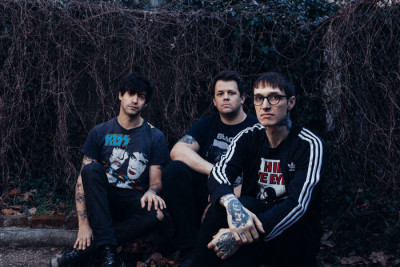
Photo credit: Ebru Yildiz