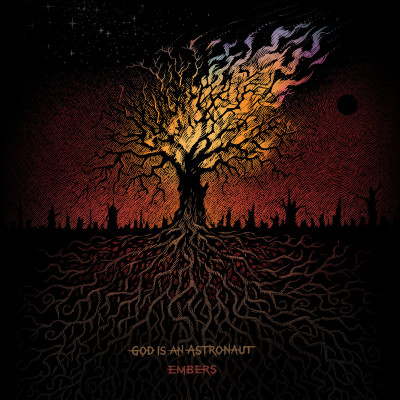
Whatever is happening in the world, it is always cause for celebration when God Is An Astronaut release a new album. The Irish post-rock trio are never afraid to push their own sonic envelope, and the end results are always a treat for the ears. Embers continues this fine tradition, bringing with it a wealth of new (to the band) instrumentation to delight audiences new and old.
Established fans concerned that the promise of new instrumentation might mean a completely new sound for the band need not worry. From the first bars of opening track ‘Apparition’, it’s clear that this is the same band that created such dark, driving songs as ‘Suicide by Star’ or ‘Agneya’ – they’ve just evolved over time. The addition of a sitar simply adds another harmonic layer to the band’s established sound. It’s a new and interesting spice in their sonic stew, if you will.
‘Falling Leaves’ and ‘Odyssey’ both highlight how well the sitar serves the group – both songs would be emptier and lesser for its absence. It’s rather like discovering how delicious curry is with a proper spice mix if you have only previously had it with curry powder. What went before was by no means bad, but now there is an extra element without which it would feel somehow lesser. Both tracks are also beautiful: bright, resonant, with deft use of reverb. ‘Falling Leaves’ in particular feels rather like a post-rock soundscape conjured around an autumnal evening fire, as befitting its name. It’s easily one of the trio’s most joyful pieces of work, and is the album’s best track by a country mile.
The only gripe, and it is very small, is that the other new instruments, including bowed psaltery, tanpura, and shamanic drum do get a little lost in the mix unless you know exactly what you’re listening for – but this is rather like complaining that the trombones get lost in the sound of a whole orchestra. The whole sound is still beautiful and rich for their inclusion, and would suffer without them.
That richness of the sound across the album is also a notable change thanks to an emphasis on the real instruments over using synths. That focus also combines with intensity that’s been retained from Ghost Tapes #10, especially notable where Jimmy Scanlon is given a guest spot, as on ‘Oscillation’, one of the album’s darker, more brooding moments which offers an excellent counterpoint to the more ethereal tracks it sits between. Both tracks feature another returning collaborator, Jo Quail, whose gorgeous cello playing grounds the reverb-laden, synth-driven ‘Realms’, adding resonance and depth like the shading on a Rembrandt painting.
God Is An Astronaut are not a band to rest on their laurels. Although each album is recognisably their music, the sound on each represents an evolution from its predecessor, and they have absolutely kept that momentum going on Embers. None of these songs could fit into any of their previous albums, yet the soundscapes of Embers retain that signature blend of darkness and light that the trio (and friends) have perfected. It’s their music, better than it was before. Here’s to more of it in the future.