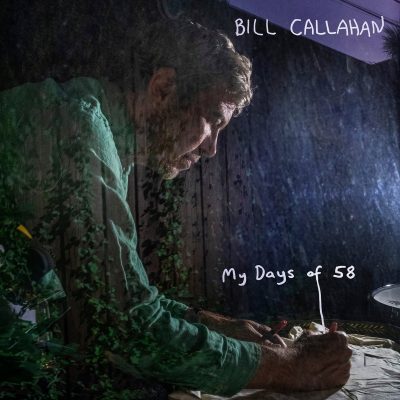
My Days of 58, released in February 2026, is Bill Callahan’s eighth solo album. The title alone sets the tone of an intimate conversation: «My Days of 58» sounds less like an album title than the heading of a diary or a confession. It will hardly be news to say that this is perhaps the most autobiographical and direct release in Callahan’s solo discography. Here he sings about himself, about his fears and anxieties, about everything that has opened up to him over the long course of his life. Callahan is no longer only a master of image and implication; he is also a man willing to speak almost without cover about family, age, mortality, and his own vocation. But Bill Callahan was not always this open. More than that, his latest work feels to me worlds away from the earliest records.
To understand just how radically Bill’s musical language has changed, it helps to remember what his early work sounded like.
His public career began with Smog: the debut album under that name arrived in 1990. In that period, Bill worked in a lo-fi, slacker-rock mode, experimenting constantly with texture, noise, and the very shape of the song itself. Those early releases did not yet carry such a strong alt-country or contemporary folk tint, and the arrangements were nowhere near as rich in orchestral instrumentation. Most importantly, though, there was not yet that measured, inwardly composed Bill Callahan we know from the later records.
Just as Bill himself looks back on turning thirty in ‘Empathy’, I find myself turning to Smog’s Wild Love from 1995, when he was nearly half the age he is now. On the opening track, ‘Bathysphere’, he sings about a childhood dream of living underwater, inside a bathysphere. It quickly becomes clear that this is not merely a child’s fantasy, but an image of voluntary isolation from other people—a motif that would recur throughout his discography. ‘It’s Rough’ becomes something close to an anthem of lostness. Bill sounds like someone who has run out of ways to keep going. Over a trembling, oppressive guitar line, he pleads: “Don’t turn to me ’cause I’m no hope / Don’t turn to me ’cause I don’t know what to do”. Nearly every track here feels like an emotional fragment of a life already worn down and broken. In ‘Be Hit’, the young Bill touches on relationships, telling the listener with evident regret: “Every girl I’ve ever loved has wanted to be hit”.
Listening to Wild Love, I see a hazy image of the author—exhausted, worn down, deeply lost. All the more striking, then, that thirty years later this same songwriter would write so movingly about his dead father, about the son who embraces him after long stretches on the road, and about the difficulties of his own fatherhood.
On every album, Bill reveals something deeply personal, but over the course of his career the form of that revelation changes radically. In the Smog era, his narrative mode remained fragmented and tangled. He leaves things unsaid, giving us not explanation but the blunt fact and its melancholy weight. That distance was a central principle of Callahan’s early work under the Smog name. But as his artistic identity changed, Callahan gradually began to relinquish that distance.
On 2009’s Sometimes I Wish We Were an Eagle, he is still writing about life’s hardships—about breaking up, about the difficulty of understanding love and understanding himself. But here the early fog has already been gathered into a much more coherent form: the songs are fuller, roomier, and the personal drama is presented as though the listener were overhearing an intensely intimate conversation. Bill is especially poetic here; he works through nature-based metaphors, and his inner voice already sounds genuinely mature. Birds, wind, animals, shifts in air and landscape—all of these become Callahan’s way of showing feeling without reducing it to clear explanation. At the same time, the album is rich with orchestral arrangements, yet it remains supple: the musicians seem to be feeling out its shape in the act of recording, creating the sensation of live performance inside the record itself.
On My Days of 58, Bill seems to be attempting a provisional reckoning with his own life. He asks himself why he sings at all and arrives at the conclusion that he has spent too long living inside his own head. He writes from a lucid awareness that life can be cut short at any moment; what frightens him is not death itself, but the possibility of ceasing to try to become the man he supposed to be.
On the third track, we hear him confess: “It started out as a way for me to communicate / With other people and myself and the spirits / I don’t want to say that it saved my life / But it gave me a life”.
Here, he speaks with a rare degree of clarity. Bill revisits his life in search of answers, and for the first time allows us to hear not only his conclusions, but the very movement of his inner monologue.
My personal favourite on the album remains ‘Lonely City’, in which Bill Callahan conducts a metaphorical dialogue with New York. But the strength of the song lies in the fact that New York could easily be replaced by any city with which the listener has formed a private relationship. The aforementioned ‘Empathy’ struck me with its intensely personal, intimate recollections. In that track, Bill does not simply return to the figure of his father; he tries, perhaps for the first time, to see that figure from within his own age and his own fatherhood—to ask whether he is doing any of it right, and whether it is possible at all to become the kind of person one once needed for oneself.
The album itself feels remarkably calm, warm, and kind, though melancholy lives constantly inside that softness. Callahan drifts into pensive, almost twilight meditations, then suddenly lifts a song upward in the choruses. My Days of 58 is built on precisely these shifts: it seems comforting, but it is never static. It is full of charmingly unexpected decisions—saxophone flares, loose rhythmic turns, and a supple sense of musical give-and-take—extending the kind of subtly orchestrated, gently surprising musical logic that shaped Sometimes I Wish We Were an Eagle. Because of elements like these, the music is always edging slightly away from the expected. It becomes unpredictable and alive.
Taken as a whole, My Days of 58 is a truly fine Callahan album, and I would not hesitate to call it one of the best of his career. The record opens up more deeply when you understand what stands behind it, and what kind of journey Callahan has made over nearly thirty-five years as a songwriter. From the ironic, tangled, deliberately evasive author of the Smog era, he has arrived at a rare kind of maturity: a musician who has moved beyond the old distance, looks at life from deep within experience, with clarity, warmth, and human vulnerability.