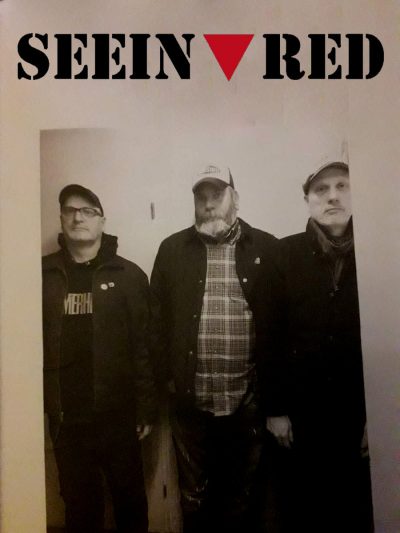
Interview: Seein’ Red
I think the moment that Seein’ Red stops speaking out, the band will stop because, for us, that's as important, if not more important, than the music that we play.
Dutch legends Seein’ Red are one of the most respected hardcore/punk bands that Europe, and indeed the world has ever produced. Their integrity has never been compromised and the band are still playing gigs, making music and going strong today.
With a host of live shows upcoming, Gavin Brown had the pleasure of talking with Seein’ Red bassist Jos Houtveen about their music, their message and the importance of being a political band, those upcoming gigs, memories from both Seein’ Red and previous band Lärm and the forward thinking that has made their music still as vital in 2026.
E&D: Are you looking forward to the Seein’ Red live shows that you’ve got coming up?
Jos: Yeah, we’ve got a couple of nice ones lined up ahead. We’re going to play two nice festivals. The first one is in Saint Etienne, which is the Kick Rock Festival on May 15th. We’re also going to play the Noise Annoys Fest in Sheffield a week later, which is also very nice. We were supposed to play there, I think, two years ago with Lärm, but then I couldn’t make it because of work issues, we had to cancel that. So I was very happy that they asked us again, and we tried to play with Lärm as well, but we now can’t make it that weekend, so yeah, so Seein’ Red will play instead. Besides that, I think we’re going to play Berlin at one point. We got a couple of gigs signed up in the Netherlands, so yeah, we got some nice gigs lined up.
E&D: With you coming over to the UK for Noise Annoys, do you have good memories from playing here in 2002 with From Ashes Rise and Shikari?
Jos: Oh, wow. I have to dig deep for that one! I think that that was the first gig of our UK tour, we played the night before in Ghent in Belgium, and it was horrible. I didn’t like the place at all. The crowd was not that good. I remember that Olaf, our drummer, got really angry by the crowd, or something like that. So we were very pissed off, and we were very eager to make it to the UK. I think we played Bristol. I know that Graham from Crime Scene set up the gig, we arrived and we had to decide on who’s gonna play first. We said, yeah, we’ll open. That’s no problem at all. He was like, ah, yeah, but, you’re very known band. And we said, well, we’re not about that, we’re doing a tour with Shikari, and we’re just gonna swap every night, first night we’re gonna play first second night is them. The only thing I can remember right now is that there were three or four different flyers for the gig, and we were meeting people again after a long time, but I don’t have really vivid memories of that specific show.
E&D: How does it feel to still be playing shows with Seein’ Red in 2026?
Jos: It still feels good. I had to take a short break because I had some issues with the muscles in my shoulders. That’s what happens when you grow older. I guess, the body doesn’t want to play along as good as it used to. I think also because we played in the last few months of 2025, we went to Germany twice, we went to Finland and we went to Belgium all in one month. So there was quite a lot of traveling, and that, combined with work, was maybe a bit too much. So I’m quite looking forward to playing again. We’ve got quite a few lined up, and I’m really looking forward to play live again.
E&D: What have been some of the other memorable live shows that the band have played over the years?
Jos: Wow, that’s a lot! I have fond memories of the Japanese tours. They were brilliant. I think Japan is quite something else for a band to play live. Also got really fond memories of the USA tours we did, especially the first two, when we had the privilege of playing with Torches To Rome for one full tour a month, and then the second tour, we played with so many good bands, and we met a lot of nice people along the way. At that time, I think America was quite different to what it is now. At the moment, I would not really want to go back there. I think that the political climate is a bit weird to say the least! The UK tour was nice as well. Like I said, there’s so many good places that we played and nice people we met. For example, the 1 in 12 Club is a place that I always enjoy playing and visiting. We played Static Shock in London a couple of years ago. I think that was actually the first gig we did after we took to pause for a couple of years. So we played that festival in the warehouse, which was nice. We played in Wales in the back of a small pub, they bring back memories. I remember playing down near Berlin. We played in a squat, which was like a house in a block full of houses where people still lived. We played in the kitchen! Another memorable thing was when we played in America, I think that was the first tour, and we drove from Phoenix, Arizona to Ogden, which is in Utah. It’s a couple of hours north of Salt Lake City, and the drive itself was like 36 hours, and we went through so many time zones that we sort of lost many hours, and we arrived at a place where the gig was held and everybody already had left, except for the organisers and Torches To Rome and played to 4 or 5 people after driving 36 hours. I think that was probably one of the best shows of that tour, because we were really intense and eager to play live again. We recently played Finland, we were invited to play the anniversary of this band called Sick Urge. They’re a really good band, very fast and tight and nice people. And we played with him that was the first time that people were singing along to our songs, which was quite an experience, to be honest. I also remember a gig we did in the Netherlands a long time ago, when we stopped the gig for a discussion with the audience, and the discussion lasted for an hour, and then we picked up the instruments again and started playing. So that was also quite an experience. We played in Brussels at the beginning of an anti-racist march. We played on the square, and there were about, 20-30,000 people there. That was probably the biggest crowd we ever played. And also talking about market squares, two or three years ago, we played in Enschede, which is close to the German border, and we were invited to play at this outdoor festival, and it was on a Saturday afternoon, sunny weather and there were so many people sitting outside of bars and restaurants having a drink, but it was like all average people. So we started playing, and I think most of the people witnessed a punk band for the first time, and maybe the last time of their life! But it was fun, because we like to play to different crowds, to people who don’t know what to expect, and especially in the past, we played some very mixed festivals, or they asked us to play at a book presentation and things like that. That was always something challenging for us to do. I might have to sit down and make a list of my 10 favourite shows. And I think if I do that, they are favorite for different reasons.
E&D: Is it more important than ever for you still to be spreading your message with your music today especially in the climate around the world at the moment?
Jos: Exactly. I had a meeting recently. I’m an elementary school principal, and I am part of a school board. It’s not for the school I work myself, but from a neighbouring town. We were having a meeting, and afterwards, we’re just chatting for a bit, and we started talk to talk about what’s happening in the world today, and also how we see the future. We sort of agreed that the times that we are in, they are changing very fast, but it’s also going downhill very fast. In the Netherlands, we used to have this very liberal climate when it comes to gay rights, for example, and we see that we that that is changing in a very rapid way, and that it’s also changing in the wrong direction. So you see that tolerance is getting less. I know that I don’t have to tell you about the dangers of the extreme right when you live in a country with what used to be called UKIP.
E&D: Yeah, they’ve morphed into what’s called Reform now but it’s the same thing and they’re just as odious and dangerous as ever unfortunately.
Jos: I think if you look globally, you see something happening in every country. The more extreme right is rising. We had the equivalent of the National Front of the Netherlands, and they had one seat in Parliament, and the guy who was in Parliament was ignored, and, people were booing away but as you were saying, things are being repeated right now by the regular parties so everybody thinks its ok to be against refugees. We have a not very large but very vocal group who travel around the whole country to protest against asylum seekers and things like that. So I think that being a punk band, you have to be political. There’s no question about it. People often say, Yeah, but you’re preaching to the converted, but I’m not too sure, because I see also in the punk scene that people are moving towards the right at some point, but also, they don’t feel the need to be vocal about political issues, or animal rights, that kind of stuff. And those are, for me, really important issues to speak out about. So I think the moment that Seein’ Red stops speaking out, the band will stop because, for us, that’s as important, if not more important, than the music that we play. I also can’t understand why a band releases a record and doesn’t include a lyric sheet, because I think that the lyrics, especially for punk bands, lyrics are really important. So I feel the need and the urge to continue doing that.
E&D: Have you had much opposition from the far right with your music and your message over the years?
Jos: Not really. Well, I think, like any punk scene back in the 80s, we had a fair share with skinheads and that kind of stuff. We had the odd threat. I think we had a bomb threat at one point, but it was fake. We had people who tried to break into a gig at a squat, but they failed. So I guess we have been quite lucky so far. And of course, we witnessed violence, but not as much when we played ourselves, but more at different gigs, I think especially back in the 80s, with with the whole UK82 thing and the oi! bands. That’s when I witnessed most violence at gigs in the Netherlands. There was not a huge skinhead movement, but there was enough of them to wreck a gig. I know that we are known by the far right. They know about the band, but I think if that stops you, why even bother being a political band. Like I said, I guess we’ve been lucky not that many troubles. In fact, I think we had more problems and gigs with, not to generalise, but with drunk assholes who claim to be anarchists, accusing us of not being real punks or things like that. It’s just bullshit, and it’s like I often say, where are they now? They had big mouths back in the 80s and the 90s, and they all disappeared, and not because they died, but just, chickened out and became the people that they were always rebelling against.
E&D: Have you had any thoughts about any potential new Seein’ Red music at all?
Jos: Well, we have. We recorded 10 Songs for a split LP that’s due to be released this year. Hopefully it’s going to be released by Armageddon Label in America. It’s a split LP with this band called Life Abuse and probably I’m going to take care of it myself of the European pressing. So that’s going to happen, definitely. We’re doing a split seven inch with a band from Indonesia, and that’s going to be on my label, and also on the Indonesian label. We just got asked to contribute a song to a tribute LP for The Kids from Belgium, because they have their 50th anniversary this year. It’s not like we’re planning years ahead. We’ll just see how it goes. Paul, our guitar player, retired two years ago. I’m going to retire this summer, and I think that Olav, our drummer was also going to retire. And then people ask us, Oh, does that mean that you’re not going to tour again? I said, Well, I don’t think so. To be honest, I think we’re a bit too old to do a two week tour and things like that. But yeah, as far as the music goes, that’s what’s planned at the moment.
E&D: You re-released the This LP Kills Fascists compilation on Crucial Response records last year. Has it had a new lease of life to a new generation with this reissue?
Jos: I think so. I was overwhelmed by the reactions that people were so enthusiastic about it. And it was for us, I played that record and I was like, Oh yeah, it’s quite good stuff. It’s stuff that I could listen to, and that’s often not too easy when it comes to your own band, of course. But for this, I was like, Yeah, we did some good, good things, and we definitely got some new people into our band, and I’m very happy with the result of it. Also the Refuse Resist LP, which is the first full length we did after a long time with new stuff. Because I think that Past Present Intense, which is all old stuff, re recorded, it doesn’t really count as a new LP. So I’m also very proud of that record. I think that turned out very well. I read a review saying that it’s one massive Anti Fascist message that comes from a slab of vinyl, and I think that’s an accurate way to describe the record. So yeah, I’m pretty pleased with those two.
E&D: How did it feel to be back playing shows with Lärm again?
Jos: The thing is, we ended the band in ’89 because Menno left the band, he had to focus on his studies, and then we did a reunion in the same year. And then after that, we lost touch. At one point, there was this festival in the Netherlands that was called Classic Fest, and it was all cover bands of hardcore bands, and we were asked if we wanted to do a Lärm set. We said, yeah, of course. So we had to look for a singer, and we found one in an old friend of ours called Roy, and he sang. Then we went to Japan for the first time, and our friend Ronald went with us, and we did eight Lärm songs every set, and he would sing them. We started talking, and I told him about the reunion gigs, and he was like, why didn’t you ask me? And I was like, yeah, but I thought you wouldn’t be interested. And he said, yeah, for sure, I’m interested. So we got offered that gig, and we said, Yeah, well, we’re gonna try to rehearse. So we rehearsed for the first time, and after the first time, we were like, wow, this feels like if we rehearsed last weekend. So it was all back, and I think the chemistry between the four of us is very good, and it’s also nice because we are, I wouldn’t say that we are picky about what gigs we play, but you know, but we’re not going to say yes to every gig, also, because Seein’ Red for us is still the band, we focus on first, and then, Lärm is this side project or something like that. We do a gig once a year, maybe twice a year, and we try to do the nice gigs. It feels good, and it’s always a good atmosphere amongst ourselves, obviously, we have all matured and the friendship of back then is still there, and that’s always nice.
E&D: Do you look back on your time with Lärm with fondness?
Jos: Yeah, absolutely, the early days of the band, we had many opportunities that we took. We also turned down a lot of opportunities, because even today, we still believe in that DIY ethic. I think one of the reasons why we also ended there was besides the fact that Menno had to focus on his studies, we also felt that the whole fast hardcore thing was going in the wrong direction, like it was only important about who’s the fastest band? At one point, I recall that we played London on our tour with Heresy, and, I think, Mick Harris from Napalm Death came up to us and said, I think you become became too melodic, and we were like What?! It was like you can’t progress as a band. You cannot change your sound. You have to keep on playing the same things. I would not say that we are not really good musicians, except maybe for Olav, because I think he’s a really good drummer. But, we all self taught, and at one point, Paul started to learn how to play a power chord, so the music was in tune instead of out of tune. I don’t regret anything we did, and I look back on it with a lot of good memories. I recall a talk with my late mother, which I had something like 20 or 25 years ago. We were just chatting, and I said, Oh, Mom, could you imagine, back in the 80s, when we were practicing at the bar on a farm that I would end up playing to crowds in Japan, and would be able to tour the USA and stuff like that. And she said, No, but that’s, that’s a good thing. I said, yeah, that’s a very good thing. People sometimes say that we are we’re the godfathers of grindcore and that kind of stuff. And I’m like, well, not really, we just weren’t able to play our instruments very well. We just wanted to make a lot of noise, and I think we succeeded in that, and if we influence people or bands, that’s good, but it has never been the main goal. We are still not any different from anybody who’s visiting a gig. We’re all equal. That’s how we started our first band. We went to see gigs and we saw a band, so we’re like, oh yeah, we want to do this as well. Let’s try it. And we gave it a go. The very first recordings we did, and those are included on the Lärm discography LP and CD is from our very first band, The Sextons, at that time we only had one small guitar amp, and we didn’t have a drum kit, but Olav had a chair and two hammers. So the first recordings we ever did was everything, bass, guitar and vocal through one amp, and then Olav on a chair with two hammers, and that’s how we started. I think that describes punk , in my eyes, the best you can. Anybody can be a musician, and it shouldn’t be important how good of a musician you are, but the whole intensity and, the rawness, whatever you want to call it, that that’s what makes my heartbeat go beat faster when I see a band perform live. I can still be very enthusiastic about new bands, and I don’t want to be one of those old punks who remains living in the past, saying, Oh yeah, but back in the 80s, it was so much better. It wasn’t better, it was different, and I think that’s something, that for me, is very important. I don’t want to live in the past. You know, I enjoyed the past, but I also enjoy the future.
E&D: Do you think that’s what punk and hardcore have always been about, that forward thinking mentality?
Jos: Yeah, exactly. That’s what I mean. I think progression is something that’s very important, but it doesn’t mean that you have to change everything all the time. I think the worst thing that you can do is, have this attitude of, like I just said, but in the 80s, it was so much better, like when we saw D.R.I for the first time or whatever, it’s something that I don’t want to brag about because I was fortunate enough to be born that time. Maybe I’m going to miss something really important within 40 years, when I’m not here anymore. You see that every era has its moments. I think that’s something that you should realise. Maybe people don’t do that too often, and I really enjoy talking about it, of course, because I can tell many stories, but it doesn’t feel right to be proud of something like that if you know what I mean, it’s just something I was fortunate enough to see many bands that people who are, for example, 20 years old, never were able to see because they weren’t born yet, but then again, I never saw the Beatles, and other people did so thats what I mean. I wish I could have seen very early Black Sabbath but that’s the way it goes.