Interview: Lost in Kyiv
That's the purpose of each song, to have a dark way of the song and a hopeful side of each track. At the beginning of the album, it's more dark. It becomes a journey, it becomes more and full. But inside each track, there is a balance, maybe two ways to see something and to interpret something in each song. But that's the purpose of the album, to have his own interpretation and different parts in a song.
Jody Dunstan sat down with Max, JC, Dimitry and Jeremy from French post-metal band Lost in Kyiv at ArcTanGent 2026 to talk, influences, collaborations and the development of the band’s sound. . .
E&D: Hi, welcome, so to start, can we please do some quick intros?
MAX: Hello, I’m Max from Lost in Kyiv, playing guitar and synths in the band since the beginning, like a long time ago, more than 15 years, and voilà.
JC: Hey there, I’m JC from Lost in Kyiv, I play bass and synths and I joined the band in 2014, so a couple of albums now, starting with Nuit Noire let’s say.
DIMITRI: Hi, I’m Dimitri and I’m also a guitarist. I play only guitar since Nuit Noire, I’m glad to be here and I can’t wait to play on the Yokai stage.
JEREMY: And I’m Jeremy and I play the drums for the band since four years now.
E&D: So you’re the new boy?
JEREMY: I am the new boy!
E&D: So We’re All Going To Be Fine. It’s got a bit of a different, slightly heavier sound. What’s that change? Is that just the band drifting there, or is it deliberate?
MAX: It’s a bit both, I think. It was something we wanted to do, but it came also naturally, I think, because one of the first steps is because we’re all listening to a lot of that kind of music. And when Jeremy came in the band, he came also with his own influence. And he listens to a lot of heavy music too, like modern metal and post-rock music and everything. And with his playing, he came and played. And we wanted to try some new things with this new album with Jeremy. And it was something coming naturally, to try more heavy music, heavy songs. And trying to keep also the identity of what was Lost in Kyiv before.
JC: Yeah, it’s also a natural evolution because there is what we like to listen to – a lot of music, like everyone. And Lost in Kyiv has always been a balance between post-rock music, post-metal, perhaps now something more heavy. But there is always this DNA of the electronic aspect. Since we are playing live, and a lot of samples or whatever. So that means that we have been influenced a lot by electronic music, with OSTs such as Vangelis, Blade Runner or whatever, some early and mixed aspects for example. Neoclassical, such as Olaf Arnalds or Nils Frahm, or even something perhaps more clubby, like Chemical Brothers or whatever.
So this balance of more rock, heavy music and electronic music is always the DNA of Lost in Kyiv. And I think with Rupture, we had a good balance of that. And we decided to continue to have this balance, but to go beyond that with what we like. Lost in Kyiv is not metalcore obviously, but we like a lot of metalcore stuff in the band. And we still continue to like a lot of electronic music.
So for this album, we decided to keep this balance, but perhaps to have the right amount of more aggressive stuff. Because now with Jeremy on drums, we can do perhaps something more technical, more heavy. And we have a lot of influence with that. So it’s definitely – we put a lot of us in this album. So it’s a balance between the DNA of Lost in Kyiv, because we are actually that, but a lot of what we currently like. And so maybe the next album is going to be more heavy. But definitely we put a lot of ourselves in this album.
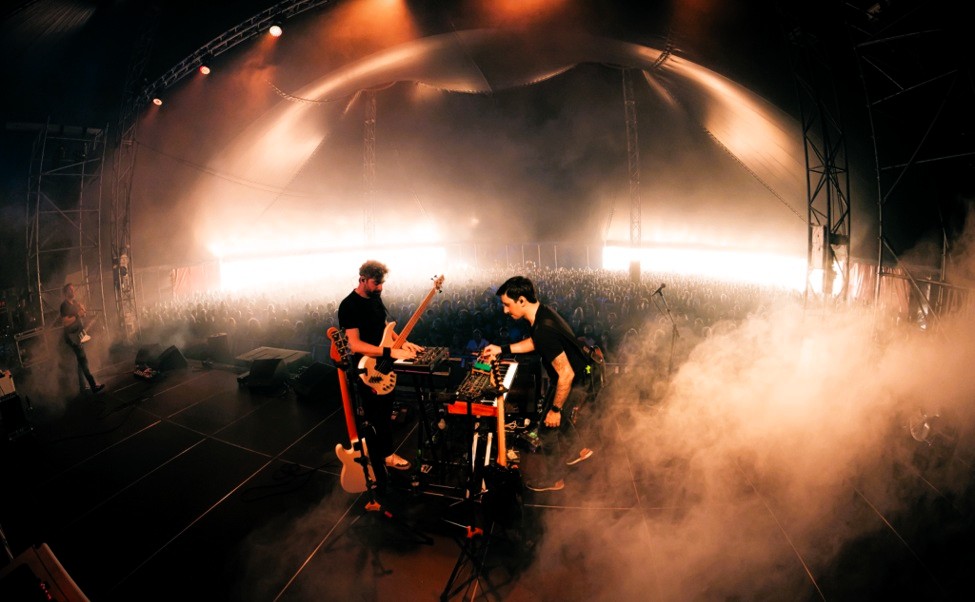
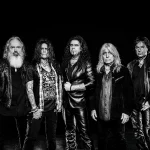
Photo: Jez Pennington
MAX: Yeah, and it’s something we are trying to do – I don’t know if we are doing it successfully, but we are trying to do something new on each album. And on this one, to bring some lower guitar tuning, more heavy songs, new drum playing, was a kind of a new step. And I think for me, it’s like the first album of the band now, also [because] of the name change and everything. But I think it’s a new way to follow for the future albums, maybe going deeper in this direction. I don’t know yet because we are not working on it yet, but we will see. But I think. . .
DIMITRI: That’s right. We. . . You said the same thing, so it’s okay.
E&D: So the sound of the album is quite sort of hopeful, right? Can you tell me a little bit about the themes, some of the inspiration behind the songs, and the theme and the meaning?
MAX: About the theme here, you mean?
E&D: Yeah, yeah. I think it has a hopeful sound to it.
MAX: Yeah, no. There is light and dark in this theme, because it came first because of some personal things that happened in our life, personally mine, something really bad. And we never experienced it before. We tried to work on the theme before writing music, because it helped to write music for us. And before, we always. . . we were always going in themes like more. . . how to say. . .
JC: The bigger theme?
JC: We wanted something perhaps more – not intimate, but more related to our life. And so, because what’s interesting is like, this album is talking a lot about our own experience, especially, as Maxime said, something happened personally to him. But what’s interesting with that, the previous albums were more generic, such as AI, such as. . .
MAX: And systemic.
E&D: So this album is more personal?
MAX: Yeah, more inside us.
JC: And this time we are trying to do this kind of stuff. It can be the inside of anyone in the audience. Everyone can identify perhaps himself to the theme that is important for us, but that can be also a theme that is important in our talking to the audience and our fans.
MAX: It’s a bit about mental health and the fight we can have with us, inside us. It’s not something really new or anything, but I think it’s something really important in the modern life we have. And mental health is something really important. It can be something really dangerous in the future for people, because of all of social networks and everything. All of mental health is. . . I don’t know how to say it, it’s super complicated. And we wanted to try to express this thing in the music. It’s always difficult for a theme because we don’t have lyrics and everything, not a lot. And we have to try to express this feeling mainly with music.
E&D: It’s interesting that you said dark and light. I think with the mental health theme, I think that’s really important, right?
DIMITRI: It’s a kind of a. . . it’s like a big polarity. You have like a phase of joyful and profound depression, being depressed. That’s the purpose of each song, to have a dark way of the song and a hopeful side of each track. At the beginning of the album, it’s more dark. It becomes a journey, it becomes more and full. But inside each track, there is a balance, maybe two ways to see something and to interpret something in each song. But that’s the purpose of the album, to have his own interpretation and different parts in a song.
E&D: That’s really interesting. You collaborated with Rebecca Need-Meanar on the recent album. How did that come about?
MAX: It came because we wrote a song coming from Dimitri, I guess, at the beginning. And we really liked the song, but we thought it missed something on it. Like, just – the song was great, but we missed something “lead”. And as we did on the previous album with Loïc from The Ocean, we told ourselves it would be nice to have a vocal featuring on this one. And I wanted, since a long time, to have a girl singing on a song – we never did that before. And at this time, I just listened to the album from i Häxa, I don’t know if you know the band there on Pelagic, and I was totally blown away by the album. The album is amazing and I really liked it.
And I was just thinking, maybe it would be nice to just ask if she could be interested to be in or not. And we just sent it, and the guys were okay, because we were seeking different people for the featuring. But Pelagic was something obvious, firstly. So we just contacted her by mail, sending the song, and she was directly okay. And we began to work by distance, because she lived in London and we were in Paris. And we did everything by mail and sending files. And we didn’t – we’ve never met in person yet.
JC: Maybe she doesn’t exist. Maybe it’s an AI?!
MAX: Yeah, maybe it’s an AI, we don’t know! But it was really a constructive thing, because on the previous album with Loïc, it was like one shot almost. We didn’t change a lot of things in the song, Loïc put his part on it, it was fine. With Rebecca, it was more exchange, more exchange with her. We ended up with some vocal parts and everything. And we gave the theme to her, she was the real reason for it.
DIMITRI: I really, really like the song. It’s a kind of in the middle of the album, because it brings something different. After some heavy songs at the beginning of the album. It’s a new way in the middle of the album.
E&D: I noticed you have changed the band name’s spelling – do you have a connection with Ukraine and, if so, has that changed in the recent geopolitical issues?
JC: Two things regarding that. It’s an important question, because everything is political, music especially. And we have to make a choice. It was the right time for on one hand, because the music, as we just discussed, has evolved. There is Jeremy joining us, so it’s the right time to change the name of the band. And on the other hand, because we are named Lost in Kyiv. We have an important fan base in Ukraine. And let’s be very honest, if the name of the band would be Lost in – I don’t know where – the fan base in Ukraine won’t be the same.
So, because this terrible war is now running for four years now. We had to do something. It’s not a lot, but the fact that we made this important choice to adopt the right spelling – we got a lot of positive vibes, a lot of love, let’s say, from our audience and fans in Ukraine. So, it was the right time, it was the right moment to do that. So, definitely we cannot be more happy about it. For these two reasons: it’s the right moment, new line-up. And the fact that the war is getting horrible day after day, and we had to do a little something. Music is political, so it was the perfect time. Let’s summarize with that.
E&D: I guess sometimes it could be not overly political, but music is always political, right?
JC: Yeah.
E&D: Right, last question. If you could collaborate with anybody, who would it be and why?
MAX: Anyone?
JC: Yesterday you were talking about someone.
MAX: Yeah, I don’t remember. A big producer, he’s doing everything now.
JC: Ah, it was Jordan Fish!
MAX: It could be fun, but it’s a bit exhausting because he’s really everywhere at the moment.
JC: Yeah, it can be interesting because Jordan Fish is interested in bands who evolve in every album, such as Bring Me the Horizon – you know, every new album of Bring Me the Horizon, there is something new. They never do the same thing. But in every album we try to bring something new on the table. So, it might be funny to have the opinion of Jordan Fish, you know.
JC: Is it Sleep Token? He’s a big fan of Sleep Token, you know.
[Band laughs]
JEREMY: For me, I have no idea because I like to be surprised. Rebecca was insane. It was just like that. Not something premeditated. We didn’t know if she was gonna agree to do something with us. And it was very intense. So, I like to be surprised.
E&D: Fantastic. Right. Thank you guys. I really appreciate your time
BAND: Thank you very much.
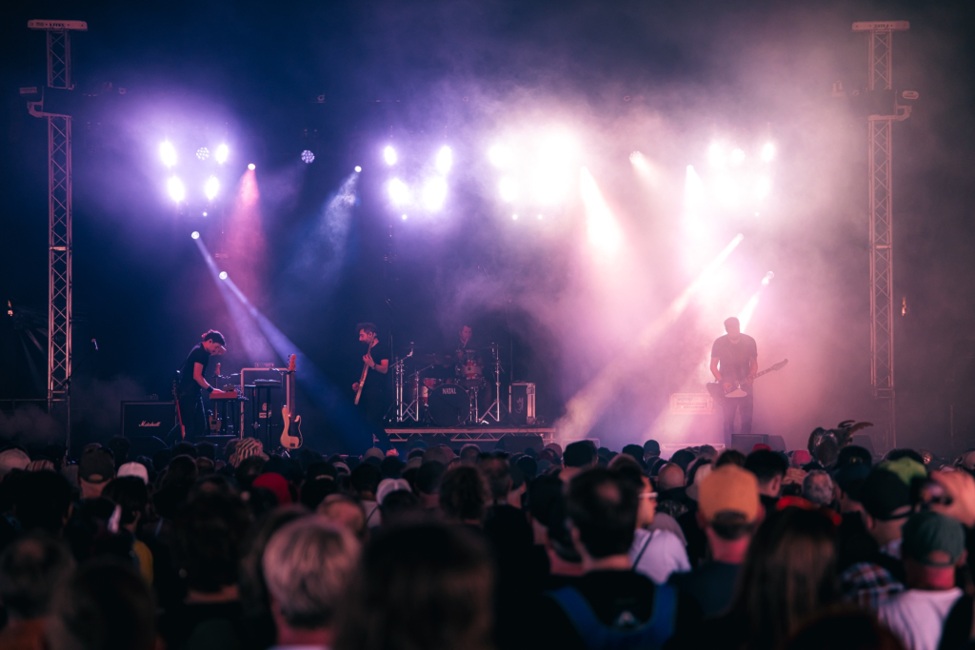
Photo: Jez Pennington
Header photo: Jez Pennington