Like an alternate soundtrack to Kaneto Shindo’s 1964 Japanese horror classic Onibaba, Steven Wilson’s solo work has always taken listeners on a roller-coaster ride through a variety of themes, dating back to 2008’s Insurgentes. From inner turmoil and serial killers to ghost stories, isolation, the brutal truths of fanaticism, online shopping addiction, the search for life’s inner truth, and journeys through the cosmos, Wilson has never been an artist who allows listeners to predict what comes next.
Whether you embrace his music or find yourself struggling to connect with it, Wilson has always been willing to take risks, challenge expectations, and venture into the unexpected. His ninth studio album, Requiem for a Village, is another example of that adventurous spirit. Conceived as a film for the ears, the album explores folklore, parallel villages, and archetypal characters through a series of interconnected stories. At its heart is a spoken-word narrative delivered by none other than David Tennant, bringing these strange and unsettling tales to life.
Released on the Fiction label, Requiem for a Village explores familiar Wilsonian territory while venturing into the imaginative depths of a horror film unfolding inside your head. With multi-instrumentalist Randy McStine, drummer Russell Holzman, and singer-songwriter Katherine Priddy lending their talents, Wilson assembles a formidable cast of musicians to help bring this village to life. Together, they create a surreal, twisted, and occasionally nightmarish environment that is sure to make your skin crawl.
Drawing on British folk horror, the television programmes Wilson watched during his youth, including Catweazle, Trumpton, and The Magic Roundabout, Requiem for a Village is far more than a challenging progressive rock album. It is a work that demands repeated listening, rewarding those willing to follow Wilson into the heart of the forest and encounter the surreal characters inhabiting his own imaginative storybook.
The folk-like chanting and surreal atmosphere of ‘Now Departing’ establish the album’s unsettling mood. By the time Wilson’s Leslie-treated vocal lines emerge on the fourth track, the music has prepared us for the nuns’ chaotic frenzy.
The rhythm section builds with an almost conspiratorial intensity, creating an atmosphere of plotting and scheming before the arrangement ascends into a twisted, gut-punching climax. It sounds as though Wilson could have written the track for Ken Russell’s controversial 1971 horror classic, The Devils.
You have to give Wilson credit for taking such risks, particularly in his exploration of witchcraft and the disturbing activities surrounding the nuns. Once the music begins firing on all cylinders, the pounding drums, enthralling guitar riffs, and clapping rhythms cut through the exorcism-like atmosphere. The result is an explosive, wah-wah-inflected improvisational passage that intensifies the track’s sense of madness.
By contrast, the mournful, bluesy, David Gilmour-esque textures of ‘Hiraeth’ evoke the slide-guitar sensibilities of Ry Cooder. There is a yearning quality to the arrangement, suggesting the desire to return home while remaining trapped in an inescapable environment. Its atmosphere brings to mind Donald Cammell and Nicolas Roeg’s cult classic Performance (1970), particularly the unsettling world surrounding Powis Square and the sense of dislocation that hangs over the film.
Between the title track and ‘On Chapel Slope’, Wilson creates the impression of continuing a musical journey that began with ‘Luminol’ and ‘The Tastemaker’ during the periods surrounding The Raven That Refused to Sing (And Other Stories) and The Future Bites. Here, gothic imagery collides with a surreal wedding procession seemingly drawn from the Victorian era.
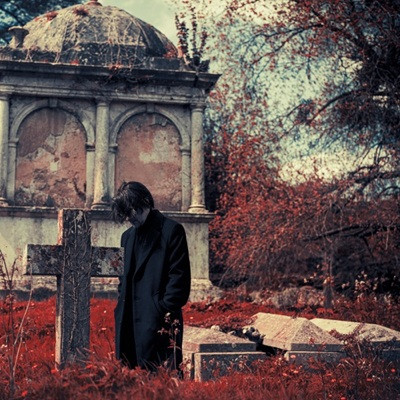
Figures emerge from their graves and make their way towards a chapel, where a wedding unlike any other awaits. The atmosphere has a distinctly steampunk quality before the music takes another unexpected turn, erupting into a trip-hop powder keg driven by muscular bass riffs and rapid-fire drumming. It is the sort of arrangement that keeps you on the edge of your seat, never quite knowing where Wilson will take you next.
Tennant brings his own distinctive approach to the narration, occasionally evoking the macabre storytelling style of the Crypt Keeper. His delivery gives each tale a poetic texture, guiding listeners through the strange events unfolding in the heart of the forest.
When the bells toll and the conga-like rhythms emerge at the beginning of ‘Swirl in a Lark’s Eye’, the effect is almost dreamlike. Yet this is no comforting dream. Instead, it feels like a disturbing vision of a once-inhabited place that has become a ghost town, shrouded in an eerie, distinctly British folk-horror atmosphere.
In Tennant’s narration, the village is described through a series of evocative images: “tear in a quail-packed quilt/fluffed and flattened farm gardens/diced by dark-hedged crosswords/hardened in the moon’s stare/standing stone, laying stone/sleep like the people”.
These words immediately establish that this is no place for the faint-hearted. The music reinforces the imagery with a soundscape that recalls Jimmy Campbell’s ‘Half-Baked’, before the recording gives way to static. It is an unsettling transition that leaves the listener suspended between the familiar and the inexplicable.
The synthesisers on ‘Murmuration’ create a doom-laden rumble that recalls the experimental textures of Jack Nitzsche’s work associated with Performance. The result is an eerie, almost post-apocalyptic atmosphere, with shades of the Berlin School of electronic music.
The opening minute and forty seconds alone are enough to make you uncomfortable as Tennant describes dreams and the removal of chains. Then Priddy and Wilson begin weaving a folk-horror narrative that evokes the likes of Trees, Comus, and Spirogyra.
Wilson’s affection for the British acid-folk sounds of the early 1970s is evident in the track’s ascending and descending acoustic-guitar patterns. The fingerpicking establishes an intimate, almost ritualistic atmosphere before the Mellotron begins to swell, filling the musical landscape like a dark, heavenly sky. Just when you think you have found your bearings, the music shifts again, leaving you uncertain about where the journey will lead.
It is worth remembering that Wilson invited Mellow Candle’s Clodagh Simonds to contribute vocals to ‘Significant Other’ on Insurgentes. Such collaborations reflect his appreciation for the musicians and musical traditions that have influenced him. His willingness to bring other artists into his world speaks to a genuine passion for music that extends far beyond the four-letter P-word: passion.
The closing section of ‘Murmuration’ brings to mind Bo Hansson’s Lord of the Rings. Priddy’s voice seems to drift alongside the dead, surrounded by echoing textures as she sings about what appears to be the living dead walking among the villagers. Eventually, the music fades into the darkness, leaving behind an atmosphere of dread.
As Wilson explained to Anil Prasad in an interview for Music Without Borders this year, “This is not beautiful, harmonic music”. Those words are worth keeping in mind. Requiem for a Village is not an album that reveals everything on the first listen. It demands patience, concentration, and a willingness to return to its strange world repeatedly.
With that in mind, let’s return to the music.
The click-track underpinning ‘A Basket of Bees’ suggests a continuation of the experimental approach Wilson explored on ‘Time Is Running Out’ from The Harmony Codex. An acoustic-electric arrangement initially establishes the mood before the drums and guitars deliver an explosive punch, with a rhythmic ferocity that recalls King Crimson. From there, the track becomes an exercise in experimentation, full of frantic cat-and-mouse exchanges and sudden changes in direction.
At times, the music feels as though Wilson has composed a score for a classic animated short by Tom and Jerry creators William Hanna and Joseph Barbera, or for one of the wild, anarchic Bugs Bunny cartoons produced during the Robert Clampett era of the 1940s. There are flashes of the manic energy associated with A Corny Concerto, Bugs Bunny Gets the Boid, and Falling Hare. The comparison might seem unusual, but the track’s unpredictable rhythms and cartoonishly explosive shifts make it an entertaining one.
The sombre piano arrangement of ‘Great Green Map’ offers a welcome change of pace. Wilson adopts a poetic, waltz-like structure to tell a tale of departure, loss, and the desire to leave no trace behind. The music flows like a quiet stream through the forest, creating an atmosphere that is peaceful and almost lullaby-like.
Yet beneath that tranquility lies a sense of unease. There is an understanding that the story has reached a certain resolution, but this is no conventional Hollywood happy ending. The music simply allows us to reflect on what has happened and consider the deeper meaning behind it.
Then the guitars begin to rev their engines on ‘Wheels’, and, as I have always said, all bets are off. The track conjures up the dramatic downfall of Grandier in The Devils, with accusations of sorcery, witchcraft, and sacrilege fuelling the unfolding conflict. Wilson’s music takes a dramatic detour, combining an in-your-face intensity with a mounting sense of tension.
The bass and lead guitar seem to engage in a heated dialogue, their improvisational lines competing and colliding as they reverberate through the sonic equivalent of Derek Jarman’s imposing fortress-like walls of Loudun. It is a powerful sequence that captures the atmosphere of persecution, religious fanaticism, and impending catastrophe that makes Russell’s film so disturbing.
The album finally draws to a close with ‘The Old God Is Buried’, where tolling bells, electronic conga-like rhythms, indistinct conversations, and distorted children’s voices combine to create one final unsettling soundscape. Tennant’s narration reminds us that the stories we have been told are not necessarily the end of the matter. Beneath the surface, there are further dangers waiting to emerge.
The result is an eruptive, chant-like nightmare from which you may never fully awaken. Rather than offering a neat conclusion, Wilson leaves us confronting the lingering mysteries of the village, its inhabitants, and the darkness that surrounds them.
Requiem for a Village is one of the most challenging albums Steven Wilson has unleashed in 2026. It took me multiple listens to begin appreciating the many layers of its musical and narrative construction.
I have had similar experiences with Captain Beefheart’s Trout Mask Replica, Magma’s Mëkanïk Dëstruktïẁ Kömmandöh, Electric Light Orchestra’s Out of the Blue, Faust’s The Faust Tapes, and Yes’ Tales from Topographic Oceans. Wilson’s latest work belongs in that same category of albums that demand time, patience, and repeated listening before their full character begins to emerge.
As with those records, your reaction may depend on how willing you are to embrace the unfamiliar. You may love it, or you may find yourself struggling to connect with it. Either way, Wilson deserves credit for having the courage to create such an imaginative, horror-inspired anthology, one that challenges the conventions of progressive rock while drawing upon the darker corners of British folklore, experimental music, and cult cinema.
Requiem for a Village is not simply an album to put on in the background. It is an invitation to enter a strange and unsettling world, to explore its chaos, madness, insanity, and wonder, and to confront the stories hidden within its shadows. By the time the final bells toll, Wilson has left us wandering through a nightmare that feels both ancient and disturbingly familiar.
And as November approaches, there could hardly be a more fitting time to venture into the village, follow its winding paths, and discover what horrors await beyond the trees.