Interview: Paul Masvidal
I felt like some ET race was just coming through: here it all is. Once I got it, all this hieroglyphic alien language, light codes came through. I felt like I was just this vessel, with these things passing through.
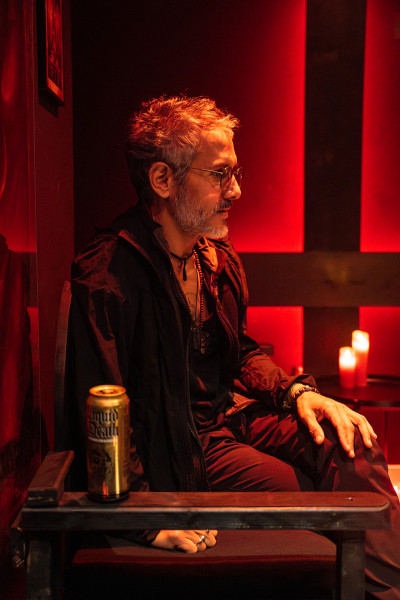
Deep below Camden High Street in a dimly-lit satanic temple may not be the most obvious choice of location to interview legendary Cynic frontman Paul Masvidal, a musician associated with Buddhism and spirituality. Even in his early days as guitarist for the incomparably-influential Death, Paul’s work was a far cry from the performative evil and gore obsession of most extreme metal bands.
But this subterranean lair was not just any satanic temple. Founded by Ben Dean and Chloe Marlow in 2023, Raven Records is a sober space that provides a haven for heavy metal addicts in need of vinyl but without the temptation of alcohol. Throughout the day, your E&D team – writer Joe Norman and photographer Talie Rose Eigeland – had various lovely chats with Ben about the shop, mental health, and heavy metal, all of which actually fit Paul’s vibe quite well.
Paul admired the space just as much as we did while Talie shot his portrait, and we all had a wide-reaching conversation, surrounded by red candles, Baphomet tapestries, and a formidable black throne-chair. Paul is a man who exudes calmness and kindness. During our conversation, he answered our questions carefully, with enthusiasm, and wit, taking in his musical and spiritual roots, his early days as a death metal punk, his songwriting process and journey as a vocalist, the queer metal community, as well as the solo career that he showcased later on at a very special matinee show in the Black Heart venue. *
E&D: So you played a show at Avebury last night, right? It’s obviously a very special place. How did it feel to play there?
Paul: Awesome! I wish I had more time there because we arrived, hit traffic leaving Bristol and kind of got in there, got set up and then the show happened as it started to get more dusky. The vibe is amazing. You know, I’ve been obsessed with that part of England for a long time. So I was just like a little kid there! Just, wow I’m here! Seeing all the sights and recognizing all the areas as we’ve been coming in. So I wanted to do a proper visit to that area again without my agenda, without having to work, to do a show.
E&D: It’s such a huge complex there.
Paul: Incredible history. It’s really fascinating, especially for me as I love the crop circle stuff; that’s the heart of it right there. Even during the set I made a whole bunch of notes and we started a discussion about all that stuff, which was a lot of fun. We kind of mixed it into the show – a nerd-out on crop circles!
E&D: There’s obviously quite a big neo-pagan community in that area. Do you see yourself as a pagan? Or is that not a term you identify with?
Paul: No; I don’t really identify with any specific school. I took my Buddhist vows a couple times and I’m a practitioner of Tibetan Buddhism. But that to me is more about a sitting practice, just sitting there working with your mind, you know? I appreciate all those different schools and traditions. I love that they go and have their little hippie gatherings on the solstices and the full moons. I definitely was raised that way with a bohemian mum, so that was part of my childhood.
E&D: Were you raised in a musical family?
Paul: Not musical. My dad was an arts major who ended up in business. But I have a great grandmother on my mom’s side who was a pianist. But other than that, I was the black sheep that ended up playing death metal in my teens. It’s not really in the line; the people who were doing that stuff were not making a living doing it as working musicians. But were obviously creative people.
E&D: Did you have lessons or are you a self-taught musician?
Paul: I had lessons, but I was a kind of a combo. My mom got me a teacher when she saw that I was serious – because I was pretty serious by 13. I started probably around 10. She got a teacher for me and I started doing classical and electric with a local guy in the city, Miami, where I grew up. So I was always interested in advancing and teachers – if you get good ones – to which I owe everything – showed me an incredible path to do the work. Ultimately, you have to apply yourself and do it on your own. They can only point things out along the way.

Photo: Talie Rose Eigeland
E&D: Thinking about your show tonight – we’ve just seen your beautiful mask. I’d love to hear about why you choose to perform in a mask. Why that one in particular?
Paul: It was really a spontaneous moment of inspiration because I had started promoting this music, Mythical Human Vessel in 2020. I was on tour opening for Anathema; we started the tour in the first week of March. Five shows in – we did a bunch of UK dates, Paris and then we ended up in Portugal – that was the last show. And everything shut down. It was really a 25-day tour, and I was in a different space with this material then: my drummer had just died. I was grieving. It’s so interesting because now my father just passed. It’s so interesting how this music merges with grief processes. But with that tour – just when I was getting into the groove – everything shut down, you know?
I was in the UK when it all happened. We drove back to Germany, dropped off a bunch of merch, and then I stayed in the UK for about a month. It was barren; it was amazing. I loved it actually: just to be on the streets and there was no one. Where were you guys in 2020? Were you here?
E&D: Yes, here in London. It was so quiet! That never happens!
Paul: I remember going to Piccadilly and there was no-one. It was so cool!
Paul: When I was really cultivating what the show would be, it all shut down and now we’re all picking up the pieces from that. So I went to revisit this idea of doing solo shows and kind of bringing this music back. Also, Aeon Spoke’s music never really got properly toured; we did some shows here and there, but that project dissolved quickly. So, I’m unearthing things that I think hold up.
[The mask] just happened. I was with a friend thinking about Mythical Human Vessel conceptually. It’s more about a reflection that the music represents than an identity. It represents a shadow figure of the psyche. There’s no one here essentially: I’m just representing some kind of archetypal energy. And it feels really natural, I don’t know why. It’s not like the music is super haunting or dark. It has those moments, but it goes hand-in-hand in a curious way. So much of the music is melancholic and heartfelt: the mask represents those crevices of the heart.
I love that kind of art where you’re transported and taken on a journey – especially in a live context – where it creates more of an environment aesthetically rather than just some dude playing the tunes. I do take it off sometimes, too, especially if I’m talking to the audience. I don’t hold the character rigidly; I’m pretty relaxed about it.
E&D: How do you go about selecting your set list for this tour?
Paul: I’m changing it every night. I go by the vibe in the room. I have probably like 35 songs that I can go between. And every night’s been something different. There’s some key stuff that I’m always touching into because I feel it holds the general environment. But I’m going “ohh, should I pick it up? Should I drop it down?” just depending on what’s happening in the room. Generally, it starts out really introspective, dirgey and slow, and then it just slowly builds up; and by the end it’s kinda rocking!
E&D: When you play material solo that you wrote with a band, is there a lot of rearrangement required?
Paul: Yeah. Even the Cynic stuff is written on acoustic guitar for the most part – maybe piano – but it’s pretty much always written in a really bare bones context. Mythical Human Vessel stuff is really released that way. There’s maybe three songs with drums and bass, but the rest is pretty stark. It stays true to how it was originally written. But even in the context of Cynic, for example, I have these baby, raw embryonic versions of the songs. And then I bring it into a band context to arrange it as a Cynic song – making it more progressive and experimental. But the roots of the songs are pretty consistently the same.
What I found is that, if you have a good idea, you can take it anywhere you want – produce it however you wish. And Cynic has a sound that I can produce and make something Cynic-y. Bring in some vocoder, play the riffs a certain way and there’s that Cynic tone. Some of the Æon Spoke acoustic stuff was brought into Cynic. There’s a handful of songs that started out really bare bones and then somehow made sense in the Cynic space.
E&D: It’s such a treat to get to hear songs like ‘Integral’ which I really latched on to – hearing the stripped-back version, as well the metal version with Cynic earlier in the year.
Paul: I like to do that. I’m getting more comfortable with exposing the roots. I always felt like, these are not fully realized ideas and I’ve been reluctant to show that because it feels so vulnerable. But now I’m like, oh, it’s cool because people can hear the journey of how it became an official release. But those demos – especially ‘Integral’ – it’s like so raw, you feel so naked. But that’s the whole point: to expose the raw bloody heart of the thing, you know?

Photo: Talie Rose Eigeland
E&D: Thinking about your vocal journey – when did you start using the vocoder?
Paul: I used it because I was growling in Cynic in the early days – by the ‘91 demo I was full death metal. But it wrecked my throat. I really wasn’t doing it properly and I think I was doing it purely out of sheer angst. Working through my trauma; just really belting it and it was not working for me. That’s why I didn’t end up growling on Focus. I got a friend that kind of sounded like me: Tony Teegarden – he did an amazing job. Then I realized I wanted to bring a melodic element into the music and I didn’t feel secure as a singer. I didn’t really know how to sing; I didn’t know what my voice was. And I knew that I didn’t want a power metal operatic vocal. And, for Cynic, I was like, I don’t know what’s gonna work with this.
Then I stumbled on this old Digitech pedal that had a vocoder setting, and made these weird sounds that were very problematic, but in a cool way. I heard it as this weird alien intelligence creature over this music, which is really weird as well. So it just kind of merged and meshed in all the right ways in contrast to the heavier vocals – like shadow light characters. I was hiding behind it because I didn’t feel secure as a singer. But over time I really loved what it did and it became something of a signature thing. There were records like Kindly Bent to Free Us where I stripped it back a lot.
Over the years I grew to love singing and I found that it’s a really therapeutic thing for me to just sing the words. I always say I’m not a singer: I’m a guitar player that happens to sing.
But I do connect with singing; it brings me back to early childhood, being a little boy humming melodies and being with my mom and doing these old folk songs and soft rock songs. It has that magical childhood place for me, so it’s really therapeutic.
E&D: I’m always interested in the creative process because it’s so idiosyncratic. Do you start with a concept and write lyrics? And match the music to that? Maybe you begin with a bank of riffs?
Paul: I’ll start with saying I have no idea what I’m doing! [Laughs] I’m completely in the darkness fumbling, and I show up, and I create space for it. Then I see what arises as a result of that. I mean it’s the edge of terror every time! I never feel secure in this process. I know when it’s right and when it feels like something genuine is happening and I kind of follow that lead. But for the most part, it really is such an amorphous, ambiguous thing, creativity and art. I have no idea where these sounds are coming from! I can’t claim ownership of it. It passes through and I try to capture something that feels genuine and then you just get it down. I don’t feel like I’m controlling it or I’ve got a hold of it at all.
What I’ve realized is – when I get that “this is cool state” – it’s because I’ve created space for it to come through. It’s not my ego directing. I’m open enough to let this information through. The songs are bleeding heart kind of stuff, but I don’t feel like I can claim ownership. It belongs to everybody else too, especially once you release it; then I don’t have anything to do with this anymore. Live especially, it’s nice because there’s that reflective process, you hear them differently in a live context. It’s more visceral, right? It hits your body differently. We’re arranging sound molecules. I’m still in awe of the whole thing, you know?
E&D: I wanted to ask about Ascension Codes. I love that album, especially the contrast between the ambient tracks and the more band-orientated tracks. Could you tell us something about how you came to assemble the album like that?

Photo: Talie Rose Eigeland
Paul: Records are really daunting tasks for me. It’s like writing a novel or something, especially Cynic’s music because it’s so dense. Other people don’t realize this, other than guitar players that try learning the music! They go, holy shit! This stuff is really hard! I don’t know why we make it so hard on ourselves. That’s just what’s coming through.
But it definitely was a record that had these very simplistic roots. And then I knew it needed this weird slender thread to connect all the dots because the ideas were emerging, but I didn’t know what it was. And then the codes came in and I was like, what are the codes? And again, you’re just creating a space. I felt like some ET race was just coming through: here it all is. Once I got it, all this hieroglyphic alien language, light codes came through. I felt like I was just this vessel, [with these things] passing through.
I get so neurotic about the details that no one will ever care about. When I meet the occasional fan who’s trying to break it down, I’m like I love you!
So that record was also through a lot of hardship. I lost my bass player right when we were gonna do the deep dive, and start going further into the work. He takes off, goes missing for a long period of time and then takes his own life. That year 2020 was such a. . . it just, you know, completely gutted me to the core. And so that record does feel almost weirdly alien and from another dimension. As alien as it is, there’s a lot of heart there: it’s not just all a cold, weird alien world. It needed the pain, the bleeding heart. . .
That record again, it’s so dense, each song could be like eight songs. If you really deconstruct it, there’s so many textures and parts that are all worlds within worlds. But they’re all simple songs underneath.
But I love the record. I think it’s the coolest thing Cynic’s ever done; it just may take a while for people to get it. So I appreciate you saying that!
E&D: That’s always my favourite music – where you can listen to it throughout your life, for years, and you can always hear something new.
Paul: Yeah! Me too; I love those records. It’s like you have to earn them! A lot of stuff, if you get it really quick, which is not bad, but pop music or really extreme heavier death metal stuff, you burn out really fast. You don’t want to listen to it again. But those records that pull you in, you just want to keep listening, you’re hearing all the details – I love that stuff!
E&D: I listen to a podcast called Weird Studies, about esotericism, occulture, weirdness in culture. They distinguish between art and art’s sake – motivated by making something beautiful – and what they call art as magical practice – something that’s part of a process of self-transformation, self-actualization. I see your art in the latter category – do you agree?
Paul: Oh absolutely. There is the art-for-art’s sake component in that desire to just make it work, not thinking about a record company or the public. You’re just in this mission to translate whatever’s coming through as accurately as possible, painstakingly. But in the end, it is like a cathartic transformational journey. I’m a big fan of transformational art: this idea of taking someone, or your own self on a journey. So then you start somewhere and you end somewhere else and you have insights and it’s an internal process as much as an external one. This inner-to-outer motion is a beautiful thing.
E&D: Was your artistic practice always like that? In the early days when you were very much in the death metal scene?
Paul: Oh no, in my early days I was a little punk! [Laughs] I was just like fuck the world and fuck everybody. Even on the early Cynic demos, the lyrics were very political and I was really at war with the outer worlds. And then I realized the war is within; you gotta conquer your own mind before you can start pointing the finger out there, and that everything’s essentially a reflection of where you’re at. So, once I turned that around, I had to make friends with this guy, you know? That’s when everything shifted. That was pre-Focus.
I was always a spiritual kid, interested in esoteric things. My mom used to take me to occult book stores in Miami when I was a kid. She’s like buy whatever you want. I was really into sci-fi writers, Philip Dick and Ray Bradbury. Then I was trying to rebel because I wanted to get my mother’s attention; I couldn’t shock her. So I bought The Satanic Bible…
E&D: Yeah, I did too! [Laughs]
Paul: I used to wear an inverted cross and spit on churches. And my mom wasn’t phased at all. [Laughs] She was just like, do your thing, you know, learn, learn about the world! And I was like, it was amazing that she had the insight – she saw that I had to work through all these processes to arrive. It ended up being more of a spiritual practice, which is about the light. But you have to go into the darkness, then you go post polarities, you go post dark and light, you realize it’s all happening. It’s not just one thing or the other. It’s all about what story you want to tell around experience. You take yourself out of it and just observe things. I think that’s the beauty of a meditation practice: you start to catch the stories that you’re telling yourself constantly and how they’re not really true.
You have to become an observer of your own mind. It teaches you how to be present for life, which is not good or bad. It’s just happening – just “isness”, which is an ongoing practice. It’s a constant thing that I’m working on right now. Just kind of slowly doing more of the inner work and trying to really bring that to light. And I found that that makes for more interesting lyrics as well because people can reflect themselves and start to talk about your own stuff and you realize if you’re telling the truth, everybody’s dealing with the same stuff at the end of the day. So, the closer you can get to that, the more everyone’s gonna relate.

Photo; Talie Rose Eigeland
E&D: Are you conscious of having a queer fanbase?
Paul: You know, I want to see more of it because I feel like it’s always been hard, especially coming up and building a career in the metal scene. This was really hard. And I heard so much homophobic stuff as a kid. It freaked us out, you know, especially Sean and I, because we were gay and we knew it and every other word is like “it’s so gay.”
Or it was just all the macho stuff in the metal scene and we weren’t connecting with that. We’re wearing colourful clothes [laughs] and were nerdy, queer, creative kids that happened to be interested in heavy music. So it was definitely challenging and when we did this story – we did a public coming out. (We were already out back in the day to our friends and peers and colleagues.) But when we did this coming out story, when Kindly Bent to Free Us came out, it was actually on the cover of The New York Times.
I remember we did this U.S. tour right after that and I started to see a queer metal presence I’d never seen before. And suddenly they had permission to represent in the room. And that’s when I realized the value of what we just did. I always thought, I don’t want to become the gay metal band – we’re gonna suddenly be pigeon-holed because we were musicians first. But then it was like, we’re doing this for everybody else; this is about everybody else having permission to exist in this space.
And so, I’m more and more wanting to connect with the community because I feel we need more representation. It’s like there isn’t a lot of us out there there! It’s still a massive minority, especially in extreme areas of music. I mean, gays are generally – you know, pop and dance and all that, and I’ve never connected with that culture. I’ve always been more of a subversive, underground. . . I like dark wave, if you get me into poppy, queer sound. But really flimsy dancey pop stuff [laughs] doesn’t work for me. It has to be more like weird industrial kitchen or something – with some edge to it. I think also that’s the musician in me being such a snob; I want something that has some musical integrity to it. E&D: With some layers to it! Paul: Yeah some layers! So much of Cynic’s music came out of that hardship and is informed by being queer. A heteronormative person will be like, well, how’s your sexuality part of the equation? Until you grew up as a gay person in a world where there was no representation and you felt like a complete outsider – you’ll never understand. It’s a big part of the sound. I think more and more queer people will connect with it and see it. But I’m trying to bring them into our world. Recently, I met a fan that I’ve mentored – I just want to create opportunities for queer tribes. It’s generally a hetero scene, especially in metal. But we’ve come a long way, compared to where we were, and it’s not as gnarly; it was really rough. Now kids are growing up with representation and it’s on TV and it’s kind of pop culture, and look at the flags everywhere. Now we have Pride Month, and I’m not a big fan of that word because I feel like it’s.. . . beyond that. For us, it’s more about acceptance and self love. Like this place I played in two nights ago in Bristol [the Gryphon]. The guy who took over this club, he said it was a gay bar that became a metal bar. He converted it but he’s still representing queer community. Twenty years ago they would have gutted any sign of queerness and just like made it a metal thing. That’s so right now. E&D: So, my final question. What’s next for you? What music are you working on at the moment? Paul: Next is the marathon – preparing for the Olympics with Cynic’s music. We’re doing an August run in Europe. The first show is Rockstadt in Romania. Basically July is – we’re trying to create a whole new set – post-Focus, bring in more Ascension Codes. We have a lot of work to do, so my July is Cynic mode and then August, three weeks in Europe and then some one-off shows. I like to keep balancing these two worlds because they’re so different. We’ve been on the road, on-and-off, for like 19 months, so I am ready to just go back into a different creative space. Live is creative as well, it’s just a different energy. I’m always writing and I want to really get more into cultivating these little ideas that are floating around and just see what happens. I don’t know what’s gonna happen, but I feel the calling to just go back in there and just create the space for it.
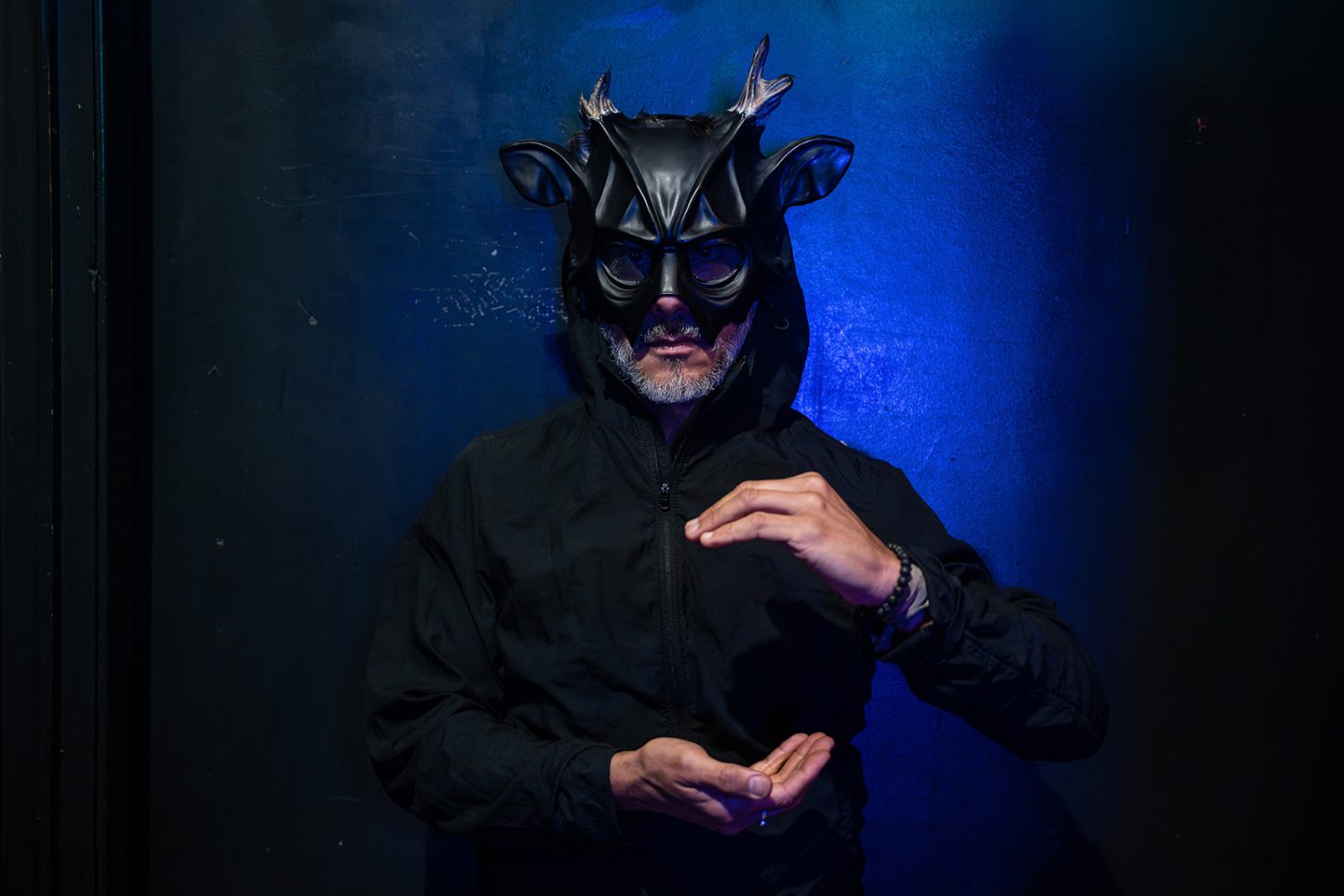
Photo: Talie Rose Eigeland