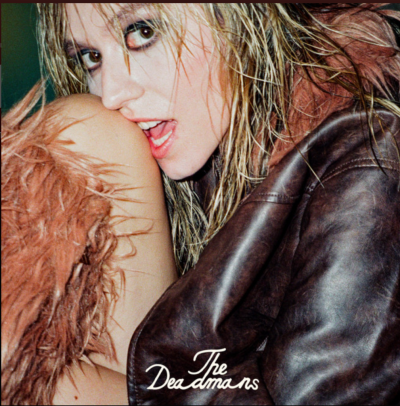
“The core concept behind The Deadmans universe is imagining a world of joyful liberation and belonging for gentle misfits,” says LaurenSage Browning — and that idea becomes the organising principle of The Deadmans’ self-titled debut. The young international alt-pop collective offers the listener not simply ten songs, but a 30-minute audio play populated by its own characters and scenes, from an escape from a Hollywood party to a date in a London cemetery. They have created an imagined world for soft, sensitive outsiders — and the deeper one moves through it, the harder it becomes not to ask why the music itself is not always as free, strange, and exposed as the people it addresses.
The album does not belong to any specific scene. It was made across four countries. Guitar in hand, Harry Deadman recorded demos in Australia. In France, Browning began sketching the first drafts of the lyrics with a playwright’s sense of structure. “Our songs all have story arcs and character development embedded in them. The overall shape of the album is also based on an act structure (Act 1: Escape, Act 2: Rage, Act 3: Catharsis),” the songwriter says. Yet within the music itself, that theatricality still functions mostly at the level of dramaturgy. The full scale of the idea opens up in the project’s visual dimension — in the videos and in The Deadmans’ first live performance at London’s Electrowerkz, where the album was presented as a hybrid of concert, gallery exhibition, and staged performance.
The first act, opening with ‘Nice Kid’, introduces the album through the aesthetic of a Hollywood party and the image of escape: fast, energetic, yet light and liberating. The song itself sounds exactly like that: it hooks you from the opening seconds and lingers not only because of its melody, but because it so precisely captures the feeling of a character who seems out of place, caught in the wrong scene. What makes it resonate is the atmosphere it builds — the strangely familiar position of being an observer among people, noise, and other people’s joy, present in the room but not quite belonging to it.
The second track carries that idea forward, adding the difficulty of relationships and the work of freeing oneself from attachment to loved ones. The final scene of the first act is ‘She’s Not Me’, a track in which external escape finally turns inward. The lightness that carried ‘Nice Kid’ is gone: the pace slows, the atmosphere grows heavier and more strained. Nikki DeParis sings of personal metamorphosis, depression, and depersonalisation.
It is here, too, that the fragility of The Deadmans’ theatrical model first becomes visible. Nikki DeParis is not simply a singer performing Browning’s lyrics; she is an actress asked to turn someone else’s autobiographical material into her own emotional experience. In the first half of the track she still seems to be searching for the right emotional thread — and only truly finds it with the line “I worry about getting older”, after which the voice finally acquires sharper accents and a more expressive play of intonation.
DeParis’ role in this structure is crucial. “Releasing the writing to Nikki to embody allowed me to be infinitely more honest and drastically less calculated,” Browning admits. She also describes the album as her most autobiographical work: “This piece is my most autobiographical ever. It leans heavily on my real life and the real people in it. I didn’t change the names or facts at all which is a brand new experience for me.” In other words, one person’s experiences, memories, and private history come to rest in another person’s voice. But DeParis was not chosen by chance. She and Browning studied together, worked on experimental theatre projects, and over time Nikki became not merely a vocalist but Browning’s muse — someone she could trust to embody her most personal material.
DeParis’ power, however, is not reducible to her closeness with Browning or to the trust between them. Her chief strength lies in a quick, high-energy vocal delivery paired with exceptionally clear articulation. “Nikki chews through words at an incredible rate,” says Browning of how DeParis changed the dynamic on her arrival. “In our vocal demo sessions she would often look up over the mic at me and just say ‘I need more words,’ prompting me to write new, more spontaneous lyrics—a lot of which are my favourite of the album because they’re so instinctual.”
One can only imagine how different the earliest demos sounded before DeParis’ quick, articulate delivery accelerated the songs and gave them their forward momentum. Acceleration plays a decisive role across the album: The Deadmans are at their best when working in the register of energy, propulsion, and inner charge. That is why, to my ear, ‘Darling’ is one of the band’s strongest songs, alongside the opening two tracks.
By contrast, the album loses a significant part of its force in the slower compositions. Most of the tracks already rest on a fairly predictable rhythmic framework: the songs are held inside a clear verse-chorus pop structure and rarely try to destabilise it. In the faster, more energetic songs, this weakness can still read as directness and simplicity, as the listener’s attention is pulled toward the sheer momentum. By the end of the album, however, the slower songs no longer hold the more demanding listener. Once drive and motion drop away, the ear begins to focus more closely on melody and voice — and it becomes clear that both need greater expressive range. These tracks rarely offer an unexpected turn, or anything that would sharply distinguish them from any number of other alt-pop releases. They grow dull after the first minute because the second hardly differs from the first. That monotony is only underlined by the polish of the production: the album needs more roughness, accident, and risk — the kind of friction that would make it less convenient and tidy, but more alive.
Still, The Deadmans have enough songs that land immediately through their hooks: the album never collapses into the feeling of one song smeared across its whole running time. On the contrary, in the opening stretch and in its most energetic moments, the group knows how to establish a song’s character quickly and gather attention around it. Nikki DeParis clearly has a greater expressive range than the album always allows her, and I would have liked to hear her voice given more freedom and more room to move — both in the music itself and in the way the songs organise their texts. That feels possible because behind this album there is a genuinely alive creative process, which Browning describes plainly: “everyone who creatively contributed to this project did so because there’s nothing we love more than making art.” There lies the band’s greatest strength, and also its central contradiction. Their method already feels free, alive, and independent; their music, for now, only reaches that same looseness from time to time. For that reason, The Deadmans’ debut feels to me less like a finished statement than an attempt charged with considerable, still not fully realised potential.