When King Crimson performed in New York City for the first time on November 21st and 22nd in 1969, at the legendary Fillmore East, they were riding the momentum of their breakthrough debut, In the Court of the Crimson King. Those performances marked a major milestone in the band’s history.
Having built their reputation through word of mouth, their first American tour proved to be a turning point in establishing King Crimson as one of the most adventurous and influential bands of the era. Sharing the bill over those two nights were The Voices of East Harlem, Joe Cocker and the Grease Band, and Peter Green’s Fleetwood Mac.
From those landmark performances in 1969 to the Islands era in 1971, and then to the band’s creative peak with John Wetton in 1974, New York remained a significant stop in King Crimson’s journey. Their July 1, 1974, performance in Central Park at the Schaefer Music Festival would become the band’s final concert before they disbanded, they were playing ‘Starless’ from what would become their seventh and final studio album of that era, Red.
When King Crimson returned in the 1980s with the Adrian Belew lineup, bringing their futuristic tribal sound into post-punk and new wave territory, and later through the 1990s and early 2000s, the Big Apple continued to play an important role in the band’s history. Fast forward to 2008, when Porcupine Tree drummer Gavin Harrison joined the band as part of a short-lived quintet lineup.
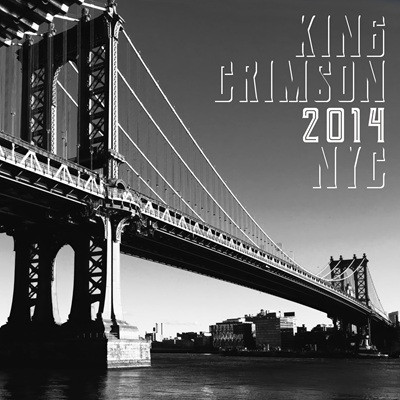
After another hiatus, King Crimson returned in 2014 as the formidable seven-piece “seven-headed beast“, performing four sold-out nights at the Best Buy Theater. This two-CD set captures those remarkable performances, showcasing a band whose power, intensity, and musical ambition remained undiminished under the direction of founder Robert Fripp.
Despite the many lineup changes throughout King Crimson’s history, Fripp has always remained a demanding bandleader, carefully shaped every aspect of the group’s performances while continually challenged his musicians to push beyond their limits. The 2014 lineup, Fripp, Jakko Jakszyk, Mel Collins, Tony Levin, Gavin Harrison, Pat Mastelotto, and the dearly missed Bill Rieflin, was more than a gathering of exceptional players. As Fripp described it, the band represented a new “point of seeing,” transforming rhythm into “a moving, interlocked engine“.
These performances weren’t simply about revisiting beloved classics; they re-imagined King Crimson’s catalog as living, evolving music, performed with renewed purpose, precision, and imagination. Rather than treating these songs as a greatest-hits package, the band approached them as living works, examining every detail with microscopic attention.
The three-drummer lineup of Bill Rieflin, Pat Mastelotto, and Gavin Harrison provides an overwhelming rhythmic force, unleashing a relentless energy that echoes throughout the heart of the Big Apple. That power is especially evident on ‘Pictures of a City’, ‘The Sailor’s Tale’, the tidal surge of ‘The Talking Drum’, and the tribal percussive assault of ‘Banshee Legs Bell Hassle’ and ‘The Hell Hounds of Krim’.
The chemistry between these three percussive masters is nothing short of astonishing. The New York audiences weren’t simply attending another concert, they were witnessing something extraordinary unfold before their eyes, the kind of performance that leaves people eager to tell others what they had experienced.
Nowhere is that more apparent than on ‘Level Five’, where Fripp’s blistering guitar work collides with the band’s stop-and-go rhythmic attacks in a whirlwind of controlled chaos. Every twist, counterattack, and sudden shift reinforces the feeling that King Crimson never retreats, they push relentlessly forward.
The musical partnership between Fripp and Mel Collins also rekindles the spirit of the In the Wake of Poseidon, Lizard, and Islands eras. Together, they transform their instruments into snarling, unpredictable creatures, conjuring an atmosphere that feels as unsettling as a classic giallo or slasher film. Their interplay creates an eerie, cinematic texture, proving that King Crimson can evoke the tension and dread of a horror soundtrack without ever abandoning its progressive rock identity.
Whatever listeners may think of Jakko Jakszyk’s role as King Crimson’s vocalist, there’s no denying the sincerity he brings to every performance. He pours his heart and soul into each song, whether navigating the haunting, jazz-inflected passages of ‘The Letters,’ capturing the smoky, mellotron-soaked atmosphere of ‘The Light of Day’, or embracing the Eno-esque ambience of ‘A Scarcity of Miracles’.
The latter also serves as a reminder of the 2011 collaboration between Jakszyk, Robert Fripp, Mel Collins, Tony Levin, and Gavin Harrison, a project that ultimately laid the foundation for this remarkable incarnation of King Crimson. The moment the mellotron announces the opening notes of ‘Starless,’ the audience erupts in applause, already knowing they’re about to witness one of King Crimson’s defining masterpieces.
The band eases into the song’s mysterious, almost lullaby-like beauty with remarkable patience, allowing every note to breathe. Jakko Jakszyk’s reverb-soaked vocal performance is filled with genuine emotion, paying heartfelt tribute to music he grew up admiring while making the song unmistakably his own.
As the performance gradually builds, the three-drummer team of Bill Rieflin, Pat Mastelotto, and Gavin Harrison lock onto Robert Fripp’s spiraling guitar lines and Tony Levin’s unwavering bass, maintaining flawless precision as the tension steadily mounts. Their rhythmic interplay recalls the spirit of Bill Bruford’s legendary work during King Crimson’s celebrated 1972–74 period, yet it never feels like imitation.
Instead, they reshape that legacy into something uniquely their own. You can almost feel the temperature rising as the music transforms into an overwhelming force, evoking the larger-than-life spectacle of the Fleischer Studios Superman classics, particularly Terror on the Midway and The Arctic Giant.
The final four minutes of ‘Starless’ become a breathtaking release of energy. The relentless pulse, Fripp’s hypnotic guitar figure, and the immense rhythmic power of the three drummers create an intensity that feels almost cinematic, as though King Crimson had composed an alternate soundtrack to one of those Fleischer masterpieces. The audience is swept along on a thrilling roller coaster of controlled chaos before rewarding the band with thunderous applause.
That same cinematic intensity carries into the two-part epic ‘Larks’ Tongues in Aspic’, a composition that has lost none of its power over the decades. The percussion team channels the adventurous spirit of Jamie Muir, embracing his fearless approach to rhythm while forging a new identity of their own.
Fripp’s guitar becomes the centrepiece of a relentless cat-and-mouse chase, the groove tightening with every passing measure until Mel Collins’ haunting flute improvisation emerges like a ghostly presence, sending chills throughout the Best Buy Theater. Part II explodes with unstoppable momentum, recalling the destructive force of The Arctic Giant as an unstoppable monster tears through a city.
It’s exhilarating enough that one can’t help but wonder how perfectly it might synchronise with the Fleischer cartoon itself. By the time the band launches into the closing ‘21st Century Schizoid Man,’ complete with its updated lyrical twist, King Crimson delivers one final explosion of controlled mayhem. The stop-and-go precision, the furious interplay, and the sheer intensity remind everyone why this song remains one of futuristic tribal rock’s greatest finales.
Listening back to these four New York performances, what becomes most striking isn’t simply the brilliance of the musicianship, it’s the collective commitment of all seven players. Every performance feels purposeful, every arrangement carefully considered, and every familiar composition renewed with fresh ideas and fearless conviction. Rather than presenting a retrospective, this incarnation of King Crimson treated its catalog as a living body of work, constantly evolving with every performance.
This is more than a document of four remarkable concerts. It captures a band that refused to become a legacy act, continually challenging both itself and its audience while proving that progressive rock could still be unpredictable, dangerous, and utterly exhilarating. It’s a concert experience that leaves you wanting to return immediately, discovering new details with every listen and wondering where King Crimson might have ventured next had the journey continued.
Sid Smith perhaps summarises it best in the closing liner notes: “This is not nostalgia, but rather a band pushing forwards. For these seven players, nowhere is off limits or out of bounds“. Those words perfectly encapsulate what makes these performances so extraordinary.
Rather than looking backward, King Crimson embraced its past only as a foundation for creating something vibrant, fearless, and unmistakably alive. As a live document, these recordings stand among the finest of the band’s final era, a fitting testament to Robert Fripp’s enduring vision and to a group of musicians who never stopped exploring the outer limits of their own music.