Fanboy warning! Regular readers of E&D will know that I like Arbouretum a bit, well, OK a lot, in fact they may be just about my favourite band currently making music. So when the opportunity came about to not only interview them face to face while they were over here for a tour and to play Thrill Jockey’s 20th anniversary show, but to do it round the corner from my house in one of my favourite local pubs, I couldn’t really say no now, could I?
(((O))): The songs on the new album seem slightly restrained by your standards, no wonderfully rambling epics like ‘Song Of The Nile’ or ‘The Rise’, was that a conscious decision to rein it & be more concise?
Dave: Yes, it sort of was. If there had been any songs that had really called for it, when we were writing, we would have gone there; we wouldn’t have cut them short. But it was an attempt to try something different to the last record. Just for that reason – just to try something different; why not? You have to keep trying different things.
(((O))): Do you have any plans to go back the other way? Something like the Coil Sea album again?
Dave: Maybe, yeah – who knows? I see our music as spiralling around a centre that’s not really there when you try to put your finger on it. In that spiral, it goes in different places, but there’s an acceptable range of motion you can have and still be called Arboretum.
(((O))): So following on from that, how do you write as a band?
Dave: From The Gathering, Song of the Nile was something that happened out of us jamming together. A lot of stuff is like we’ll jam, get into something, go back and listen to it and point out bits that we like and work on those. On this record, ‘Easter Island’ was something we came up with in practise and it really felt good, but everything I tried to do in terms of trying to put a vocal melody over it didn’t really work, so we just left that. But sometimes I’ll sit around with an acoustic guitar and a recorder and bring something to the guys and if people think we can work with it, we’ll construct the song from there, meandering around through different versions.
(((O))): One thing I’ve been dying to ask Dave; your guitar sound. I don’t know what it is but it does something to my brain that no other band does.
Dave: Oh wow, thanks.
(((O))): I’m not a guitarist, but is there any way, without giving away state secrets that you can explain how you make that noise?
Dave: No. Haha. I mean, I can tell you on the surface what it is – it’s me playing a Martin EM18 through a Snarling Dogs distortion pedal – it goes through one or sometimes two amps. But I dunno, it’s tough to answer that question. It is something I spend a lot of time on, trying to play guitar better, and the sound itself…well that’s probably something I’ve spent more money than time on!
There’s no magical stuff that goes into it – it’s little things, certain vibes that I think might get me to the sound that’s in my head.
(((O))): So, we’ve got a couple of questions from readers.
Dave: From who?
(((O))): From readers. I know, it’s weird, I only thought we had one!
Nathalie wants to know: Carl Jungs red book gave a lot of inspiration of creating “The Gathering”, but what was the biggest source of inspiration for the new record?
Dave: There isn’t really a similar thing on the new album. Even with ‘The Gathering’, it wasn’t a Carl Jung theme album or anything, but there’s nothing like that on this album, no overarching theme. One song was inspired by a book – ‘Renouncer’ was inspired by Afterlives of the Saints. [It emerges that the rest of the band haven’t read said book]. Well, the words were inspired by it. The words come from Dave’s head, his dark place, and the music comes from somewhere deep within all of us. ‘The Promise’ is based on a folk song – The Demon Lover, also called House Carpenter; that’s the more famous version. It’s an English folk song I think.

(((O))): Many of your lyrics seem to hark back to simpler, if perhaps more dangerous, times. Also they conjure a bucolic rural ‘at one with nature’ vibe, there’s almost a sort of Englishness about it in fact. Where does that spring from?
I think there are musical things from the British Isles generally that I’ve always found compelling. I think a lot of what you do melody wise is informed by stuff you heard between the ages of 5 and 12. Those things are in you, you can’t do anything about that. In terms of the kinds of melodies I come up with, I think there’s an influence there. It’s kind of English music refracted through American sources – country and bluegrass that had its roots in England.
[We recommend Somerset Rhapsody to the band and they promise to listen to it]
[This then prompts a big discussion about modality in music, and the dropped seventh that’s so characteristic of English folk music.]
Dave: dropped seventh would be mixolidian mode. That’s actually probably a lot of the reason why people find our music to be English; because of the modes we write in. I hadn’t really thought about it that way but I think it’s true.
(((O))): It’s something about your lyrics that makes me think of England. There’s a lot of the English romantics; Wordsworth and Keats
Dave: A lot of my lyrics are inspired by things I’ve read.
[The scales conversation seems to baffle Corey and Brian]
Dave: One of the things I like about the band is that we’re not overly technical. Matt and I have music in our scholastic background, whereas Corey and Brian don’t, and I like that. Like in The Band, you had Garth Hudson who knew everything about music, and the others had this really vital experience that gave it a great feel – the interplay of those various elements. Neil Young and Crazy Horse as well.
(((O))): Speaking of technical, I was having an argument with a friend of mine last night about King Crimson. He’s a massive fan.
Dave: I am as well, the early stuff
(((O))): I admire the technical ability, but it leaves me a bit cold. Maybe because I’m not a musician.
Dave: The thing that made his early stuff so cool is the air of antiquity. The ‘Red’ era, I think that’s pretty great because I feel it combines a lot of different things; very modern classical music, he’s writing with diminished scales, stuff like that, combined with all these other elements, and there’s something that sounds really old about it, that gives it a real depth. John Wetton was the bassist, he went on to form Asia, who were boringly commercial. Then the drummer (Bill Bruford) went onto play with Yes – this really vapid, new agey commercial bullshit. But King Crimson was the concentrated essence of all these incredibly talented musicians.
(((O))): I always found it too polished, maybe?
Dave: I disagree there. It was too weird to be too polished. Later on it became something different, but in that 70s era, there’s a certain sloppiness to it that’s really compelling, yet it’s so good technically.
(((O))): Reader number 2, Geoff, was wondering if you have any plans to work with Nathan Bell again, and reprise the Human Bell album?
No plans, but I’m open to it.
(((O))): One thing that’s noticeable about your career to date – you’ve worked with a lot of people, both within Arboretum and outside of it. Why is that?
Dave: There is more music out there that can be found in any one combination of souls. Sometimes you just have to explore.
(((O))): The last 2 albums have been written with the same band – do you feel as though you’ve found a good fit here?
Dave: We’re still exploring what we can do together, so we have no plans to change. The point was never to change members for the sake of it, people came and went for natural reasons, but at the moment we have a really good balance in terms of what the different members can bring. We feel really comfortable playing together and we still have a lot of ground to cover in terms of what we can do.
(((O))): Dave, you’re the driving force behind the band but do you see yourself principally as a song writer or a guitarist? What comes first in the creative process?
Dave: If I say songwriter, I think of a whole load of songwriters that are better than me. I think “Well, I’m not as good as Bob Dylan”. But then if I say guitarists it’s like “Well, I’m not as good as Robert Fripp”. So what are you gonna do? I don’t think there’s a line really. After I write the best songs that I can I try and play the best guitar I can over that.
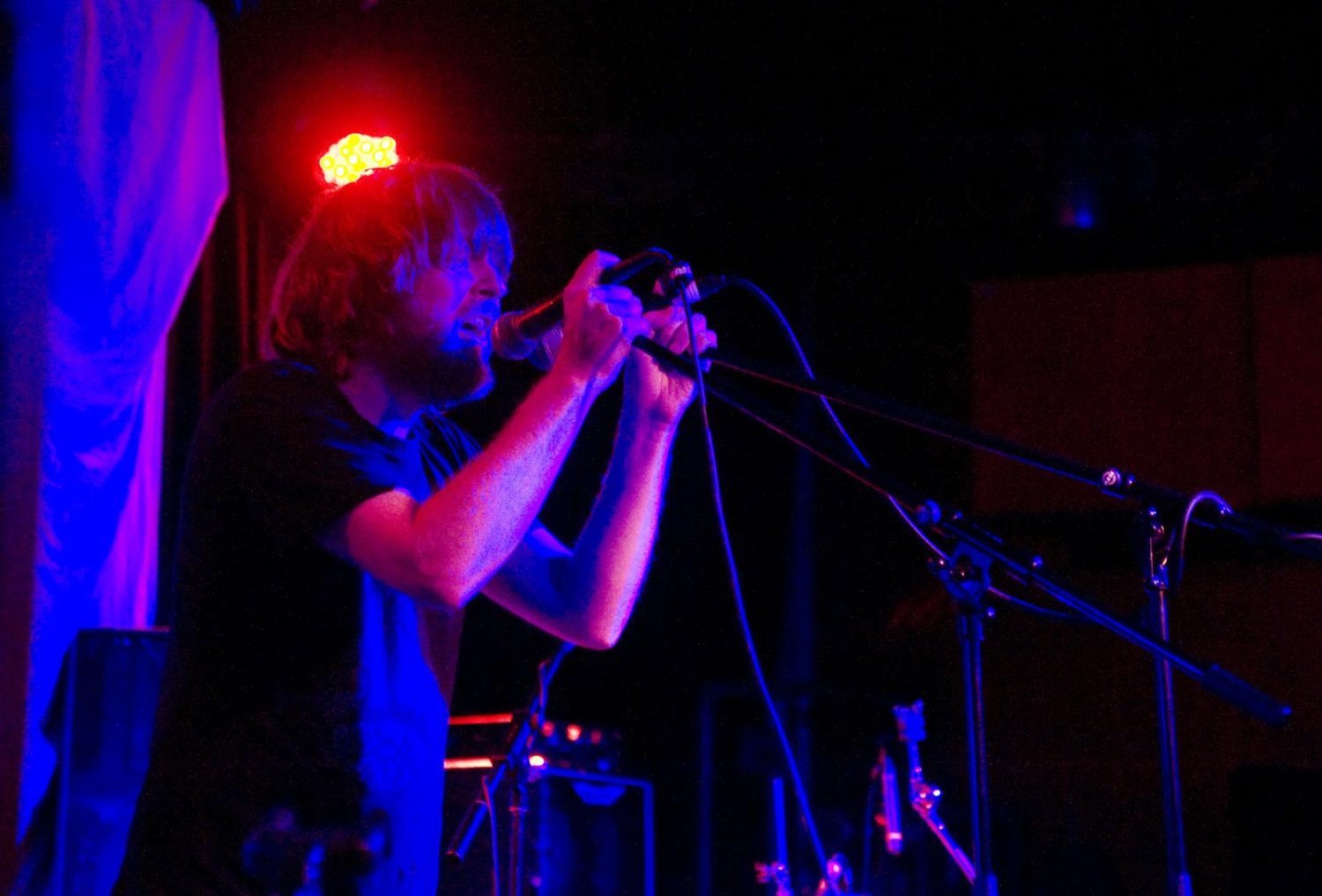
(((O))): We seem to be entering a new golden time of progressive psych music, bands like yourselves, White Hills, Marriages, White Manna over your side & Gnod, Goat & Hookworms over here. Is that something you’ve noticed?
Psychedelic is a loosely-defined word. What’s really psychedelic about it? Is it music that’s really going to take your mind somewhere new or different, or is it just because they have some swishy sounds going on? I feel like our connection with the term is that when we play shows we really do want to take the listener somewhere with it – that’s a conscious thing, we want our shows to be an experience. That’s what I’d say our connection is with the term psychedelic. There are bands that are calling themselves psychedelic just because they have a phaser on their guitar. What’s that about? There’s a guy I know from Boston in a band called High Aurad – we were talking about Goat and he said “yes, that’s definitely my favourite Jesus Lizard album”
(((O))): So when you play live, do you take your songs as just a jump off point, or do you try to stay reasonably faithful?
We stay faithful to the spirit of the song, but there are some songs that have evolved over time. The longer it goes from having them recorded, the farther out the song goes. Which is why ‘Tonight’s a Jewel’ is now like west african desert blues, and ‘Ghosts of Here and There’ is now like this fast rock thing – that was from an album in 2007 and it’s not even the same guys anymore. But even stuff that’s from the new album, that process is happening already. The stuff doesn’t even come out for a couple of months but we’ve already started to fuck with it, so who knows how far it’ll go. It’s basically a case of keeping ourselves entertained, which hopefully translates to keeping the audience entertained.
(((O))): That’s often something I’ve thought about with touring bands, they’re playing the same songs 5, 6 nights in a row. How do you keep it entertaining?
Dave: Well some bands stay very tight, but that’s not how we do it. That seems boring to me. Just from a musician’s point of view, you may as well work in Starbucks or something if you’re just doing the same thing every night.
(((O))): But take the Rolling Stones for example, Keith Richards must have played ‘Satisfaction’ thousands of times. How do you keep that fresh?
Dave: But I saw a video of them playing it in 1978 at Cathy’s I think, on Maine Street? And it was totally different. Still totally compelling and really fun, but it sounded very different, so they obviously change it around a bit.
(((O))): What’s next for Arboretum?
There’s an idea of something, but the next stuff is a long way off at the moment, this record’s still really fresh. We have dates in Baltimore, and are looking to play New York soon.
(((O))): Do you find it harder to get dates here compared to the States?
Dave: Well it’s just a case of who you have as your booking agent, really. We’re not very good at doing it for ourselves, to be honest, as we’re not very good at asking people for money. It’s just a bit awkward, really, to say “Well we need £x amount to be able to play this show for you”.
(((O))): Do you plan to release singles from the album?
Not really. I think there’s a German single coming out. ‘World’s Split Open’ and ‘Oceans Don’t Sing’, but we didn’t really have very much to do with that. We’ve had to do an edit for radio which was a little weird. Taking those 30-40 minutes of playing with chords over the beginning really takes the feel out of the song.
Corey: You mean seconds, I think.
Dave: Ha. Yeah, seconds. 30-40 seconds.
(((O))): Something we’ve noticed is that radios don’t tend to play songs unless they’re released as singles, I just wondered if that was something you’d thought about at all
Dave: Well to be honest those kinds of decisions are best left to someone else. I mean we’re writing, and recording, and we want every song to be the best it can be.
(((O))): Do you have a “plan” for Arboretum? Are you trying to “get famous” or just to make the music you love?
Dave: Well I’m not going to lie, fame and money would be nice, but the whole thing falls apart if you don’t have any respect for your music, and if the fans don’t have any respect for you as an artist. You want to go home and say “I did the best I could today”
(((O))): If this isn’t too rude a question, is the band self sustaining?
The tours are fairly self sustaining but we don’t make a living out of music, but when we tour it pretty much pays for itself which is nice. We all have day jobs, though. The music income has tended to get better I think, as a proportion of overall income. It has got better over the past couple of years.
And with that they ambled off in to the Stoke Newington night.