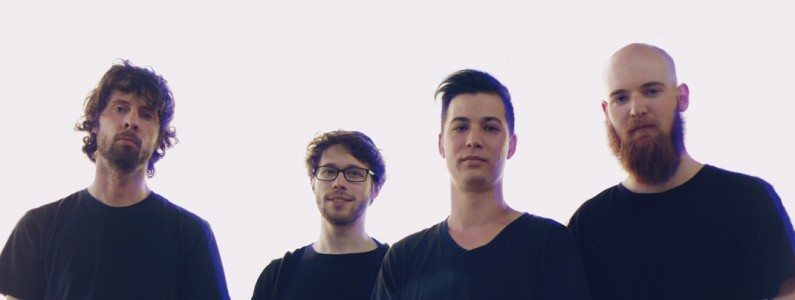
Last week we posted part one of our latest interview with Alex Wilson of Sydney instrumental rock band sleepmakeswaves. Two years ago when we first interviewed Alex, they were yet to tour overseas and most of the handful of writers we had at (((o))) had not heard of the band, let alone seen them. We now have 50 writers here, and sleepmakeswaves' recent tour of Europe and UK supporting 65daysofstatic gave the chance for some of them to finally get to see the band live, like Sander in Edinburgh, Dani in Rome, and Magda who got to their only headline gig of the tour, in London. It’s been great to keep in touch with the band and see them grow almost exponentially over these last two years. This week in part two we talk with Alex about the future of music, side projects and of course the band’s recent tour.
To give some perspective, for most Australian bands made up of musicians with day jobs a tour means spending three consecutive weekends taking Friday off to drive or in some cases fly to the nearest city which is probably between 700 and 3000km away, and play one or two gigs. A tour might have a dozen dates, but more likely half that, so when you find yourself doing 37 shows in 40 days, what is it that makes one day different from the next?
“Whether it's vodka Monday or gin Tuesday of Kahlua Wednesday or Bourbon Thursday (much laughter). That was 65daysofstatic's rider I think from memory, they worked it out really well so they had a good selection on the bus at all times.”
I immediately have images of a dozen guys lounging around in a tour bus wearing pyjamas and dressing gowns drinking White Russians and answering to “Dude”. Alex continued:
“I think you just have to do things, you have to try to be active doing things in that place that are kind of like a signpost for your memory, at least in the short term so they don't just blur into endless trips on the bus or as it could really easily become – playing a show, loading onto the bus late, starting to drink because you're with a rad band and you're having a really great time, getting to bed at five or six in the morning then sleeping through most of the day until you need to load out into the new venue again not seeing anything. That's a pattern you can really easily get into and we would really make as much effort as we could to try and interrupt that and so at least for me if I had some kind of brutal hangover or whatever I'd be like 'Fuck it! I'm in Rome. Never been here before. Let's go see the Colosseum', or like try and break into Vatican City, which we did and got chased out. When you go and do something like that it marks the day and makes it more than just another day on the bus.”
I remembered an entry in the band's tour diary and asked Alex if he signposted places he'd been in terms of how long it took him to find somewhere to take a dump in the morning (an act forbidden in the bus toilet). With a laugh he observed that particular morning in Frankfurt had been a particularly difficult one. Reminiscing done, he continued:
“It's not just about places, it is the people as well and people react to your music differently and they react to you differently and it's all just different kinds of positive because as a musician people treat you differently from a tourist. They're quite willing to open up to you and take you out to a bar where the locals drink or tell you something cool about their town. People do have a very different kind of character and it's easy to sit back in your dressing room and not really talk to anyone, but we just had so much fun on the tour. It was kind of a blessing in disguise having to sell our own merch because we ended up at the desk after every show and talking to a bunch of really cool kids and music fans who had come out to see us and it's just like being at a bar, you know you're drinking at the merch desk, selling stuff, talking to people, having a really good time. Some nights that was really incredible like this unreal night in Ghent in Belgium where it was just this complete swamp of happy people at the merch desk. Those nights really break it up as well.
“But then at the end of the day there's only so much that you can do and I think part of touring well is being stoic and giving yourself over to the logic of it. It warps your mind. It reduces your needs down to really simple things like drinking, eating a really minimal amount of food from a rider, playing a show and trying to play it well, selling your merch, trying to chase girls at the merch desk. It's not a complicated life you know, and it repeats day in, day out and the same demands are placed on you from day to day so you try and add to it and interrupt it where you can. The other secret is just trying to be Zen about it and finding the satisfaction in the repetition.”
For most bands gaining a following involves playing gigs and being seen, and despite the internet and easy access to music from around the world your average instrumental band is going to be best known and best loved in their own country. Because of the isolation it's not cheap for Australian bands to tour overseas and as a support band the crowd is clearly not there to see you. So were they surprised at just how many punters did turn up to the shows who were completely familiar with their music?
“Yeah. Totally. It's flabbergasting really. I suppose it ties back to what I was saying earlier where you're confronted with the reality of the situation where people are familiar with what you've done, and I feel there's an obligation to respect that back and I think that's really important. It's always surprising and I think honestly if it ever stops having a sort of other-worldly, dreamlike quality to it I think that's the moment you should stop? Maybe? You know, when you get complacent with people's passion about something that's really important to you would be a worrying development, at least for me. So that was one of the best things about the tour because obviously we're very into connecting with people – that tangible evidence that something you've done really mattered to someone is amazing and we certainly weren't expecting it.”
If you haven't read the band's tour diary it's worth having a look. As expected there were continual references to grog and stories about people they met, but playing tricks on Otto had clearly died down this tour - according to Alex he gets his own back these days; “our little boy is growing up”. Alex had written the first two of the four instalments and suddenly for number three Kid had taken control, no doubt in an effort to show how to do it. But the novelty wore off quickly and Otto took the reigns half way through part III, with Alex taking back writing duties for the final instalment.
“I think I'm the only one who's verbose enough and navel gazing enough to really be able to keep it going for the whole time and I'd have Mike Solo (their manager) behind me cracking the whip so I'd get it finished. So I mean I think the question was, yeah we did drink a bit of grog and 65 certainly put us through the paces in that way because they're from Sheffield and Manchester and thereabouts and they know how to drink well and show you a good time and play all of the best worst songs over the bus PA at 4 o'clock in the morning when you're driving. I suppose as an opening band one of the only things on your rider that you can reliably count on is beer (laughs) so it's a staple.”
In the diary Alex also spoke about the need to have a few drinks before playing but not too much. So what is the yellow zone and has he calculated the exact blood alcohol content where he switches from, if you like, playing like Lemmy to just being the drunk guy with the bass?
“(Laughs) Oh man, if only I could be Lemmy. I think probably two solid beers in the hour leading up and two drinks of scotch just before I go on I think that will have you nicely sauced to the point where you don't really care about who's in the crowd and your nerves have gone but still able to play. For me it's totally a nerves thing, like on stage I know I play a very physical show but a lot of it is not really conscious so when I play I can know people are enjoying it but I feel very exposed. I can play reasonably comfortably in front of a few hundred strangers, but especially if there are people I know that have seen me just as an ordinary person who I work with, or a friend of a friend, or someone’s cousin, it's a bit of a dramatic side of yourself that you introduce to them so I suppose, for me, having a few drinks certainly puts me in the headspace where that stuff doesn't matter so much, so that means I can play the show I want to play and people want to see.”
I had noticed that any reference to “playing cards” in the tour diary attracted the correction from Otto that what Alex meant to say was “playing Magic: The Gathering”, the original trading card game. Just who were the players in the band?
“Time doesn’t play at all. He’s the least nerdy one in the band. Otto takes it more seriously than anyone else. For me and Kid MTG was definitely in our childhoods but we’ve eased up a bit as we got older and are not so worried about some of the rules. Otto’s a serious stickler for the rules, like if you tapped before you picked up your cards, Otto will untap your mat and make you pick up the cards (becomes unintelligible here due to the laughter). He does win more than anyone else – he has this lead goblin deck that will totally own your arse. (more laughter)."
Did they get any converts?
“Yeah Neil Bunn, or Lord Bunn, who has an amazing beard and full sleeves and sells merch for 65daysofstatic – we tried to teach him to play Magic and it basically ended up with him taking the piss out of Otto the whole time and he even came up with a song about Magic (which Alex refused to share with me)”
And which member of sleepmakeswaves is the most impossible to live with on a long tour?
“Oh, me hands down. I’m not just being self deprecating but I am. I have the highest highs and the lowest lows.”
The topic turned to side-projects of the band members and what role, if any, they played. Tim, the drummer, also plays in Sydney band Pirate, with their looped-saxophone and vocal led math-rock/progressive metal, and they've been working on new material. Kid harbours a long term dream of starting “the world’s most brutal sludge doom band” and the name he had chosen did in fact become the name of their album; “…and so we destroyed everything”, Otto would probably like to do some sort of acoustic project, while Alex is interested in playing around more with the electronic side of things. He describes how difficult it can actually be to find that separation:
“One of the hard things about it is that I can come up with something that I really like in an electronic form with drum machines and chords and melodies that I think are really nice, and then my brain starts fucking it all up, and it's like; 'You know what, you could really easily imagine this with guitars' and I'll start experimenting with that and it sounds really good and eventually becomes something that could be part of a sleepmakeswaves track.
“Part of the way we write in the band is imagining ideas being interpreted in five, six, seven different ways and writing for us takes a long time because it's about experimenting with all those ideas and selecting the best ones, the best interpretation of a melody or riff or chord progression or the best structure to string it all together. And that makes side projects difficult because it become this repository of riffs that you steal back into your main band. I'm spending a lot of time writing music that isn't sleepmakeswaves and I'd really like it to encompass some of may many interests outside sleepmakeswaves, but putting a boundary around that and drawing a line under it – I haven't figured out how to do that yet.
“I would love it on the level that I'm an absolute control freak and being in a situation where I did not have to compromise on anything at all, being able to pursue my own interests would be really satisfying to me. And that's not to say that compromising on what you want is a bad thing at all – it leads to incredible results. I remember Steven Wilson from Porcupine Tree saying once that he got bored with his own record collection and one of the reasons he loves playing with a band is all of the ways of doing things that he wouldn't have thought up by himself, but then again he's got probably seven thousand projects that are all about what Steven Wilson likes.
“We've sort of been talking about, in the trajectory of the band, where perhaps the best way to do it is I need to develop a really serious drug addiction and then do a series of commercially unsuccessful but critically acclaimed solo records about the recovery and everything like that, so maybe that's the key?”
There's no shortage of composers and songwriters who have shed their band in an effort to do what they want because of the need for compromise, but often something gets lost that you can't make up for with that freedom alone. Alex was a massive Smiths tragic growing up and talks about how the magic of that band came from everyone, not just Morrissey, or Johnny Marr or Andy Rourke. He was given Morrissey's autobiography by a friend and says you get the impression Marr got sick of Morrissey getting all the attention and so decided to go out on his own, but with that neither of them could recreate the magic they had with The Smiths. Similarly, Alex considers sleepmakeswaves greater than the sum of its parts and that when they play together it's a feeling he just doesn't want to ever go away, in the same way as being in love. Doing all this touring has made him realise that “all the people that are in the band right now are the people that need to be in the band pretty much forever.”
When Blur pulled out of the Big Day Out the band tweeted to promoter AJ to offer their services – it was pretty funny. Needless to say the offer was not acknowledged taken up, but it did make me think about the fact you can't headline an Australian festival unless you were formed before about 1995 (and Beady Eye is just Oasis so don't go there). Does this mean when all these bands eventually die there will be no more festivals?
“I think it's an ideological shift in the way people perceive music. I think the whole internet thing and everything it represents has changed the idea of there ever being any more classic bands in the way that Blur or The Stones or Zeppelin or King Crimson. In 1970 there were like five classic bands that that were all awesome that had big record deals and got played on radio that were two of the avenues for getting big and those bands that got into those avenues were there and you only needed a handful. But now it’s totally different and you can choose any sub-genre of music and there are 200 bands in the world that are world class, and you are right in that you can’t get a headline in Australia in some ways without being one of those bands, but when these groups die I wonder if it’s going to be a situation where other bands are going to fill the holes that are left or whether those gaps are going to be filled in for good and we end up having what I think we’re heading for which is a really cosmopolitan kind of music scene where it’s more about specific stuff, like the logic of the internet facilitates your own really quirky musical tastes and puts you in touch with people that are really into that too so you can explore all that weird stuff.
“I don’t think there’s anything to worry about with the idea that you might not be able to be Blur and heading a big festival or something like that because I think we’re gonna do just fine. I think we may not have bands that are the equivalent of those massive corporations like we did in the past, but we can have bands that are the equivalent of hardworking cottage industries. Bands that don’t make a lot of money and they have to work pretty hard, like anyone does, but the rewards are there and they stay afloat and they live their lives and they do something good as a result.
“There are roadblocks to work around like how Spotify works and how bands get paid but I’m certainly not mourning the fact that I was born in a time where live bands not playing headlines to a massive festival is a possibility. That doesn’t particularly faze me.”
A lot of this makes sense. There’s always talk about rock and other forms of music dying, but perhaps music is going back to a form that’s more community and household based. Before TV and the internet and downloads and mp3 people would gather round the piano and sing or play some other instrument. In the late ‘50s there were estimated to be some 30-50,000 skiffle bands in the UK. Bands still play at parties and the local pub is still a defacto back yard shed for those with intolerant neighbours. Alex talks about the way geographic music communities are thriving and despite music being available everywhere people are linked to local scenes.
“This is the most amazing time to be alive for music, because there are literally no rules. There is more music being created and transmitted than ever before and there’s more possibility that your unique vision will find its audience and could grow into something bigger than you imagined it could be. No time is ever perfect and there’s things to figure out, but from my perspective it’s just incredible. There’s more chance I think for people to feel included in these smaller indie communities that have become really self-sustaining, than they can with that big rock stadium kind of thing.”
The term ‘music industry’ makes it all about production, consumption and profit – these are not the lifeblood of music and nor have they been in the past. Perhaps it’s better thought of as the “music world”? Alex takes it a step further and questions whether the term “music” has become too restrictive for what’s happening and how artists go about creating. He feels music journalism misses the point in asking questions like “What gear do you use” and “What are your influences”, which, as it happens, I asked in my first interview with Alex. He explains that the very personal way someone creates music is not built around those thoughts and constructs, so the term ‘music” doesn’t accurately encompass everything that’s happening when people get up on stage and make sounds for the entertainment of others. For example it doesn’t take into account the differences between someone like Girl Talk and sleepmakeswaves and that personal connection someone has with music.
“I believe that when you understand music on those levels and you try to understand the different reasons musicians have for making it, it actually becomes a method for helping you connect with different kinds of people as a whole. It opens you up to whole new ways of being a person that you might not have really thought about.”
Great – now I have to rethink everything again!
Thanks to Alex for making the time for a chat (I finally used that new-fangled Skype thing the kids are using). This is our third annual catch-up and we intend to continue reflecting on each year as it passes. As a big fan of the “Smiley” films of the late ‘50s I was super pleased that Alex used the word “flabbergasting”.
The band starts their support stint for the Karnivool and Dead Letter Circus tour this week. They will be killer shows so make sure you get there. Details on facebook.