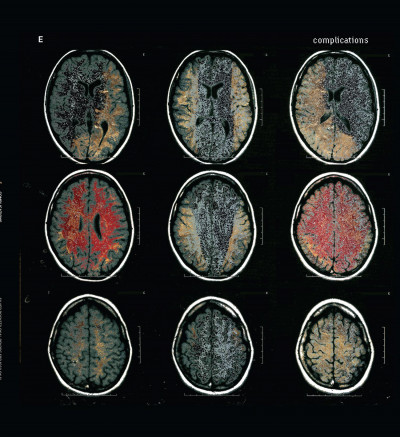
The third album from austere Boston noise-rock trio E, Complications is a claustrophobic, urban march. Like pacing the city’s filthy grid while lost in your own thoughts. Somehow either blessed or cursed with precognition it arrives preloaded with the loneliness and disquiet of the lockdown mental overload. A hard edged sonic kaleidoscope charged with eerie serendipity. Short and sharp, the songs are shorn of rock indulgences, tightening their stern attack.
Without preamble ‘Caught’ dives directly into the anxious churn, although the tension slacks off as Thalia Zedek’s vocals come in. All three band members write and sing, the nine songs are split three apiece. This feels like a misdirection because the real core of the band is their instrumental voices and here they form an even more integrated unit than before. Complications is a tightly wound record that pulls their three sided, post-everything, rock into a taut triangle. Three interlocking planes, sharp at the corners, satisfyingly balanced in geometric harmony.
Second number ‘Acid Mantle’ sees them happy to run over half it’s length as a conversation between the guitars. They pace warily about the perimeter, goading each other, leaping forwards before the brief vocal comes in. It ends with a glorious bout of dissonance which, typically, they don’t allow to overrun or unbalance the unity of the composition.
The lyrical approaches taken across the record share a desire to step outside the familiar and a brevity that again and again allows the music to take the spotlight. In this arena E have hit on a rare and elusive balance, nobody showboats and no one wants to drop the ball. Their slightly unusual two guitars and drums set up is stretched further by Jason Sandford’s unique home made instruments. Here he debuts another new guitar and several other contraptions. The ‘monosequencer’ is a stomp box that plays a short run of bass notes but doesn’t loop them, requiring repeated involvement to be played. I take it to be responsible for the deep thump adding dramatic dynamism to several tracks and particularly noticeable in ‘Contagion Model’.
That’ll be the eerie serendipity I mentioned. One of Gavin McCarthy’s songs, ‘Contagion Model’ is the album’s most pointed, but by no means only, exploration of disease as metaphor. Picking at the wound to the body politic caused by the poison of fake news and the delirium of the Trump death cult. It simmers as McCarthy outlines the infection “Inhibitions fall, cognition cracks. It’s contagious, spread it around” before boiling over as Zedek yells “Don’t erase me. Quarantine” against the boom of Sandford’s machines. I still can’t quite tell if the timing of its arrival uncannily captures the zeitgeist or is just unfortunate, but it’s a great song.
‘Sunrise’ is brighter and warmer, even hopeful. Led by a sparkling guitar line Zedek urges a friend to “regenerate yourself again, start from the end” over neatly interlocking rhythms and sheets of sound. The closing ‘Apiaries Near Me’ may be the album’s best moment. A headswim reverie again content to let the guitars play against each other for the first half before a beguiling “Swarm, swarm” refrain introduces two contrasting vocals.
This is the third great album from this wonderful band and somehow hardly anyone seems to have noticed. I know they’ve not really done themselves any favours with the name, becoming abandcalledE for algorithmic convenience but more people should be singing their praises. Despite its clear impracticality I like the name E. I like how stubbornly reductive it is, how elegant. It suits them. The music they make is restless and inventive, a singular space filled with subtle tones and textures. It never labours an idea in case you might miss it. It’s quite unassuming in that sense, but it’s well worth paying attention.