Interview: Sumac
It's not like Sumac goes away for me when we don't have a new record coming out. It's present for me at all times in terms of my creative life.
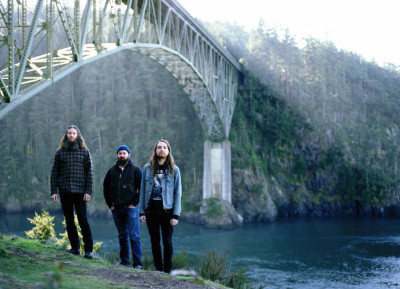
Sumac have just brought out their latest album, the epic The Healer and it sees the bands experimental and heavy soundscapes reach even higher heights in terms of their outlook and execution, resulting in a hugely emotional, hypnotic and rewarding listening experience. Gavin Brown had the pleasure of catching up with Sumac guitarist/vocalist Aaron Turner to hear all about The Healer, its creation and sound and also Sumac celebrating a decade as a band as well as discussion his other musical projects as well.
E&D: The new Sumac album The Healer has just been released. Can you tell us about how you’re felling about getting the record out?
Aaron: I am excited for it. It’s different being on the inside of the process, because it’s neverending. It’s not like Sumac goes away for me when we don’t have a new record coming out. It’s present for me at all times in terms of my creative life. So in some way, this just feels like the next part of an ongoing process for me. I’m not sure how it is for the other guys, I can really only speak for myself in that regard. I do feel very connected to this piece of music, and I’m excited for other people to experience it and not to just have it contained in our world in isolation anymore.
E&D: What were the biggest influences on The Healer and its vast sound?
Aaron: In some way, it’s kind of a cumulative set of its operational sources, from the beginning of when I started to play music, or even when I just started to listen to music. They’re the inspiration for me at all times to try to make music that I find moving, and that that poses a challenge to me as its creator. I want to feel very connected to what I’m making, and I want to feel like it is a sincere expression of what I am as a creator, and what we are as a creative group together. I also don’t want it to come too easily. Things that come too easily, they tend not to last for me in terms of the engagement that I can have with them. Something that feels, in some way, too familiar, is usually something that I’ll discard as an idea, that feels like I have to dig into it for a while before it really takes shape is the stuff that I that I try to pursue. So I guess, challenge and creative challenge and emotional resonance is the inspiration for making what we make.
E&D: Is that something that happens with all Sumac albums?
Aaron: Yes, from the very beginning, and that’s been that’s been part of the process for this record, I think it was probably harder to write in that way because the beginning of the process came out of probably more like a year and a half of not writing any music at all, and that basically had everything to do with the pandemic and all of the social upheaval that was going on in the US at the time, it just took over for me in a lot of ways and I wasn’t sure if and when I would be playing with Sumac again. Things seemed very uncertain at that particular point in time, and I just didn’t feel inspired to make anything partially because I didn’t know what the timeline was going to be like. A part of it also was just questioning why I was wanting to make work and was making this kind of music even a valid thing to do. I guess that was more of an existential concern, but the end result was that I was out of the habit of writing music and thinking about music and being in regular contact with my instruments. So it took quite a while for me to get going again and to find my way into writing music again.
E&D: Is that regrowth a big part of this new record?
Aaron: I don’t think so, I think it just took me a while to pick up the threads again and continue from where we left off, it was just the process of finding that initial ignition, and getting the ball rolling was more of a challenge and it took more time. A lot of the past Sumac records, once I had gotten started on them, the flow of the music came fairly quickly, and there was too much of a gap between finishing one record and starting the next. So this is the longest interim between one album and the one that followed.
E&D: Will the songs from The Healer form the basis if you live set when you go on tour?
Aaron: Our songs are so long, that we can’t really have too many songs in a set that’s usually four or maybe five at the most. So, if we were to play all the songs from The Healer, that would be our entire set. So I think what we’re going to try to do, at least for this first round of touring is play two songs from the record and then two or three from other records so that our set is somewhat rounded, and not entirely focused on new material.
E&D: Have you ever had the chance to play any of the Sumac records in full live and would you do that with The Healer?
Aaron: I don’t think so. There’s never been a record of ours where I felt like every song worked as well as I wanted it to in the live environment, it seems like there’s always been one song from any record we’ve made, that when we finally bring it into the live setting for whatever reason, just doesn’t have the right kind of flow and energy for presentation in a live setting. So we’ve never played a record in its entirety, at least not to my recollection, maybe we did with The Deal, because it was our first record and we didn’t have any other material to draw from. The other part of this is, while I don’t feel the need to capitulate to audience expectations. entirely, I don’t want to deny people the experience of hearing a song of ours that they really like from previous albums. We may not play everybody’s favourites, of course but as long as there are songs that we still enjoy playing from past albums, I think it’s important to play those, so that people aren’t just hearing one thing. It doesn’t feel right to me as an audience member myself, there have been times where I’ve gone to see a band and I haven’t necessarily heard everything I wanted to hear, but the fact that I hear different pieces from across their catalogue is satisfying to me as a listener. So I’m thinking of things from that perspective, as well as from the perspective of what feels relevant for us to play as a group.
E&D: What are your touring plans after the album comes out?
Aaron: We don’t have anything concrete beyond these first two tours in the US. We’re we’re trying to do the entire US over the course of the album cycle, but we’re not doing it all at once. We’re breaking it up into chunks. So we’re doing the West Coast in June, and then we’re doing the South West in August, and then I think the next thing we’ll do is the South East and the South in December. Those are the only things we’ve plotted out at this point. We cannot tour extensively or we choose not to tour extensively for a variety of reasons. However, with that said, our goal is over the course of the life of this particular record, at least in terms of touring, we want to hit just about everywhere we can, so I imagine we’ll do at least one or two tours in Europe and maybe Japan and try to go to Australia for the first time. But none of that is none of that is set in stone yet.
E&D: You mentioned touring Australia there, are there many places in the worlds that you haven’t had the chance to play with Sumac yet?
Aaron: I’ve been there before, but never toured Australia. I would love to tour South America, we haven’t really had any offers to do that, and we can’t really force our way into that territory, or uninvited. So I’d like to go as many places as we can. Australia as a place where we have had some invitations to go. I have toured with previous bands, and I’d like to make it there with Sumac at least once during the lifetime of this band. The world is an unpredictable place, but, yeah, I would like to go as many places as it’s feasible for us to go and is allowable by the the lives we live outside of being in this band.
E&D: It’s been years since Sumac started as a band, what have been some of the highlights for the band and yourself in that time?
Aaron: I was talking to a friend this morning, about making music in general and I just feel lucky to be able to do this band at all. To play with Nick and Brian is a huge thing for me, they’re both very dear friends. Nick, I didn’t know before we started playing together, but he’s become a great friend, and for me, a huge part of the process is just playing with people that I care about. As players, both Brian and Nick are people I have a big admiration for what they do. Also, I’m exceptionally grateful for the chemistry we have as a group. This is very much an experiment. In the beginning, I had a concept for what I wanted us to sound like, and I thought that Nick and Brian were the right people to collaborate with to achieve that sound. I didn’t know if it would work. I didn’t know if Nick and I would be compatible on a musical or a personal level, but this group ended up embodying exactly what I hoped it would be, both creatively and personally. And so that, for me is the biggest source of gratitude, The highlight for me is getting to play this music with these people. The secondary highlight is that there are other people who are also interested in it, and that has allowed us to collaborate with some artists that we feel are very inspiring. So that’s another highlight too, we’re not just connecting with each other within the group or with an audience but also with other artists and that process of being able to invite in outside collaborators or have outside collaborators, instigate a project with us is another thing that I’m exceptionally grateful for.
E&D: What do you do credit to the longevity of Sumac?
Aaron: I think it’s in large part connected to what I was just talking about. Nick, Brian and I really just enjoy each other’s company and we enjoy the process of making music together. If those two things can continue to happen, then I don’t see any reason why we would stop. I mean, every band ends, that’s inevitable. However, I think what for me in the past has has been the reason for wanting to stop participating in a project or end a band is finding that personal relationships are within the band are extremely stressful or they start to deteriorate as a result of being in a band or and or the creative aspect of it starts to diminish in terms of its its rewards. I will say those things often go hand in hand, so I would say, the fact that Nick, Brian and I feel inspired by each other’s music and ideas and the fact that we really appreciate one another as people is how we’ve been able to make it work over the course of ten years and and however many releases. The other thing is, while we do try to pursue this as much as we can, this is not a career band in the sense that we’re not trying to tour six months out of the year, we’re not dependent on this one thing as our source of income. And as such, there’s less pressure, which keeps it more focused on the creative part on the on making music, and less so on kind of the practical, or financial aspects of its existence.
E&D: Is that freedom refreshing in terms of me making music?
Aaron: For me, certainly. Nick has never been in a band that was his job. He’s always done some other kind of work, or at the present moment, he’s doing this, but he’s also doing other bands and other music. So he’s not entirely reliant on Sumac as his job. Brian and I, on the other hand, have, at least at points in our lives, had our bands as our work, which obviously, on some level was great, because we’ve been able to do the thing that we really love, and also have it be the way we are able to pay rent, or pay mortgages and buy food and all that stuff. But that comes with a price of its own, and for some groups, or some artists that can really work out well, and for others, it becomes the things that cause the work to start to become more like what we think of as a job, meaning a thing that we just do to make ends meet versus being a thing that we do because we really care about it. I think there can be a balance there, and you have to be really conscientious about it in order to make sure that that balance is maintained. So that tips to the direction of becoming a job sucks the life out of it and invalidates the word.
E&D: Have you got any plans to do further collaborations with artists you have worked with like Keiji Haino for example and who would you you’d like to collaborate with in the future?
Aaron: We started a project with Moor Mother, which I think when it is finished, will be a full album. That’s the next thing that we’re really focusing on, and as I mentioned earlier, collaboration is a part of our creative process, and we intend to keep that going. On this upcoming tour that we’re about to do, we’re playing two shows in Los Angeles and one of them is going to be a collaborative set with Zachary James Watkins and Patrick Shiroishi. Both good friends of ours and exceptional artists. I think that that this process of doing live collaborations is a really enjoyable practice in and of itself, and it’s also something that can become a release in some form or another. On the last couple shows we did a few months back, we played with Raven Chacon and Zoh Amba. Both of those went well, and one of them was recorded, so I think we will probably continue to try to do this thing here and there. Throughout the course of tours, we find people that we want to collaborate with, and do it for the sake of doing it and when possible, record it, and if the results are good, try to shape it into something that will be an eventual release. We played live with Caspar Brötzmann a couple of times in Europe, some years back and we discussed the idea of recording with him which I would love to do. Whether or not that’s going to happen I can’t say but you know there’s there’s a lot of people whose music we like and a lot of people who we feel we have musical musical compatibility with so we’ll continue to seek those things out and and ask them when possible.
E&D: Old Man Gloom are also celebrating your 25th anniversary as a band this year. Have you got anything planned with the band or any new material in the works?
Aaron: We have a record, which is definitely a bit different for us that we started a couple of years ago, but between the four of us, it’s pretty complicated to align our schedules and that’s the biggest hindrance in terms of us being able to do things. I would like to be able to do that, and I would like to be able to finish that record. I’m sure the record will get finished at some point. I don’t know when that will be, and I’m sure that we will play together live again but I also am not sure when that’s going to be.
E&D: Are there plans for any new Mamiffer material at all?
Aaron: No, Faith has been working on material of her own, basically solo material. I think that that’s the next focus for her. I’ve always been just a side participant in Mamiffer, which has been a great opportunity for me, but I also understand that right now, she feels like she needs to focus on her own solo material, and she has a couple other collaborations in the work too. I think that she really wants to see those through and doesn’t feel compelled to pursue Mamiffer now, maybe again, at some point after these things are completed, but it’s an open ended project.
E&D: I saw Sumac and Mamiffer live together back in 2015. How was that experience of playing in both bands on the same night on tour?
Aaron: Both bands are so different that it doesn’t feel like a huge challenge for me. If I was having to do two sets that were both the same kind of level of physical intensity as Sumac, I think that I would find that pretty challenging, but Mamiffer is much more contemplative, and requires a lot of mental and emotional focus, but it doesn’t require the same kind of physical exertion. So for me, it was great. I enjoyed doing both and I feel like they’re complementary while not being at all the same. I mean, Faith is my partner and wife, so having the opportunity to play music with her is a wonderful thing. It does become challenging, simply because there’s no break throughout the day, and throughout the night, with multiple soundtracks and multiple performances but when I go out on tour, which I don’t do very often, I like to make the most of it.
E&D: Will you ever do anything with Celestial again or is the book closed on that project?
Aaron: I don’t think so. I mean, I didn’t think we were going to at all but then our good friend Caleb passed away, and we felt that it was really important to be a part of the process of honouring him and supporting his family. Hopefully, there is no other instance like that, that occurs amongst our group of friends, that’s the only exception I could see. I would have a hard time imagining something like that happening again, and beyond that, I feel like in many ways, again, I can only speak for myself, but I suspect this may be true for some of the others that we’ve all moved on into other parts of our lives and to revisit that would feel like a step backwards.
E&D: Thank you very much Aaron, it’s been great talking to you!
Aaron: Well, thanks, Gavin. I appreciate it. Thanks for taking the time to do it.