Interview: Lisa Meyer – Supersonic Festival
"It's against all odds that we're making something happen; but that's why when it does happen it's just so important – the loyalty and the relationship with the audience. When people buy their tickets and they care about what we do, then it makes it all worth it. It's definitely a labour of crazy love."
“When you were younger did you buy records and just listen to one track obsessively over and over again? I think that’s how I programme. I listen to so much stuff in advance of the festival and if there’s something that really catches my attention and I’ve got to play it over and over again then I think I’ve got to share that with everyone else at Supersonic.”
Lisa Meyer is reflecting on programming choices and the mixture of joy and heartache that goes into assembling the UK’s best underground festival. I’m talking with Supersonic’s Artistic Director and guiding light a month out from 2024’s edition. This observation on her method is prompted by one of this year’s headliners, Gazelle Twin. “The first time I heard Unflesh it was something so new, that combination of almost performance art with really danceable electronics but like a heaviness to that in terms of the beats and stuff. There was no-one I’d ever seen who made that kind of combination that way.”
Gazelle Twin (Elizabeth Bernholz) brought Unflesh to Supersonic in 2015 and absolutely smashed it, returning in 2018 to launch the Pastoral album. This year she’ll be bringing Black Dog, which I suggest looks like being a more theatrical show. “Yeah, It’s completely different to anything else she’s ever done and I think that’s what really interesting about her, she reinvents for each album, she kind of creates a new persona. I think people are in for a real treat with that.” The importance of long-term relationships with both audience and artists is a recurring theme.
At the newer end, after an electrifying set a couple of years ago, Grove is back with a soundclash/collaboration featuring Taliable x Toya Delazy. I wonder how involved the festival is in making these unique sets happen. “It’s more like, here’s an opportunity, here’s some budget, what would you dream of doing, can we help you make that happen? That’s what we proposed to Grove.” As for the increasing difficulty of setting up such moments she laughs, “Yeah, really difficult. The success of the festival is not just a shopping list, it’s about building relationships with artists, agents, labels, and being trusted by them. For them to be able to propose ideas to you as well. I think Grove is gonna go off; this time there’s two other singers and dancers as well so it’ll be next level in building on that energy. There’s a lot of thought that goes into the flow of the day and how the energy builds, how one artist relates to the next so that you go on a bit of a journey at the festival.”
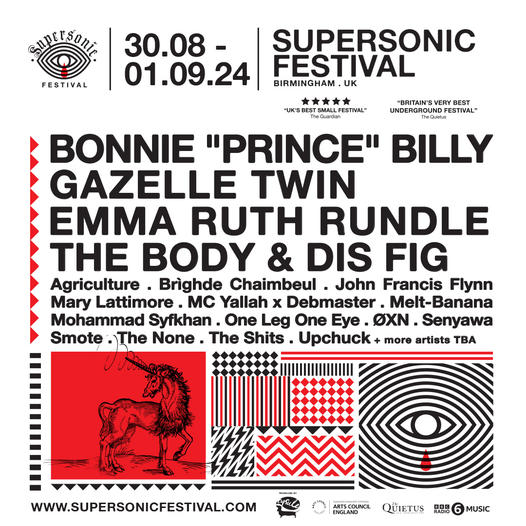
As for how bigger name acts inform or build the rest of the bill – “It’s a bit of both. With Bonnie ‘Prince’ Billy I’ve been a fan for such a long time, so it’s always been a dream to try and put him on. I’ve written to his agent on and off over the years saying ‘if ever there’s an opportunity, love to do it.’ Then equally we already booked ØXN, One Leg One Eye, Mary Lattimore and so when I was pitching to his agent, Will Oldham, [he] wanted to know who else was on the bill. I guess the kind of artists we tend to have coming to play Supersonic, it isn’t where you’re going to get a big fee, so it’s for artists that are interested in music and other artists. He was quite excited about who else was on the bill and it worked in that way. The sorts of artists we’re working with, it might take a couple of years to make it happen because we are limited in our capacity and the sort of fees that we can pay, particularly now when things have gone so crazy; it’s based on years of building relationships with labels and artists that we’re able to achieve the sort of line-ups that we do.”
Bonnie ‘Prince’ Billy heads up an impressive bill of folk-adjacent acts on Sunday which, while not explicitly stated, has a history of being a little gentler on the crowd’s tired ears and legs. “There is that flow to the festival. Friday is go in hard, it’s that party moment. Everyone’s made their journey, they’ve got there and everyone gets a bit over excited. On Saturday the heavier bands are playing and then the big party stuff on the night as well; then Sunday you’ve got to ease people in slowly but surely and build to that moment. But within Sunday, so people don’t get too flat or too tired, you have to have bursts of energy.”
“I suppose with the folk thing there’s a zeitgeist always in terms of programming, and maybe fifteen years ago the newest most interesting sounds were things like Sunn O))) for example, and then in 2024 I guess the genre that’s really pushing in terms of doing really interesting stuff is folk, but in quite a different way. I suppose you’re evolving to reflect that. Also what’s really lovely about that folk scene, particularly the Irish folk scene, is y’know for a long time ATP, although I loved it, was dominated by American bands and then you had lots of English bands trying to replicate that. So to hear people singing in their own voice and their own identity, I think that’s quite exciting.”
Alongside Irish, there are Welsh, Scots, and Cornish language acts this year providing a nice spread of traditions. “It’s got to be that balance, you want to bring in really exciting acts internationally but you also want to celebrate what’s happening in terms of home grown talent as well. You’re trying to create a global community, I used to say Supersonic was ten people from Nottingham, five from Leicester, six from Dublin and so on, and then you kind of create critical mass. I found having done gigs with Capsule for years, the stuff that I absolutely love, you try and put that on on a rainy Tuesday night in Birmingham and you’ve got a pitiful turnout of 20 people. A festival allows you to take a risk on some of those acts that aren’t as well known, but are brilliant, and bring in those 20 people from all over the place; and suddenly you have a thousand people watching them.”
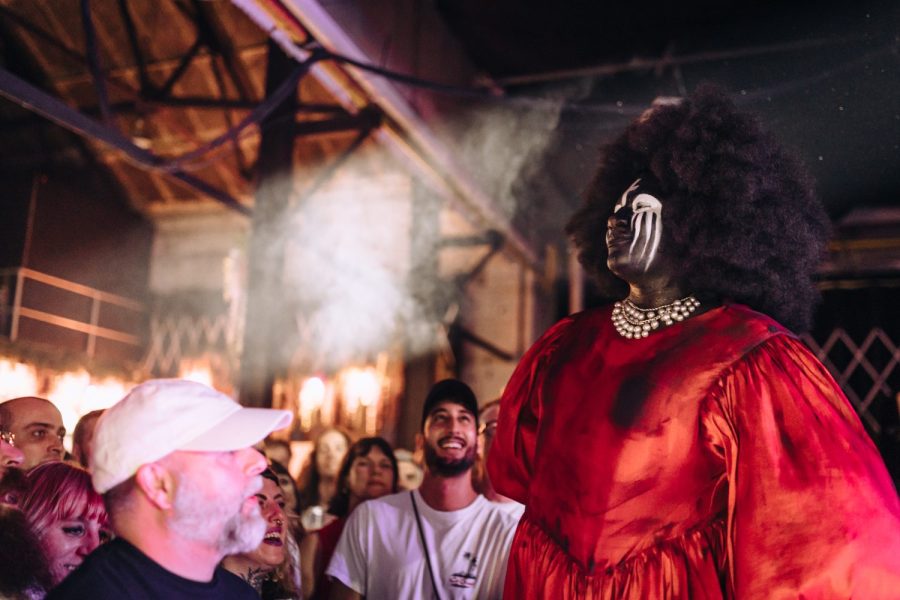
Backxwash at Supersonic 2023. Photo: SnapRockandPop
Supersonic and similar events create a kind of symbiotic feedback loop with this scattered community of musical adventurers, gathering it together and nourishing it. It’s why it’s so beloved, but you can’t help thinking a couple of bigger bookings might help smooth the path. “You have to work really, really hard to get everybody to come. We spend such a lot of time promoting the work that we do, it doesn’t just sell out automatically, and it probably could be easier. Last year, there was an artist I was going to put on who was bigger and probably would have sold it out but then I was like OK, I can pay these two white men to play or I can split that fee to five women artists and have a much more interesting line-up. So, you’ve got to make those decisions, and its probably not a very hard-nosed entrepreneurial way of looking at it.”
Indeed it’s not, but again this is part of the festival’s particular charm: music drives the decisions, not business. “Well, I’m a fan. So I’ve got to love everything that we’re putting on – none of it is filler. You’ve only got like 30 places and there’s like 20,000 bands out there. So you’re whittling it down to 30 and every one really has to make sense to play.”
MC Yallah x Debmaster and Matana Roberts return to the bill having dropped out last year due to visa issues and Covid respectively; on the matter of these added complications Meyer sighs. “If you think, post pandemic, of the landscape now for festivals – you’ve got Brexit, you’ve got an increase in production costs and artist fees, and then you’ve got the cost-of-living-crisis where the audience have less money; and then for us we’ve got this fourth layer of the gentrification of Digbeth. It’s against all odds that we’re making something happen; but that’s why when it does happen it’s just so important – the loyalty and the relationship with the audience. When people buy their tickets and they care about what we do, then it makes it all worth it. It’s definitely a labour of crazy love.”
The steady loss of ground in Digbeth to shallow men with deep pockets is one that long-time Supersonic-goers might have observed first-hand in yearly instalments; there’ll certainly be opportunity to take it in while walking up and down Lower Trinity St. this year. The festival has consistently moved around venues in the area, but the ongoing squeeze on space came to a head a few months ago when the developers who now own the warehouse the festival has used in the past two years decided, at the last minute, that they couldn’t have it. Potential ruin has been diverted and a new, in many ways better, venue has been found; but a shadow falls across the future. “Basically, developers have bought that entire block; so where the warehouse is all the way up that road, up the hill, it’s going to be residential within the next 24 months. Digbeth as we know it is a thing of the past; it’s now like themed bars and these soulless one-bedroom flats, and you think, who’s going to move into those?”
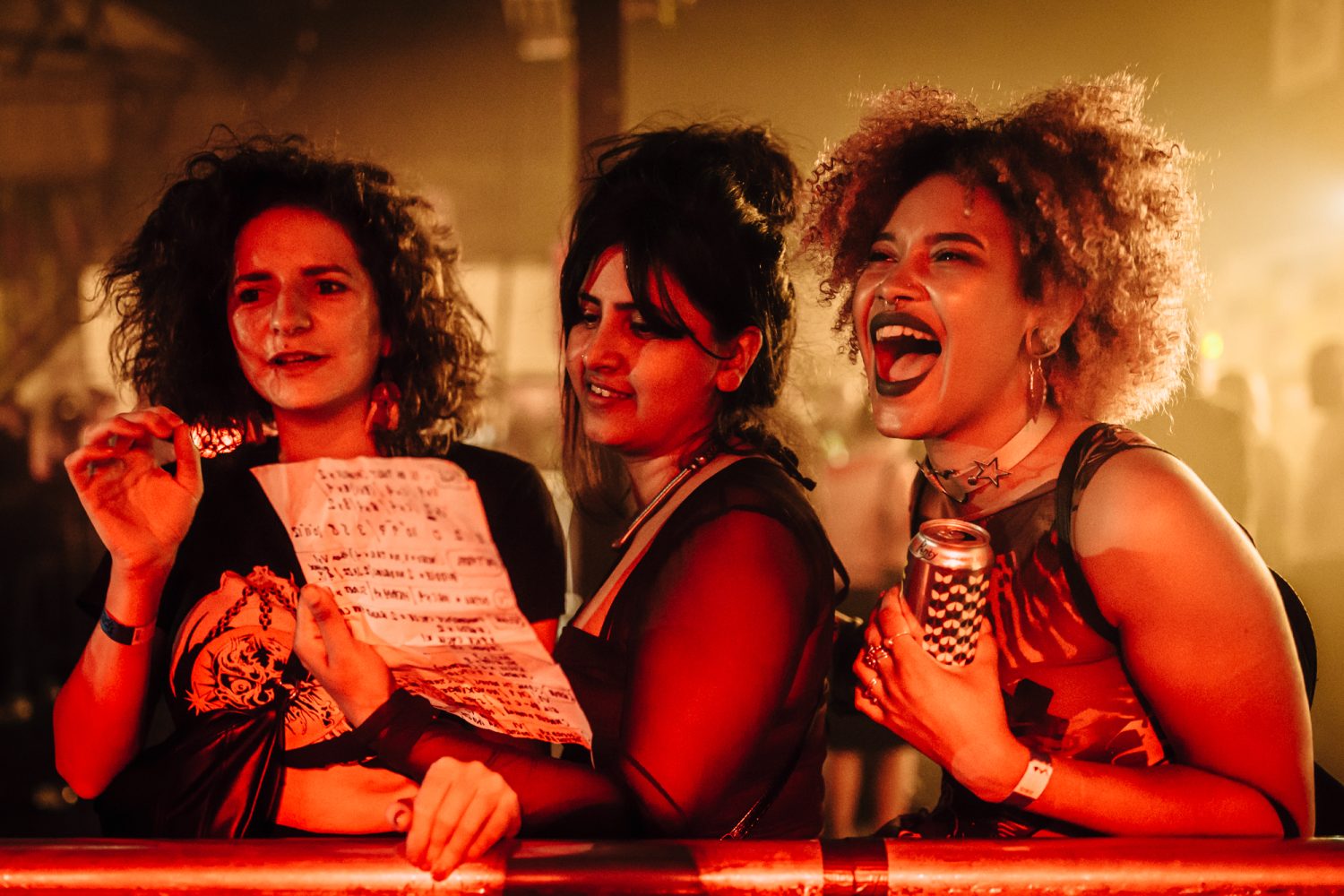
Photo: SnapRockandPop
The slow-motion cleansing of low-rent local creativity by monied and shiny investment is a familiar tale – inevitable but grating. I’ve always really loved Digbeth myself, even when people thought it was scary, but it’s difficult to articulate why it suddenly being full of bars and life is not exactly a good thing. “I think it happens in every major city,” Lisa comments. “It’s just because of HS2 there’s a lot of external investors who bought into Digbeth, ‘cos it’s so close, so they’re holding onto property hoping that it will be that golden ticket over the next few years. For me, a healthy eco system is having a bit of both – it’s good to start putting in street lighting and a cash point and those sorts of things that didn’t exist in Digbeth previously, change is good; but you also want an eco system that values the people that are there and the artists as well, not price them out and start putting in spaces where you can’t have any noise. Cities need a bit of grit to make them exciting, and that’s the bit that’s being sanitised and moved out.”
This year then, will be the first without the sort of post-industrial raw space that has always characterised the festival.
“You know for many years, Digbeth was off the beaten track, so you could make as much noise as you liked; you could make it into your own little urban village almost so people were able to just walk from stage to stage within minutes. What I’ve always loved about Supersonic, and I think it’s got even better now, is it’s a sort of a space for everyone; for that weekend you can kind of escape real life; and that’s why it is important to have those independent spaces, because we want to curate every element of it. That’s not only the stages and the live music, but it’s the beer ‘cos we don’t want to rip off our audience, and we know that people have travelled. Corporate venues are used to people coming to a gig for a couple of hours and charging as much as possible for a beer. It’s all those elements, like being able to sell samosas so there’s a cheap food offer, and that has a taste of Birmingham, I suppose. So, yeah, it’s more difficult when you start working with corporate venues.”
Although it has moved about, Digbeth has always been the festival’s home – leaving is a potentially big upheaval. “I can’t see us being able to keep it in Birmingham sadly. Every year in the lead-up we’ve explored other buildings in the city – looking at some of the bigger art institutions and seeing if they would work – but it’s quite a hostile place for independent culture. So I think our next move would be outside of the city and, because 80% of our audience come from outside the region and travel anyway, I hope that the audience would come with us on that journey.”
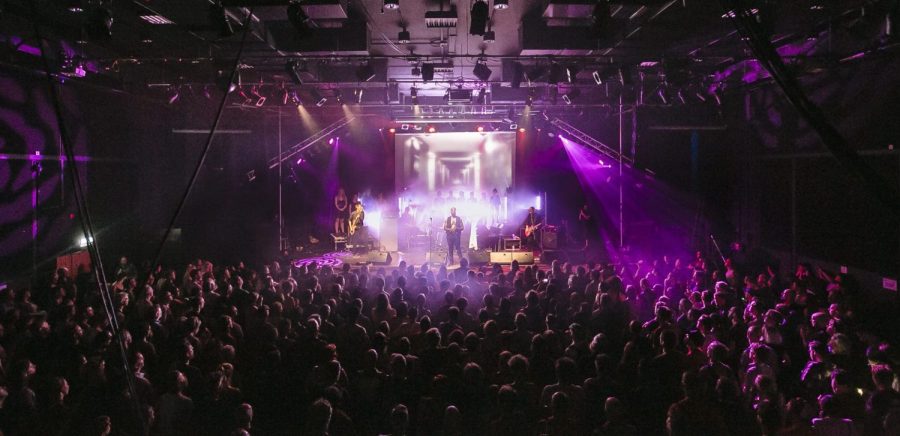
Oxbow Choir, 2017. Photo:SnapRockandPop
A depressing turn of events, and a great loss to the city, but simply finding a new locale of untapped warehouse space doesn’t seem to be on the cards. “Not necessarily, it could be our second phase; we could be working with something that is established where we are focussing on the programming for a change rather than working out where the toilets need to go.” As for the holiday camp model that has slightly died out, it’s a firmer no. “Y’know I had such good times at ATP but I wouldn’t want to replicate that. I think that was their USP, and I’ve got great memories of that, but I don’t think it would be our model.”
“An ideal venue would be working in partnership with a space that wanted us to be there, and valued us. It would be a partnership where they get something from it as much as we do. Somewhere that has that flexibility that you can create a little world while you’re there. It’s also got to be in a place that’s good for the audience as well: I’m thinking about reasonably priced hotels, good transport infrastructure, stuff to do outside of the main festival time, those sorts of things are all important as well.
“XOYO, which was The Mill, have been amazing to work with. They let us take it over and they let us work with them to run the bars and bring in Purity, so there’s an independent beer offer and stuff like that. It’ll be interesting to see what happens with the O2 because that’s the first ‘Corporate’ corporate venue that we’ve worked with in our now 20-year history. On the plus side, the Institute is a set-up venue, so there’s really good sight lines, there’s a balcony so people can sit down, and there’s infrastructure there in a way we’ve never had before.
“But we have no control over the bar; and we won’t be doing the artists’ merch there because they’ve got a blanket policy where they charge. For us, we’re really aware that the sort of bands that we work with, part of what keeps them sustainable is being able to sell their merch; and if the venue is taking 15% that’s taking a lot of money from them. So, we’ll create a different space for their merch. It’s working through all those things.”
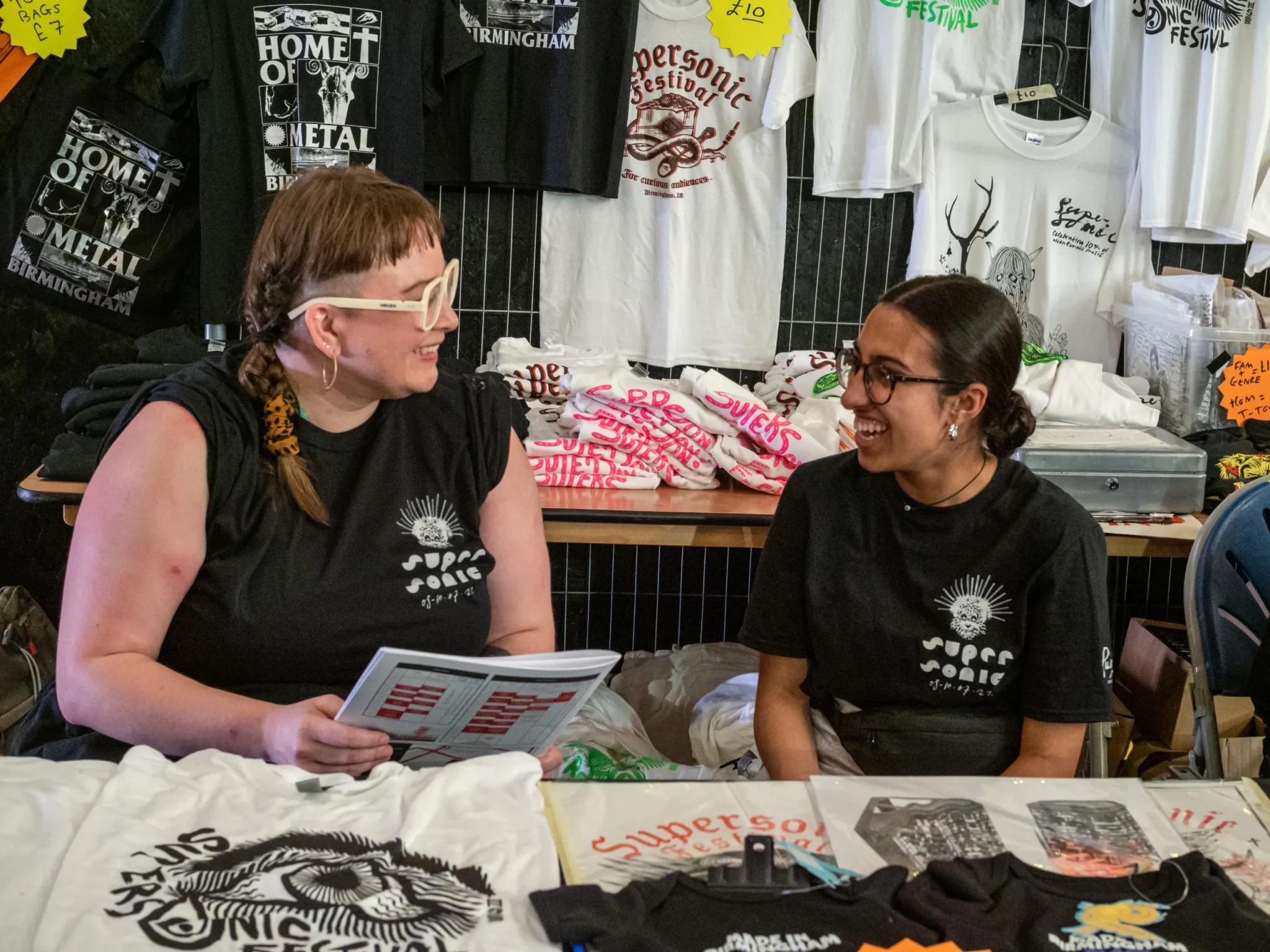
Photo: Ewan Williamson
With such an endless festival to-do list, I ask if she actually gets to see much of it. “The last couple of years. . . I’ve got such an amazing team now. In the early days, Jenny and I did like everything: we made the veggie chilli, we were trying to stage manage, Jenny was sewing the tote bags for our merchandise, we were folding all of the brochures ourselves. As the years have gone on, we’ve tried to professionalise it more by having a team, and we are still, relatively, a tiny team that make it happen; but they are really good in now taking a lead on stuff that happens behind the scenes. Still if something happens, y’know, it’s on my shoulders, and that’s quite a big burden to carry.”
“In the early days just making a festival happen with this kind of eclectic line-up (in 2003 we were the first people to do a festival that had like The Bug and LCD Soundsystem and Coil and Pram) just making something like that happen was a feat in itself. Then as I suppose I’ve become more confident, I’ve become more conscious of what our role is; more conscious of what the programming is about; and I suppose that comes with the responsibility of thinking about better representation of women say, better representation of punks of colour, so that’s evolved over the years.”
This aspect of the programming is kind of show not tell; rather than campaigning for better representation it simply offers a model of a better way. “There’s a lot of thought that I put into it behind the scenes, of thinking about that responsibility and using our programme as a way to showcase artists. It’s the artists that are doing that though, we’re just creating a space for them to do it without being overtly political; but in itself it is political, if that makes sense. I grew up going to DIY punk gigs and so that’s really what Capsule came out of – and being ethical, paying artists, feeding them, not trying to rip off your audience. I take that for granted but actually it is a little bit different. Those are like the core values of the festival really.”
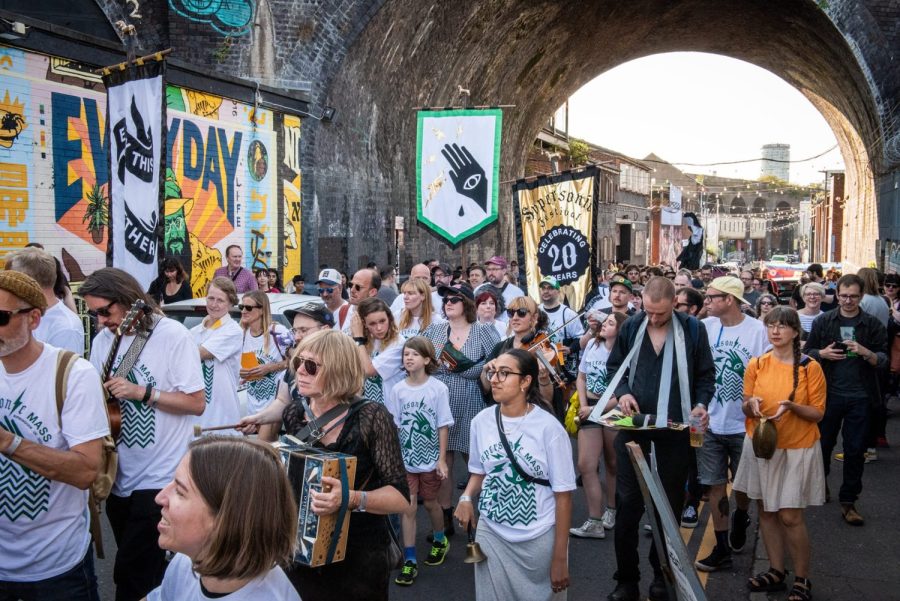
Supersonic Mass, 2023. Photo: Ewan Williamson
Those values reflect in the community of audience and artists, many of whom make a point of expressing how special it is from the stage. I think of Lankum’s Ian Lynch, last year, saying it was the best festival they’d ever played; or Jessica Moss, talking about how welcoming the atmosphere was, hitting the nail on the head when she said, “It’s not an accident, it’s a choice.”
The festival’s relaxed atmosphere creates an easy sense of community even if not everyone feels like marching behind a giant banner featuring 20 years of artists. “Well, not everyone’s a show off are they?” Meyer laughs. “Sometimes you don’t really take stock of what you’ve achieved, so it was quite a good moment last year to say actually the fact were still here at 20 years on is quite an achievement. It’s also scale and what you define as success. For me the fact that we’ve been able to stay fresh and relevant and be able to evolve, for me that’s creatively challenging – more so than having a shopping list of the it bands of the moment.”
This year’s line-up is, once again, ridiculously strong; and if it is to be a last stand in Digbeth, a fitting farewell. The festival’s future has always been unwritten, it’s dogged persistence something of a magical feat. “I often think that having made it work in Birmingham we can probably make something work anywhere, because it’s been so challenging to do it here. The fact that we have made it a success when we’re competing with European peers like Le Guess Who, Rewire festival and Roadburn – that have got such incredible venues and support from their cities, and a substantial amount of funding – the fact that we are still up there being compared to them, and being seen as shoulder-to-shoulder, is quite an achievement.”