Interview: The Emerald Dawn
We, as a band, take seriously the original drive behind progressive rock. Our message aims to be socially and politically progressive. Our music seeks to push new compositional boundaries...At the end of the day, we do everything by consensus...The band definitely feels much more like a community than a bag of individuals. And when we play live, today’s prog audience feels very much like a family coming together as one and sharing an experience.
I have been at A New Day Festival near Canterbury over the last couple of years, a great smallish festival that specialises in prog and blues. We first went in 2024 as the combined attraction of Tangerine Dream and Hawkwind proved too much to resist! Wandering in slightly late one day in 2025 I walked straight into one of the most beautiful, epic, sublime performances I have ever had the good fortune to encounter! I stood there transfixed for their whole set before finding out from various other onlookers that they were The Emerald Dawn and I had caught a good bit of their 2023 album In Time which I immediately bought.
Fast forward to June this year and I was able to catch them again, this time in Camden. A different set, including a track off their now released The Land, the Sea, the Air Vol 2, but one that was equally sublime, equally epic.
Turns out I was pretty late to the party as The Emerald Dawn formed in 2010, their first album Searching For The Lost Key coming out in 2014!
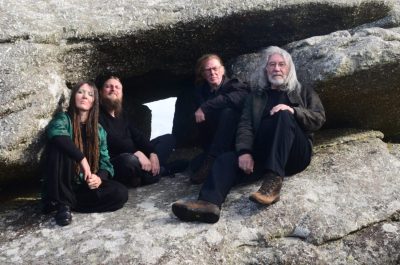
The band is comprised of Ally Carter (guitar, saxophone, keyboards and vocals), Tree Stewart (keyboards, vocals, flute, acoustic guitar, percussion), David Greenaway (fretless and fretted 6 string bass guitars) and Tom Jackson (drums). Originally started by Ally and Tree when living in Scotland they met Tom having relocated to Cornwall with David joining before the recording of the third album. Searching For The Lost Key was followed by Visions in 2017, Nocturne (2019), To Touch the Sky (2021), In Time (2023) and then The Land, the Sea, the Air Vol 1 and 2 in 2025 and 2026.
As I became more familiar with the band I realised there was a lot more going on than awe inspiring music and that in fact the band have a lot to say about our contemporary sociopolitical world and its effects on the natural environment and consequential climate change. Not surprising really if you consider that Ally, as well as being an academic and author of several books, has a history of environmental activism and was on the Board of Directors for Friends of the Earth!
Intrigued by the synthesis of Genesis adjacent prog rock and insightful, often environmentally conscious, lyrics I contacted Ally Carter to see if he would consider an interview exploring various aspects of The Emerald Dawn from their DIY model to plans going forward and he very kindly agreed.
E&D: Prog in the 1970s included bands that made political/social comments for good or bad, Selling England by the Pound by Genesis, ‘Don’t Kill the Whale’ by Yes and ‘2112’ by Rush for example. Have there been any bands that you were encouraged or inspired by lyrically both within and beyond prog?
Ally: For a very long time there has been music that has been part of the mainstream and music that has opposed it. Woody Guthrie was writing political songs in 1940. Many in the folk tradition sang or themselves wrote protest songs: Joan Baez, Bob Dylan, Donovan Leitch. That influence is clear in our composition ‘And We’re Left Wondering Why’, which, to me, is what happens when Flip Sloan’s ‘Eve of Destruction’, made famous in 1965 by Barry McGuire, collides with 1970 Soft Machine. 1969 saw the release of On the Threshold of a Dream by the Moody Blues, which is a clear call to reject the Establishment and join the counterculture. Released in the same year was King Crimson’s ‘21st Century Schizoid Man’, and if any track can be said to have launched progressive rock it is that opening salvo from their first album, In the Court of the Crimson King. And if “Innocents raped with napalm fire” isn’t political, then I don’t know what is.
But why do I talk about music in the late 60s — before the 1973 to 1978 music you mention? Because, it seems to me, progressive rock is seriously misunderstood today both by its critics and by many of those who currently listen to it or by the newer bands who play it. In the second half of the 1960s there were a number of protest movements: civil rights, feminism, gay rights, environmentalism, opposition to the US involvement in Vietnam, and within the USA itself protest against military conscription for that war — the draft. All of this came together in the counterculture, which wanted to build for itself a very different social order. And in rejecting the Establishment wholesale, the counterculture rejected its music. It wanted its own, new music. It wasn’t played on the radio in the UK, except by John Peel. But if you went to independent record shops you would find a small section called either underground or progressive. The counterculture was progressive. Its music was progressive. It is important to be aware that ‘progressive music’ in the late ’60s was a far wider category than what is called progressive rock today. It included everything from Tyrannosaurus Rex to Black Sabbath. What became progressive rock was the part of that wider category that was pushing musical boundaries the furthest. The counterculture was progressive and it was pushing boundaries across the board. It’s core music was the same. That is why, in the early seventies, part of that countercultural music came to be called ‘progressive rock’. Music wouldn’t be included in that category if it wasn’t pushing boundaries.
By the mid ’70s, little was left of the counterculture. And those who got into progressive rock at that time were, by and large, not countercultural fellow travellers. The same is certainly true of the next wave of progressive rock — the neo-prog of the early ’80s. So what has subsequently happened is that the progressive rock of the 1970s is now by and large looked at through eyes of those who came late to the party and who are not especially sympathetic to social, political or musical revolution. The result of this is that progressive rock has come to be a name, rather than a description, of a certain style of music — just as the Holy Roman Empire was neither holy, nor Roman nor an Empire. It was a geographical and political area that had a name that did not describe it, even though each part of the name sounds like a description. The term ‘progressive rock’ is similar. It now lumps together music that is long form, has unusual time signatures, requires virtuoso musicianship, and so on. But the word ‘progressive’ has lost its meaning. It is not uncommon for prog bands of today to compose what they and their audience think of as progressive rock by having a section that sounds like Yes, another that sounds like Genesis, another that sounds like Rush, and so on. But no boundaries are being pushed by composing that kind of cobbled together music. And why would such music need to have any progressive message when the word ‘progressive’ in progressive rock has lost its original meaning?
We, as a band, take seriously the original drive behind progressive rock. Our message aims to be socially and politically progressive. Our music seeks to push new compositional boundaries.
E&D: One of the things early punk has come to symbolise is a DIY aesthetic independent of the mainstream – is that a path TED consciously took with self releasing or was that more to do with financial reality in a capitalist society? The Emerald Dawn as (prog) punk!?
Ally: Let’s not forget that the Sex Pistols had a manager and were signed by a label — none other than Virgin Records! We’re far more independent and DIY than that… We do everything ourselves, apart from the physical manufacturing of CDs or vinyl records. We only play our own compositions. The Emerald Dawn has never recorded or performed a cover. We record ourselves. We mix and master those recordings ourselves. One of the band members, Tree Stewart, paints all the album covers. So, why do we do everything ourselves? First, because we can. We spent years learning how to play our instruments, learning musical theory, learning how the recording process works, and, in Tree’s case, learning how to paint (she has an art college degree). Second, because the technology is now available — and which is relatively cheap — that enables you to have your own recording studio. (There is a downside to this, namely that the digital technology that allows you to record, mix and master at home also lets people give your music away for free on torrent sites. And then there is the great streaming rip-off, with Spotify being the worst. And musicians need to eat.) Third, being able to do everything ourselves provides us with the opportunity for complete artistic control. We compose, record and release what we like when we like. We perform live what we like and, assuming we can get the bookings, when we like. We don’t have a label forcing changes to our music or telling us when an album is due. And we don’t have a manager telling us when or where our next gig is. In short, we are fiercely independent. And that allows us to be as progressive as we hope we are.
E&D: In a capitalist system that encourages us to derive an individualised sense of self based on consumption, bands like TED seem to model an alternative sense of self based on collective creativity. Would you recognise that suggestion or experience that tension?
Ally: At the end of the day, we do everything by consensus. David Greenaway, our bass player, who was a full-time professional musician from the age of 19 to 65, when he retired (and now plays only in The Emerald Dawn), says that this is the only band he has been in that isn’t plagued by ego problems. The band definitely feels much more like a community than a bag of individuals. And when we play live, today’s prog audience feels very much like a family coming together as one and sharing an experience.
E&D: At a time when conventional protest is being closed down and suppressed it could be argued that the arts are an important space for contestation of the hegemonic and the sustaining of a counter discourse. Is that something TED are conscious of when writing or is it a less self conscious expression of beliefs and values? Art as activism?
Ally: I can’t speak for the rest of the band, but for me our music is certainly art as a form of activism.
E&D: How does the creative process work for TED? How does a song come about? Lyrics first, melodies, riffs? Do lyrics inspire music or vice versa?
Ally: A number of music critics have said that The Emerald Dawn doesn’t sound like any other band. There is a reason for this. One of the ways in which we try to push musical boundaries is by exploring scales that are rarely, if ever, played in rock, folk or popular music. Jazz musicians sometimes play some of the scales I have in mind, but jazz rarely stays on a single scale. It frequently switches scales, so doesn’t tend to explore scales extensively in the same way we try to do. For anyone who doesn’t know anything about the theory of harmony, indulge me for a moment while I attempt to explain what I’m talking about.
If you play a note on a guitar and then move up one fret and play, you have moved up what is called a ‘semi-tone’. If, instead, you move up two frets and play, you have moved up two semi-tones, which, unsurprisingly, is called a ‘tone’. The vast majority of western pop, rock and folk music is based on one long pattern. It goes up in these intervals: tone, tone, semi-tone, tone, tone, tone, semi-tone, and then repeats, and repeats. Try it yourself. Pick up a guitar. Play a note on one fret, then move up two, then move up two, then move up one, then move up two, then move up two, then move up two, then finally move up one fret. This set of intervals is what you hear when you walk past a window through which you can hear someone learning to play their instrument. It goes do, re, mi, fa, so, la, ti, do. That is the major scale. If you start on the note G and then move up tone, tone, semi-tone, tone, tone, tone, semi-tone, then you have just played the G major scale. If, instead, you begin with the note C and then move up tone, tone, semi-tone, tone, tone, tone, semi-tone, then you have just played the C major scale. And so on. If instead of starting on do, you start on re or mi or whatever, then you have changed the mode. If you start on the sixth note (which gives you the sixth mode), then that is the natural minor scale. In other words, the natural minor scale (starting on the sixth note of the major scale) goes tone, semi-tone, tone, tone, semi-tone, tone, tone, and then repeats. And that sounds like this: la, ti, do, re, mi, fa, so, la. In a nutshell, there is a repeating pattern from which is derived the vast majority of western pop, rock and folk music. You can begin in different places, say re rather than do. The first note can be different, say D rather than C. But viewed abstractly, the long pattern is the same. And from that pattern comes the melodies and the chords we hear every day.
But in the grand scheme of things, this is but a small part of what, potentially, can be played. For there are many different patterns. For example, the harmonic minor scale goes tone, semi-tone, tone, tone, semi-tone, tone-&-a-half, semi-tone. No matter where you begin on the major scale (in other words, no matter which mode you play) you won’t find that set of intervals. The jazz melodic minor scale goes tone, semi-tone, tone, tone, tone, tone, semi-tone. And no matter where you begin on the major scale or the harmonic minor scale you won’t find that set of intervals (for neither has tone, tone, tone, tone). There are many of these scales, all different to each other. Some have the possibility of chords you don’t hear elsewhere. The augmented chord, for example, is found in several scales but not in the major scale. The various scales have their own possibilities of chord progressions. And they have their own possibilities of melodies. So, in a nutshell, each scale forms the basis of different chord progressions and each forms the basis of different melodies. It is through exploring such different scales that we try to push the present musical boundaries of rock music.
This is why our music doesn’t sound like other bands’. Some examples: The middle section of ‘Shadow in Light’ is in the harmonic major. The middle section of ‘In Search of the Lost Key’ is in the East Indian Scale. The first half of ‘The March of Time’ is in the diminished scale. ‘While Oceans Die’ begins in the jazz melodic minor, then moves to the harmonic minor, and then moves to the double harmonic minor. The beginning section of ‘Under Changing Skies’ is in the Hungarian Major. The middle section of ‘Song of the Rainforest’ is in the Neapolitan Minor. All of these scales contain different intervals. And if all you ever listen to is the major scale (or the natural minor scale, which, as I said, is the same pattern but starting in a different place), then our music might sound very strange on first hearing. We certainly won’t sound like the vast majority of other bands.
With that in mind, our creative process tends to be like this. Tree mainly, but not always, comes up with the chord progression. David comes up with a bass line for that set of chords. Tom finalizes the rhythm, and I usually, though not always, come up with the melody. In practice, what often happens is that Tree decides which new scale she would like to explore. She finds, derived from that scale, a chord progression she likes. Then the band jams on that chord progression by playing the various notes of the scale in question. When we hear something we like, we’ll think about what emotions, images, and so on, it evokes. From that we can build up a musical picture or from several such pictures tell a musical story.
Sometimes we have a topic in mind to begin with. We then explore different scales to see how we might best convey and develop that topic. Sometimes the topic is such that the lyrics are what first appear. Sometimes not.
E&D: The lyrics to ‘Musique Noire’ on the 2017 album Visions seem to have a real sense of optimism as it tracks a resurgence of interest in, and activism around, environmental issues? Fair reading? And another track on the same album, ‘A Vision Left Unseen’ reads as prescient in a time when environmental and human rights protesters are framed by the mainstream press and governments as extremists!
Ally: You can’t take the lyrics of ‘Musique Noire’ in isolation. Tree always paints the cover artwork with a gatefold sleeve in mind. Sadly, Visions never came out in vinyl. But if you look at the CD booklet, you can open it out and see on a smaller scale the outer cover. It is of a strange face with a pair of eyes. The face is made up of two cave entrances. In the middle of one is the sun. In the middle of the other is the moon. The music of the album concerns two very different visions. Had it come out in vinyl, it wouldn’t have had a side A and a side B or an A-side and a B-side. It would have had two sides with one labeled the Upside and the other labeled the Downside. The whole of the Upside would have comprised ‘Musique Noire’. That track tries to convey what it was like being within the environmental movement from the very early 1970s onwards. It ends with what we might be able to achieve if we come together as a mass movement with an environmental consciousness. So, one vision starts in the past and looks towards the best possible future. The vision portrayed on what would have been the Downside of the vinyl begins with where we are now and presents a very different possibility of where we might end up. The first track on what would have been that second side, ‘A Vision Left Unseen’, views the present as a nightmare. The second track, ‘Waves’, is about the end of the world, or at least the end of the world as we know it. The words ‘As the waves roll in’ are about sea level rise. What then about the last track? How do you follow the end of the world as we know it? To me, ‘Stranger in a Strange Land’ consists of three vignettes. The first sounds coastal. The second, perhaps moving in land a bit, sounds like some remnants of industry hanging on (perhaps Mad-Max-like). The third, perhaps moving even further in land is a wasteland. In others words, what follows ‘Waves’ is meant to be post-apocalyptic. The final section of ‘Stranger in a Strange Land’ is a threnody to a species with such incredible potential, but through choosing social, economic and political systems that reward competition and division rather than co-operation seems most likely to destroy itself and everything around it.
E&D: Your album In Time seems to be exploring ideas around temporality – our subjective experiences of time, how the past, present and future relate to each other?
Ally: The first track is about wanting a special moment to last forever. But you could only do that by taking it out of time. Taking a moment out of time would be somewhat disruptive. And trying to make things last beyond their allotted time can, indeed, be disruptive for oneself and those around you. The second track is about how time is subjectively experienced — how it feels depending upon one’s state of mind. The last track is about no matter how subjective we think time might be, it is nevertheless relentless. We are, no matter what we think of it, continually aging and heading towards our deaths.
E&D: It’s been suggested that extractive, industrial capitalism and human organisation as we know it are on a collision course and that sooner or later we are going to have to choose between the two, is that something you point to?
Ally: That is indeed what both volumes of ‘The Land, the Sea, the Air’ are about.
E&D: ‘And We’re Left Wondering Why’ has a similar feel to Hawkwind’s 1979 track ‘Uncle Sam’s on Mars’! After describing ecological degradation on Earth, Robert Calvert went on to write “And science is making the same mistakes, but Uncle Sam’s on Mars, and no one down here knows how to work the brakes, but Uncle Sam’s on Mars”. It’s interesting that these ideas have been given expression for so long in Rock music!
Ally: I don’t know that track. But from what you say it sounds like there are clear similarities.
E&D: The 2021 film Don’t Look Up and your track ‘Under Changing Skies’ include the challenge to not look away from the climate catastrophe that is gradually engulfing us. Are you encouraged that acceptance of climate change is now pretty mainstream or does Don’t Look Up still resonate!
Ally: Sadly not. The majority of the mainstream press is extremely right wing, and does everything it can to direct attention away from what we are doing to the environment. Social media, in particular Facebook and YouTube, is a major source of disinformation. Many of those who think they are radical deny anthropogenic climate change. They think it is a ploy by the state in order to tax them, when, in actual fact, their views have been manipulated by the oil industry and the wealthy libertarian right, both of which want no limitations on their profiteering. There is currently a climate-change-denying government in the USA, and Reform might well win the next election in the UK, and it, too, is climate change denying. Suffice it to say, after being part of the environmental movement for over 50 years and seeing how much work was required to bring about small changes for the better, and how quickly they have been rolled back in the USA, I don’t find it easy at this moment in time to feel optimistic.
E&D: You must be hugely encouraged by the response to your albums in the Ppog world! Really positive reviews, #1 in ProgArchives 2026 Chart, top 10 album and band in the 2025 Prog Readers Poll!?
Ally: Beyond our wildest dreams!!!
E&D: What’s next for TED? Will The Land, the Sea, the Air become a trilogy? Will you head in a different direction? Lots more festivals and gigs?
Ally: It won’t be a trilogy. The plan had always been to focus upon the seas and the air in the first volume, and to focus on the land in the second. I expect the next album to be very different. What we would very much like to do is play more in Europe. But as we are pretty much unknown there it will only happen if we get a few more festival slots on the other side of the channel.
The Emerald Dawn have some Autumn dates in the UK this year – starting this September they play The Con Club, Lewes (with Dandelion Charm) on September 26 and then The 1865, Southampton (with Candacraig) on September 27.. They then play the following:
October 18, 2026: The Arena, Crewe, UK (with Monkey Trial)
October 19, 2026: Ivory Blacks, Glasgow, UK (with Comedy of Errors)
October 20, 2026: Backstage at The Green Hotel, Kinross, UK
October 22, 2026: The Cluny, Newcastle, UK (with Candacraig)
October 23, 2026: The Forum, Darlington, UK (with Candacraig)
October 24, 2026: Seven Arts, Leeds, UK (with This Winter Machine)
November 1, 2026: Tavistock, UK (with Franck Carducci & The Fantastic Squad).
To check out their music and buy albums visit their Bandcamp, and for more info on the band visit their website.
Referenced:
Arcwielder, Scott. 2023. ‘Tree Stewart of prog rockers The Emerald Dawn talks new album ‘In Time…’, painting, staying positive, keyboards, and why everyone should try the trapeze’ oldmansmettle.com (https://oldmansmettle.com/2023/10/15/tree-stewart-of-prog-rockers-the-emerald-dawn-talks-new-album-in-time-painting-staying-positive-keyboards-and-why-everyone-should-try-the-trapeze/)
Calvert, Robert, Brock, Dave, House, Simon and King, Simon. 1979. ‘Uncle Sam’s on Mars’ PXR5 Charisma Records.
Holloway, John. 2005. Change the World Without Taking Power (London and New York: Pluto Press).
Klein, Naomi. 2014. This Changes Everything: Capitalism Vs The Climate (New York: Simon & Schuster).
Lazland,. 2023. The Emerald Dawn (https://lazland.org/interviews/the-emerald-dawn)
Reijman, Alison. 2024. ‘The Emerald Dawn in Time’ loudersound.com (https://www.loudersound.com/features/the-emerald-dawn-in-time)
The Emerald Dawn https://www.theemeralddawn.net
The Emerald Dawn https://theemeralddawn.bandcamp.com/music
West-Pavlov, Russell. 2013. Temporalities (Abingdon: Routledge).
Image courtesy of The Emerald Dawn.