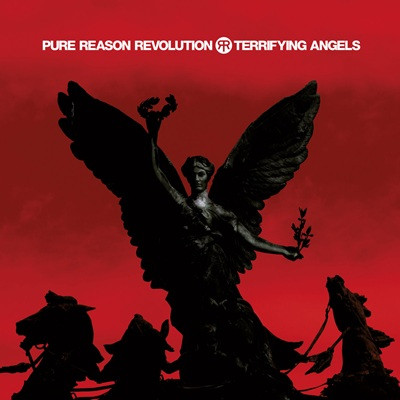
When you think of album covers that almost tell a story by themselves, you think of Sabbath Bloody Sabbath, The Dark Side of the Moon, In the Court of the Crimson King, Lizard, Close to the Edge, and Moonmadness. Each of these covers creates its own visual world, and once the music starts playing, that artwork almost comes alive.
For Pure Reason Revolution’s follow-up to Coming Up to Consciousness, Terrifying Angels, the artwork feels like a striking nod to the upcoming re-release of Ken Russell’s controversial 1971 cult classic The Devils, especially with the film receiving renewed attention through its restoration.
Released through InsideOut Music, Terrifying Angels explores themes of duality, salvation, transformation, destruction, and the consequences of the damage people leave behind. There is a constant feeling of darkness running through the record, but it is not darkness for the sake of being dark.
Instead, Pure Reason Revolution use it to explore what happens when people are forced to confront themselves, their actions, and the things they would rather leave buried. Recorded at Eutropia in Rome, Italy, the album finds the band firing on all cylinders and proving once again that they are much more than just the four-letter p-word: prog.
The guest contributions make the record even more interesting. Having Lunatic Soul’s Mariusz Duda, Kristoffer Gildenlöw, Losers’ Paul Mullen, Greg Jong, and Kenny Fitzgerald lend their talents gives the album another layer without taking away from Pure Reason Revolution’s identity. These collaborators feel more like reinforcements than outsiders, helping Courtney, Shireen, and Kesavaram push this surreal and sinister musical world even further.
When you first hear ‘Black-Arrow Acrobats’, you might think you have walked into some dreamy indie-rock landscape. There is almost an Arcade Fire-like quality to the opening, with the Mellotron helping create a hazy, lullaby-like atmosphere. For the first couple of minutes, everything feels strangely peaceful. Then, suddenly, the doors come crashing open and the song explodes into a much heavier attack.
What makes the transition work is that Pure Reason Revolution never completely abandon the melody. Shireen’s vocals provide a beautiful contrast against the heavier instrumentation, particularly when she shares the vocal space with Courtney. Beneath them are pounding riffs, new-wave synths, post-punk influences, and a structure that occasionally feels almost radio-friendly. Yet the band never allows it to become too comfortable.
There are also moments where Pure Reason Revolution seem to tip their hat toward the French duo Air, particularly their work on Sofia Coppola’s The Virgin Suicides. That soundtrack captured a very specific feeling of suburban isolation and melancholy, and Pure Reason Revolution seem to take some of that atmosphere and drag it into a much darker environment.
You can hear other influences lurking around the edges, too. Agitation Free’s ‘Haunted Island’ comes to mind, particularly the way it embraces the kosmische Musik tradition while creating a sense of motion and space. Pure Reason Revolution then take that idea and push it toward something much heavier.
‘Haywire Heart’ moves into metallic and spaced-out territory, while the opening track, ‘Spin Like Fire’, unleashes some seriously nasty riffing. The latter feels like a six-headed beast charging through a small town, leaving destruction behind as its Middle Eastern-flavored bass gallop keeps the whole thing moving.
Shireen’s vocals are one of the album’s biggest weapons. She does not simply sing over the music; she pulls you into it. On ‘Spin Like Fire’, when she sings, “I let you in / And watch your freedom burn / You’re free from sin / Now let the demons come”, there is a sense that she has finally reached her breaking point, where the gloves are coming off.
It feels like she is standing in front of an antagonist and forcing them to look at themselves. All the abuse, neglect, manipulation, and damage they have caused are reflected back at them like a hallway filled with mirrors.
And remember the old saying: play stupid games, win stupid prizes? Shireen is definitely not someone you want to mess with. Cross the line with her, and she will kick you straight in the family jewels while you go running home to mommy whilst shitting your pants, nonstop! She can hit those notes with enough power that you might want to think twice before you start talking trash. Watch your tone around her.
The title track, ‘Terrifying Angels’, takes things into a more mysterious direction. Early Floydian textures, sliding guitars, eerie keyboards, and ghostly atmospheres create the feeling of entering some kind of crystalline cave. Rather than charging forward immediately, the song encourages you to stop and think. It feels almost meditative, as though the music is preparing you for a journey into your own head. Then Pure Reason Revolution pull the pin.
‘Rumination Ruin’ sounds like the soundtrack to a dystopian battlefield. Kesavaram’s click-clacking percussion gives the song an almost mechanical quality before the heavier instrumentation begins to tear through the arrangement. The guitars become more aggressive, and the entire piece feels like it is constantly threatening to fall apart. It is chaotic without being completely uncontrolled, which is one of the things Pure Reason Revolution do so well. After that assault, the band shifts back toward a darker and more reflective mood with ‘Below Radiance’.
There is a strong late-’70s and early-’80s new-wave atmosphere here, with Joy Division-like melancholy sitting alongside Kraftwerk’s colder futuristic textures. It is another example of Pure Reason Revolution taking influences from different corners of music history and somehow making them fit together.
Then comes the big one: ‘Hold Your Wrath’. Clocking in at nearly fifteen minutes, this is where Pure Reason Revolution really show their progressive credentials. The song feels enormous. Imagine standing in the middle of the Mojave Desert while a sandstorm slowly builds in the distance.
At first, you can see it coming. Then the wind gets stronger, the sky gets darker, and eventually you realise there is nowhere to hide. A layered electric guitar establishes the foundation, gradually building the tension.
The drums eventually enter with increasing force, while the riffs bounce back and forth like a desperate cry coming from somewhere in the distance. There is a feeling of someone approaching the edge of madness, and this is where my mind immediately goes into DC territory.
The atmosphere reminds me of the darker corners of Gotham City, particularly the kind of fever-dream storytelling you get from DC’s more psychologically twisted stories. It is almost as if we are watching the beginning of Batman: Bad Seeds unfold through sound: everything is familiar, but something is deeply wrong underneath the surface. The music becomes the city itself, with paranoia, violence, and madness spreading through the streets.
Then the song takes another unexpected turn. An ambient passage emerges, bringing to mind Aphrodite’s Child’s ‘All the Seats Were Occupied’, along with the Rhodes textures of the Doors’ ‘Riders on the Storm’.
Add the jazz-inspired drum pattern, spaghetti-western guitar flavour, country-like touches, and even a hint of Bo Hansson’s Lord of the Rings, and suddenly the band has created this bizarre musical crossroads where none of those influences should logically fit together, yet somehow, they do.
That is one of the best things about ‘Hold Your Wrath’. It refuses to stay in one place.
Eventually, the heavier elements return and everything starts collapsing around us. This is where I start picturing one of those classic DC scenarios where the villains have finally pushed things too far and the entire city is about to pay the price. The house of cards in Poison Ivy’s hands as mayor begins to crumble, while Vandal Savage’s Supermax prison feels like it has been built on a stick of dynamite with the fuse already burning.
The prisoners are ready to take control, the authorities are losing their grip, and Barbara Gordon suddenly finds herself thrown into another fight for survival in Barbara Gordon: Breakout. It sounds ridiculous when written down, but that is exactly what the music feels like: a completely surreal comic-book catastrophe where everyone is fighting for control while the world around them slowly falls apart.
We hear classical touches, more reverberating guitar effects, and that unmistakable Kscope-era Steven Wilson influence seemingly rising from the grave during the final stretch. The music keeps moving forward as though the characters have escaped the destruction behind them and are heading toward some strange new paradise.
And that is ultimately what makes Terrifying Angels such an interesting addition to Pure Reason Revolution’s catalog. The band still carries that electrical spark that has always made them special, but here they have connected it to something much darker and more unpredictable. They are not simply trying to recreate their past.
They are taking progressive rock, alternative music, electronic textures, post-punk, heavier riffing, and cinematic atmosphere and throwing them into one strange, beautifully damaged world. The DC imagery fits because Terrifying Angels often feels less like a conventional album and more like the soundtrack to a graphic novel that has gone completely off the rails.
One minute you are walking through a deserted street, the next you are trapped inside a supermax prison, and five minutes later you are watching Gotham disappear beneath a wall of noise. Terrifying Angels may not be for the faint of heart, but that is part of the appeal.
The more you listen, the more details begin to surface. The riffs hit harder, the atmospheres become stranger, and the quieter moments start revealing what is hiding underneath all that noise. Pure Reason Revolution have once again opened the door to somewhere unfamiliar. All you have to do is step through it. Just don’t expect to come back completely sane.