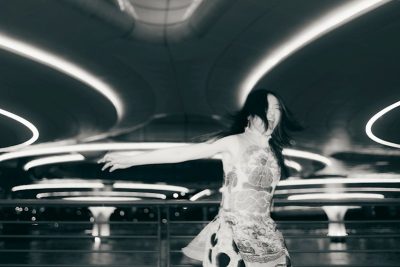
Interview: otay:onii
Music has taught me how to feel again as a human being.
There are interviews where the conversation takes you somewhere unexpected. Speaking with Chinese-born, Berlin-based artist otay:onii, also known as Lane Shi, turned out to be one of those occasions.
Our conversation began with an unlikely coincidence: Lane grew up in Haining, a Chinese city where I regularly spend time teaching. From there we talked about childhood, cultural identity, creativity and the importance of human connection. Fresh from a demanding European tour, Lane discussed her album Love Is in the Shit, her three-year Roadburn residency and her experiences with The Ocean Collective.
E&D: First of all, I have to mention something of a coincidence. I spend quite a lot of time working in Haining, where you grew up. When you return, does it still feel like the place you remember from childhood?
Lane: It has changed quite a lot. Everything I remember about Haining from childhood is gone. The buildings are gone, the bridges are gone, even my grandparents’ little apartment is gone. My parents now live on the outskirts of Jiaxing, and most of my memories of their home are relatively new.
My childhood in Haining was a transitional period. My parents went away to earn money, first my father and then my mother, and I stayed behind for two years. It was difficult as a child, missing your parents when they were far away and always working. I stayed with relatives, but they were working full-time too, so I ended up at boarding school. After just two weeks I was expelled because I caused too much disturbance in class!
I moved to Guangzhou to be with my parents when I was eleven. Now I mostly return to Haining for Spring Festival, to see my family. Even the celebrations have changed. My mother’s family comes from a village, and we used to have these huge dinners with tables set up outside. Now everybody goes to restaurants. It’s easier, but it’s different. There are so many things I remember from childhood that aren’t there anymore.
E&D: Do you think those early experiences, and your memories of growing up in China, have influenced the way you approach music?
Lane: On my mother’s side of the family there are a lot of traditions. When somebody passes away there are ceremonies we have to perform. If you look at them through a modern lens they can seem quite superstitious. You might have to kneel seventy-seven times if you’re a close relative, or walk around the coffin calling the name of the deceased. There is always a band playing loud music throughout the ceremony.
There are ghost stories and superstitions, and family memories. My father remembers his mother calling his name from a bridge that doesn’t even exist anymore. We share old family photographs on WeChat. Those memories are beautiful, and for my parents they’re enormous because they shaped them. It’s important for me to participate in those memories because I can see fragments of who I am within them.
I also find it fascinating to see how China has changed. So much energy used to be focused on infrastructure, business and improving people’s quality of life. Now there are more opportunities for cultural preservation. I’m part of a generation where my parents could give me choices that weren’t available to them. I could study in China or abroad, and I chose to go abroad.
My years in Guangzhou were especially important because that’s where I started listening to rock music. My father was suspicious of what was on my iPod. He asked, ‘You’re not listening to The Beatles, are you?’ He never graduated from high school but built a business through his diligence. He has a wonderful sense of humour, but he carries the trauma of working in industry too.
I hope my life can be about being with friends who care, growing together and creating beautiful things and memories. But I’ve learned a difficult truth: you cannot heal others if you haven’t healed yourself. I’m still on that path of healing.
E&D: On the opening track of Love Is in the Shit, ‘Have You Ever’, you sing in Tuhua, the dialect spoken around Haining. Does singing in that language allow you to express different emotions from those you experience in English?
Lane: Absolutely. People of my generation who were born in China and went abroad to study are almost a social experiment. I experience different emotions, behaviours and social expectations when I speak English compared with Tuhua.
I only really speak Tuhua with my parents and close family. When I switch into that language, another part of my consciousness becomes active. With ‘Have You Ever’, I think those two worlds collide.
I went to the United States to study when I was younger. I have beautiful memories from that time, but leaving one of my bands was heartbreaking. I came to Berlin because I wanted to heal, to be somewhere I barely knew anybody, to see the world through a new lens and leave old assumptions behind.
That isolation brought me back to my earliest memories of China, including ghosts and superstition. I missed my friends in America and wanted to be part of their lives, while remembering things from childhood. It was all connected by a longing for belonging and a sense of home.
I don’t know exactly why I wrote ‘Have You Ever’ in Tuhua. I think it came from a dream. I saw a face hidden behind a veil in my burning apartment. When I opened my eyes, my window was open and the curtain was moving in the wind. It was memory and reality colliding.
E&D: The album title Love Is in the Shit suggests that something beautiful can emerge from difficult experiences. Is that where the idea came from?
Lane: Yes. And when I say shit, I don’t necessarily mean it literally! People have asked whether I have a shit fetish, and the answer is no.
I mean the difficulties and obstacles in life. Through those things you see what is important to you and what speaks truth and light to you. I don’t believe anybody has gone through life without heartbreak, but not everybody can admit how deeply it affected them and take the steps towards healing.
I was struggling and didn’t know a way out. When I wrote the album, I cast a wish for myself to move beyond that impact. It hasn’t made everything easy, but it has given me a chance to keep moving in the direction I want to go. It keeps asking me whether I’m really ready. Beyond the shit, there is love.
E&D: Speaking of shit, there’s also that wonderful 3D-printed poo in your live setup. Where did the idea come from, and what does it actually do?
Lane: It’s a MIDI controller, basically a potentiometer controlling the soundscapes in my session. I’ve mapped it to different effects. When I turn it one way, everything starts shaking and struggling, as though something enormous is trying to squeeze through a tiny hole. Turn it the other way and it’s as if that thing has finally passed through and is expanding to occupy the universe. There are states in between that I improvise with using my voice.
There’s symbolism too. The lotus flower connects to Nezha, the mythological figure born from a lotus. I love that character because he’s a stubborn child who won’t give up on what he thinks is right. A bit like me!
The shit represents human beings, because we’ve done so much damage to the world. It also represents my experience of dealing with visas and immigration. That process can be degrading and dehumanising. During my years in the US I met kindness, but also situations that forced me to confront the differences in how people are treated because of where they were born. That’s another pile of shit. Using the object live is about finding some light within all of that, trying to create a kind of alchemy.
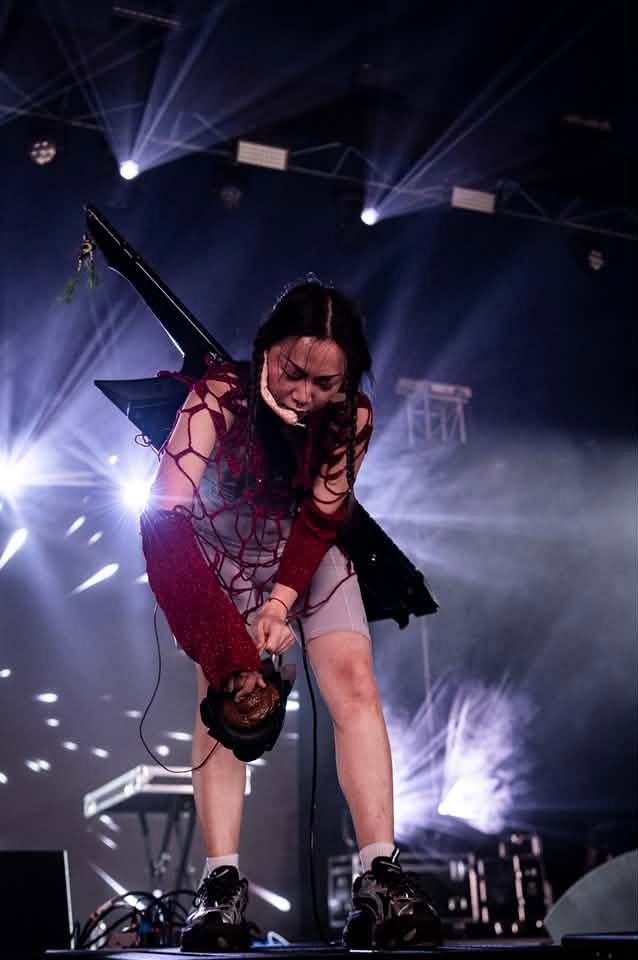
otay:onii – ArcTanGent 2026 – Magda Campagne
E&D: There’s humour in your music too. On ‘World Class Citizen’, I understand that strange, fragmented vocal section came from a software error you decided to keep?
Lane: Yes! It was an error in Ableton while I was working on ‘No Talent’. The vocal take started jumping around and changing length, making this funny, jumpy vocal line. I recorded it back into the session.
‘World Class Citizen’ is a joke about the idea of being world-class. There’s so much classism in the world and it makes me uncomfortable. I wanted to play with that and lead into ‘No Talent’, which is partly a joke about myself.
I don’t really believe in talent in the usual sense. We can accumulate skills, but what we call talent has something to do with memory, our ability to extract something from this long chain of human experience. I think we’ve become disconnected from our collective memories. For me it’s about recovering the ability to sense and feel those things. There aren’t many lyrics because it’s more about a feeling. I want to lead people towards a door, but they have to open it themselves.
E&D: You’ve also joined The Ocean Collective, and your vocals really stand out on Solaris. The band has long been driven by Robin, so how much creative freedom did you have? I imagine the process was different from making your own music.
Lane: When I joined The Ocean Collective, I had enormous hopes of bringing everything I could into the band, including writing lyrics and melodies. But I found the creative process difficult. My English was criticised, and I wasn’t really able to write my own lyrics because there was a particular style and grammatical approach the band wanted to maintain.
That isn’t how I approach writing. I care about poetry. I care about things that might not make grammatical sense but somehow make emotional sense. Our creative frequencies weren’t aligned. It was difficult to sing and memorise lyrics when I didn’t necessarily connect with what they were about.
I understand Robin’s perspective. It’s the first album with a new lineup, and he has a direction he wants to pursue. Perhaps later, with more trust, there can be more freedom. I know the album means a great deal to many people. People have come up to tell me how wonderful it is, and Robin deserves credit for that. But in terms of writing together, I don’t feel I had much creative input or control. I even feel that another female vocalist could replace me without much difficulty.
E&D: That surprises me, because I think your voice brings something distinctive to the record. Do you think there could be opportunities for more collaboration in the future?
Lane: I think everybody needs to be able to write together in a band. There are things I appreciate about the experience. On ‘Simulacra’, for example, there’s a line towards the end about a hand. After going back and forth rewriting lyrics with Robin, I was able to keep it, and I’d like to sing that line in the future.
I also have very good things to say about Enrico, the other singer. He’s a wonderful soul and very talented. I hope he can gain more creative control and bring even more to The Ocean. I wish Robin the best too. He’s a busy person, but he’s also a kind soul. Maybe it wasn’t the right time for the collaboration I’d imagined, at least on this album.
I’m still going on tour with The Ocean in November and December. I wouldn’t go on tour knowing I couldn’t deliver. I’m excited to spend time with everybody and create beautiful memories. Five years ago I might have seen things as zero or one. Now I recognise the complexity of humanity and the potential for good in people. I want to hold on to that.
E&D: Moving on to Roadburn, a festival very close to my heart. You’ve been given a three-year residency with the freedom to develop a different performance each year. That must be an extraordinary expression of trust.
Lane: Absolutely. That kind of trust is hard to come by. I’ve been doing performance art for about ten years, but Roadburn has given me the opportunity to present it in ways I couldn’t before. I want to shout out to Becky ( plz check out her Slowpoke on Substack) for pushing the envelop on this one! They’ve supported me in exploring what I want to convey.
Roadburn is special because people care about music, movement, progressive thinking and community. Everybody feels part of a larger family. Walter has put so much energy into that festival. Even with the difficulties he’s faced with his eyesight, he’s still there and still showing how much he cares.
I remember watching AYA at 013 and Jaimy(crew at 013) mentioned Walter getting so excited that he raised his crane into the air. Moments like that show you something genuine about a person. You can’t hide that authenticity.
E&D: Was there a clear plan for all three years? The performances seem different, but also connected.
Lane: The first year was based on my acoustic piano and voice album, True Faith Ain’t Blind. The trust of the residency gave me confidence to dive into an uncompromising world.
In the second year I arranged six Chinese lullabies into rock songs. We designed costumes for four performers representing the four auspicious beasts of Chinese mythology: the dragon, vermilion bird, turtle entwined with a snake, and tiger.
My childhood memories are fading, and I wanted to remember them through music. I was also thinking about children around the world who have lost their families and face difficult years ahead. The beasts became a wish of protection for them.
We also created a moon made from sugar, decorated with osmanthus petals. Sugar drawings were a big part of my childhood. At the end I brought the moon down, cracked it open and shared the candy with the audience. It was about sharing fragments of our realities, hoping we might build something more whole together.
E&D: And what about the final year? Do you know where you want to take the performance?
Lane: I’m developing something around the idea of home. What is home? What does it mean to feel at home?
I’ve invited Colin Marston from Krallice and Dante from Mourning [A] BLKstar to collaborate, and we’ve started composing and making demos. I’m also working with a lighting engineer to transform the atmosphere of 013. I want people to walk into the room and almost forget they’re in 013, to feel that they’ve entered another environment.
There’s a lot of work to do, but I enjoy the process. The audience experiences the outcome; I get to experience the journey of making it.
E&D: Given that you’ve lived on several continents, the question of home must be particularly complicated. It seems to connect back to childhood and memory.
Lane: Yes. Those fragments of childhood and memory lead towards the bigger question of what home means. It’s something I’m exploring.
E&D: You’ve spoken about music almost as a philosophy. What has making music taught you that you might not have learned another way?
Lane: Music is action. Music is alchemy itself for me. I’m deeply influenced by writing and film. When I experience great art, I digest it and express it through music. Music becomes the action of giving back.
It’s like theory and practice. Theory is everything you’ve learned and perceived, everything you’ve been cooking up in your mind. Practice is putting it into the world, making something from it. That requires skills and wisdom, but also being lenient with yourself and others, and telling the truth while still wishing for the best.
Sometimes you listen to a great album or see a performance and it makes you cry. You feel something powerful but can’t put it into words. Music has taught me how to feel again as a human being. Our lives are musical. If you listen closely enough, there’s music in everything. I hope through making music I can change not just my own state of mind but somebody else’s too.
E&D: I know what you mean. Some concerts leave you feeling privileged simply to have been there. There’s something about that shared experience you can’t replicate.
Lane: Absolutely. We were watching Woodstock footage, Primus and Nine Inch Nails. The footage is wonderful, but it isn’t the same as being there. The audience contributes energy to the musicians, and the musicians give something back. I remember Nine Inch Nails covered in mud, with instruments malfunctioning, and seeing how they responded.
We talk a lot about AI, but what it can’t recreate, at least for now, is the physicality of being together: warmth, vibrations, energy moving between people. A live concert creates that chemical reaction.
When I think of the people who’ve supported me and the audiences I’ve played for, I know I couldn’t have experienced this in the same way alone. That’s the miracle of being human.
E&D: I remember seeing you at Roadburn with Elizabeth Colour Wheel. That was a remarkable performance. Do you feel you’ve now found more confidence in your own artistic identity as otay:onii?
Lane: That was really fun. I think that group created something beautiful, and I’m grateful for it. Who’s to say something like that couldn’t happen again, even with different people?
With my solo work, I’ve only recently started to take confidence in it. I’ll continue and keep going, because it’s essential to what I do. Music is my teacher.
E&D: Before we finish, is there anything else you’d like to share?
Lane: Can I recite something to you? I’ve regained my ability to write things in a language that might not be the best of my ability, but I tried. There is a poem I wrote in the bunk bed of my previous tour.
Do you know how warm is a smile from a human being?
And how heavy is the glare of pride and prejudice?
And how destructive is the pit of hatred?
May today grace you with gratitude to embrace that smile,
The attitude to walk past pride and prejudice,
And the altitude to crawl out and heal through that pit of hatred.
Sorry, maybe that’s very trivial to you, but I love practising my ability to put my thoughts into words again.
E&D: Thank you, Lane. That was beautiful.