Following the release of their fourth studio album Storm Season, White Willow’s attempt to push forward from their prog-rock sound from what they were known for from their first three albums. With fellow producer who worked on the outside named Tommy Hansen, who had been known for working in the heavy metal scene with bands such as Helloween, Pretty Maids, TNT, and Pagan’s Mind to name a few. So, for Hansen, to collaborate with a band like White Willow, seemed like a perfect chemistry to show how far they’ve come.
The release of their fifth studio album, Signal to Noise was originally released on The Laser’s Edge label, and a continuation from their Karisma reissue with Holm-Lupo handling the remasters once more, is time to give this album a shaft of white light it properly deserves. Hard to believe, but it’s been nearly 20 years since this album came out.
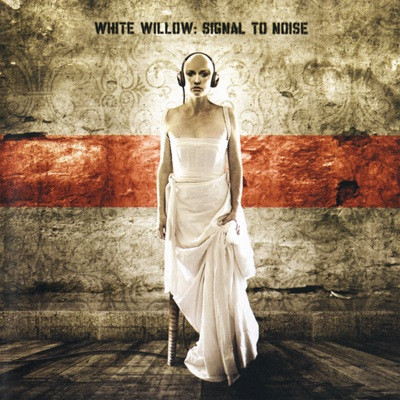
The artwork done by Killustrations, brings to mind of a utopian city gone horribly wrong. With its art deco decay, on the brink of collapse, but a powerful force of incredible music comes along the way with Orwellian atmospheric structure. Yes, there is that divided line in the sand about Signal to Noise; some love it, some don’t. I prefer not to be in the middle of it, but I always have a soft spot when it comes to bands who want to go beyond the prog and metal structures.
When it comes to albums such as Black Sabbath’s Technical Ecstasy, Captain Beefheart’s Trout Mask Replica, Electric Light Orchestra’s Out of the Blue, Renaissance’s Azure D’Or, or David Bowie’s Earthling, White Willow’s Signal to Noise deserves to be on top of that list of albums with repeatable, desirable listens. And for Trude Eidtang to be on this album for the first time, you can tell the chemistry is always there, right from the very beginning.
For example, the spooky sounds of ‘Ghosts’ you feel as if the walls are coming towards you inside the loony bin, with no way out. You can tell the band are creating this wailing cry of a patient, having a mental breakdown with blaring guitar notes, drum cymbals setting up the climax, alarming measurements, and temperatures going up to a higher level as the patient becomes one of the characters in the 1974 film, One Flew Over the Cuckoo’s Nest.
But then, it changes into an ‘80s pop-orientated sound as Trude Eidtang takes hold into her Kate Bush, Adore-era of the Smashing Pumpkins, and Bonnie Tyler’s appreciation as she ascends into the sky with the flowing wonders on ‘Joyride’. Then, she returns to the house of Thanatos once more as it becomes this collapsing city with this ‘Night Surf’ with its double-tracking vocals, setting up the ascending beauty of returning to the Sacrament-era, knowing the emperor has already gone into a psychotic breakdown, without anyone to help him as he has become his own worst enemy.
When I think of ‘Splinters’ I think of an early prototype beginning of Norway’s own Ring Van Mobius that comes to mind in which Jacob Holm-Lupo written this for the band during the time they were making Past the Evening Sun. ‘The Lingering’ on the other hand, returns to the desert highway, on the search of a spiritual quest.
Its dooming, eerie, scenario, makes you think of Brandon Lee’s swansong performance in The Crow as Eric Draven. It has that gothic mournful vibe, rain-dropping piano melody, Floydian guitar arrangements, and middle-eastern guidance that just hits you, each time Lupo tells Walthinsen, Schou, Einarsen, and Froislie to follow Eidtang’s angelic vocalisations.
You got to love the Italian Prog vibrations Lupo holds in his heart which speak of Banco del Mutuo Soccorso, Le Orme, Museo Rosenbach, and Murple that comes to mind as Trude reveals the devastation that has unfold in front of the listener’s eyes before returning back to the road once more with its mellotronic, folky-country swift, as the sun approaches for a new day to begin, as we travel to The Dark Road’ returning home.
Then, Brynjar Dambo comes into the world of Jazz-Fusion as he goes into a full-throttling moog improvisation behind ‘Chrome Dawn’. He starts off with this mellotronic lust, Lupo’s nod to Camel’s Moonmadness that comes to mind, and then Lars heading off into space and time, honouring not just Wakeman, but the late, great Peter Bardens where he goes into this arpeggiated synchronicity on the synthesisers.
There are some crystalized structures that have this cavernous vibe in which the band walk into. Revealing the diamonds inside, the echoing chambers that come with it, and the beauty that unfolds. Trude reveals her darker territory as she does this intensive dance to reveal the nightmare that’s about to unfold in this deserted ‘Dusk City’.
When Trude goes into this angelic turned hellish persona on this track, you better run like hell. The band walk into this thunderous punch between Schou’s drumming workout and Walthinsen’s intensive bass workout, makes Trude’s clothing designs of this white dress she imagines herself wearing, morph into this crimson, bloody red terror as she unleashes her own dystopian hell that’s unfolding.
As I close this out, getting ready to play BioShock Infinite for the umpteenth time and in a month for its 12th anniversary on my XBOX Series S, I always felt that White Willow have always kept doing what they wanted to do. Being true to their selves, being honest, and never giving up without a fight. It’s been an amazing road for Lupo to not only remastering from the original master tapes, but revisiting Signal to Noise and giving it the proper recognition it deserves when it originally came out in 2006.