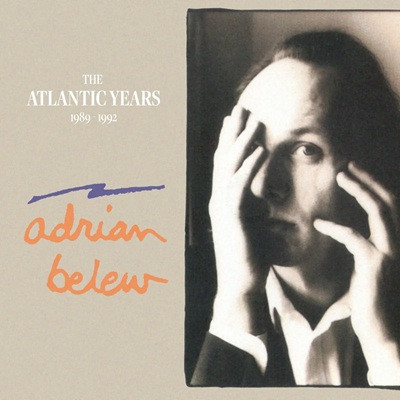
For nearly 50 years, Adrian Belew has carved out a singular identity in modern music. From Frank Zappa, Talking Heads, King Crimson, Jean‑Michel Jarre, Laurie Anderson, Paul Simon, The Bears, to Nine Inch Nails, he has never once slowed down or stopped reinventing himself. This new 3‑CD Esoteric set, covering his Atlantic years from 1989 to 1992, captures a period where Belew pushed his solo work far beyond the crimson‑colored expectations that followed him.
Across Mr. Music Head (1989), Young Lions (1990), and Inner Revolution (1992), Belew dives into an avant‑pop landscape with a progressive edge, and the results are consistently surprising. My own first deep dive into his solo catalog outside Crimson was 2022’s Elevator, but revisiting this Atlantic era feels like opening a time capsule from a restless, fearless creator.
After The Bears dissolved in 1989, largely due to poor label support and disappointing sales, Belew pivoted sharply. Mr. Music Head shows him experimenting with pop forms, most charmingly on the father‑daughter duet ‘Oh Daddy’, where Audie Belew adds a girl‑group wink to the track’s humour and warmth. The surreal, backward‑tape flamenco swirl of ‘1967’ nods to George Harrison’s psychedelic lyricism, while ‘Cruelty to Animals’ veers into musique concrète territory.
He then snaps back into post‑punk angularity, tipping his hat to David Byrne with the frenetic ‘Motor Bungalow’, before surfing into twangy, percussive bliss on ‘Coconuts’.
Young Lions is leaner, sharper, and more art‑punk in its attack. According to Mike Mettler’s liner notes, Reeves Gabrels approached David Bowie during this period to bring Belew aboard as musical director and lead guitarist for the 1990 Sound + Vision tour, which ran from March to August and totaled 108 shows. Belew recalls in the liner notes, “Whenever David wanted something ‘bigger’ than our band, we’d have to start incorporating sampling and other things which got to be pretty hairy”.
Out of that collaboration came two overlooked Bowie gems: the propulsive ‘Pretty Pink Rose’ and the blistering ‘Gunman’, a pointed take on gun violence. You can hear Bowie beginning to shed his mid‑’80s commercial gloss and drift back toward the stranger, more experimental instincts that would later resurface in the Outside era.
Belew’s own ‘Heartbeat’ remains a standout, reconnecting with his King Crimson roots while pushing the song into more personal territory. His cover of the Traveling Wilburys’ ‘Not Alone Anymore’ is a heartfelt tribute to Roy Orbison, delivered with reverence and a fresh emotional angle.
Inner Revolution opens with its title track—a sharp, melodic reflection on personal and societal upheaval—before launching into the distorted alt‑rock punch of ‘Standing on the Shadow’. ‘Big Blue Sun’ shifts gears entirely, channeling Harry Nilsson and Andrew Gold with baroque‑pop sweetness and Beatlesque psychedelia. Belew revisits Orbison’s emotional terrain again on ‘I’d Rather Be Right Here’, blending country warmth with Townshend‑like uplift. He then confronts the Gulf War directly with ‘The War in the Gulf Between Us’, echoing the sharp, ascending pop intelligence of late‑’70s/early‑’80s XTC, something Andy Partridge would surely appreciate, especially on ‘Heaven’s Bed’.
In the end, whether every experiment hits you the same way or not, the creative force Belew unleashed during his Atlantic years is undeniable. These albums aren’t footnotes to his Crimson legacy, they’re proof that he never stopped reinventing himself. And if you love his work with Crimson, this set is the perfect doorway into everything else you’ve been missing.