Interview: moksha
The idea, at its core, is a spirituality not defined by a faith, tradition or by any kind of divinity or any kind of supernatural presence, but more an emphasis on interconnectedness and presence in the moment. There is more beyond what we see in front us. There's a sense of intention and of "we're all here, together, with one life, so what do we do with that one life?"
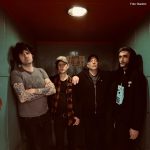
Photo: Derek Bremner
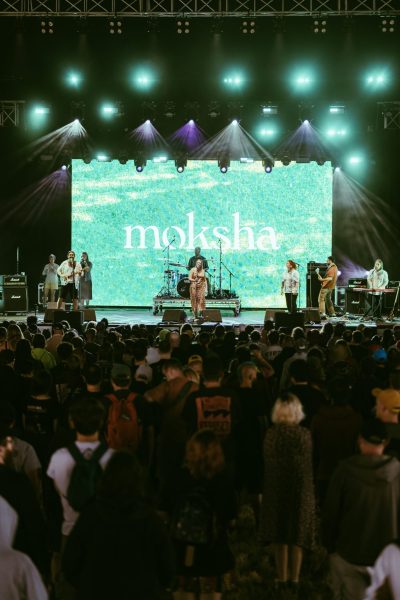
Former Ithaca guitarist Sam Chetan-Walsh and his wife, Holly, have formed a new collective – moksha. Keen to find out what it’s all about, Nick Dunn sat down with them at ArcTanGent to talk about Sanskrit, spirituality in music, and 70s’ prog bands. . .
E&D: What makes ArcTanGent the right venue for your debut?
Sam: It’s only our second gig, but it’s been really lovely. I wanted to play here partly because I thought it would be nice continuity from Ithaca finishing here last year, and because this is one of the best audiences in the UK for any kind of music. The ATG crowd are such an open-minded bunch and there’s such an emphasis on the avant-garde, the challenging, the out-of-the-box. Unless you’re really crap or inauthentic or a piece of shit, ATG will give you a hearing for almost anything. Someone said yesterday someone was rolling a plastic poo around in a tuba and the crowd loved it! Only at ATG would you get something like that. So there’s that, there’s us, there’s Conjurer, so there’s a hugely open-minded spirit here. So even if people didn’t like it, they’d be up for the vibe at least.
E&D: Do you feel like you’ve pulled in a lot of Ithaca fans, or do you feel you’ve got a broader audience now?
Sam: There was a smattering of t-shirts, which was a lovely compliment given how different we are! But I hope so. That would be nice, but let’s see where it goes. I can tell people are responding to the ideas and principles on show, because they responded to them when they were being communicated via Ithaca, so there’s a continuity philosophically, even if not sonically. In a sense, it’s not that new or different: different sound, but it’s still Captain Earnest who blabs on and makes us feel our feelings!
Holly: The invitation of moksha is that we’re a young band. We got together to practice for the first time in February, so it’s an unbelievable privilege to then be playing the main stage in ATG in August. It’s partly because of the trust that comes from Ithaca fans, but also there’s an opportunity for people to come on this journey with us wherever it goes. Music is always like this, it sometimes taps you on the shoulder and says “come with me”, and I love to think people from all different churches would want to see where this goes! Maybe we can build something together.
E&D: I do think that one of the strengths of ATG is the open-mindedness of the audience. Obviously at any festival you are encouraged to see bands you wouldn’t necessarily think of, but ATG really does nurture that curious spirit.
Sam: Big time. Where else would you see us, Primus, Alcest, Cult of Luna, Napalm Death, and such a wild genre list? But everyone here is of that mind. Authentic is authentic, good is good, and even if you don’t like it, people will always give you a chance here if you’re real, authentic, and sincere.
When is the debut album dropping?
Sam: You’re not the first to ask! Thing is, the big difference with this project compared to a normal band, is that this is more of a musical collective. Everyone’s in different parts of the UK with different lives and lots of responsibilities, and we’re not trying to build to a traditional album cycle, we’re just trying to make meaningful art as we go. We put out a single a few weeks ago, another one’s out next month, we’ll do gigs and live sessions. There should be a regular drip-drip of stuff coming, but I wouldn’t expect there to be an album per se. It’s just challenging to get everyone together to do something as big as an album. It’s a bit like Black Country New Road – they’re a collective doing the same drip-drip of singles. That’s the plan, I think. But we’re not ruling out an album.
E&D: The term ‘moksha’ refers to a liberation from samsara, the wheel of rebirth. Is it safe to say that the music and lyrics of the band will be examining that kind of spiritual liberation, as opposed to Ithaca’s political agitation?
Sam: Someone’s done their reading! The idea, at its core, is a spirituality not defined by a faith tradition or by any kind of divinity or any kind of supernatural presence, but more an emphasis on interconnectedness and presence in the moment. There is more beyond what we see in front us. There’s a sense of intention and of “we’re all here, together, with one life, so what do we do with that one life?” I’ve said to other people that I’m a parishioner of the church of Holly, Holly being my wife who’s sat here with me and who is an interfaith minister herself, and can probably talk a bit more about it.
Holly: Two things: the first is that Sam is the architect and he chose the name and he is of Indian origin. His Indian heritage is important to him, and we wouldn’t have picked a Sanskrit name if it weren’t an expression of his lived experience. That then meets with the fact that I’m an ordained interfaith minister, which means I’ve received training to offer spirituality to people of all faiths. I don’t belong to a particular religion myself but obviously I have spiritual practices that I nurture. I have also studied theology and Hinduism in particular, so it’s always been something I’ve enjoyed learning about. It’s not my heritage or practice to own, but it’s something I deeply appreciate. Being a student of spirituality, that will always run through what I write. Sam said that the framework won’t be dogmatic, but it’s a spiritual project, so that’s been amazing for me because I can express through my lyrics the paths and concepts I’m exploring.
E&D: That feels very humanist and grounded. A lot of “spiritual stuff” these days can come off otherwise as very “woo”. So making this a grounded and interconnected project is nice. I appreciated you taking a moment to lead the audience in a little breathing exercise before the music started so that we could all be here and present together before it began. Especially because a lot of UK audiences will just chat with their mates!
Sam: At ATG of all places! This is the music fans’ festival. That was exactly the point, so I’m glad that that’s what you got from it. We’re all here, we’re all together, loved and worthy of love. And to your point of spirituality being a framework to work within: for me a lot of what I take from what I’ve been taught by Holly and by life in general, spirituality is something that’s actionable, it’s present in the now. It’s something you do, something you live: immediate presence and interconnectedness, working towards a common cause, rather than trying to disappear off this Earth or ascend somewhere else. We are here now, so what does that mean? How do we operate under those conditions?
E&D: I was raised Christian, and now I’m agnostic, and something that Christians seem to have forgotten is that we are stewards of the Earth, we are not above it or separate from it. A lot of the problems we’re seeing at the moment are the result of that mistaken thinking – we’re all animals, part of one big ecosystem.
Sam: We were both evangelical Christians as teenagers, and the reason the shine came off that tradition for both of us was the idea that it’s all about later, that you’re gathering up things for getting to Heaven or when Jesus comes back. Which is fine, but it’s all happening in front of us. It can be tempting to miss what’s happening right now, in front of your face, because you’re thinking only of the future.
The band has been described as a “collective” – do you feel that’s an accurate term, and how do you define the idea of a ‘collective’ for yourselves? Does that mean a looser structure with a revolving door of session musicians, or is it something else entirely?
Holly: I think it expresses a looser organisation overall. Being a gigging band is a part of it, but it’s also a reflection of how much bigger than a normal band we are –we have a brass section! People might come in and out as time goes on.
E&D: So there might be a revolving door of session musicians?
Holly: Yeah, the uniting thing will be if we love them, because if so then they’re in. But also as people’s responsibilities and so on ebb and flow, the heart of what moksha means to us as a collective will either draw people in or it will put them off.
As a musical collective, there’s a wider range of musical styles in your inspirational melting pot, and a wider array of instrumentation in the music itself. How difficult or otherwise is that to grapple with in terms of composition?
Sam: I’m very lucky that while I drive a lot of the writing and the musicians are willing to go along with my crazy ideas. I can come in with a fleshed-out idea, and it gets on its feet in the room, but then the musicians can help craft it into something completely new. The idea of working in a collective is quite a DIY punk thing, a form of mutual aid and mutual support and interconnectedness. Although I’m driving the writing, I want it to be an “us” project not a “me” project.
E&D: Ithaca stopped largely due to the increased financial and personal demands of being musicians in the 21st Century. But Ithaca came to an end and those demands have not gone away. How do you feel about facing them as part of moksha rather than as Ithaca? Do you feel that it’s easier?
Sam: I think having it shared more widely in a collective is a big help. The thing is, what’s harder to communicate in a social media post about the break-up of Ithaca is that while it was the financial pressures, it was also that these things like the album-and-tour cycle can be arduous and tough on the body and mind. I personally came to a point where I realised I didn’t want to do that any more. I love gigging and playing music, but as moksha we can do whatever we like. That’s the freedom of moksha. I feel like I’m not bound by any obligation to be driving towards some bigger goal. We’re just having fun. We were having fun in Ithaca of course, but I felt responsible that it had become something bigger. With moksha, we’re just going to be playing good shows when we can with joy as the priority. We wrapped up Ithaca at the height of its joy, that’s something that’s hard to communicate. We all were such good friends, we had wonderful final shows, it couldn’t have ended better. But the other option is that you grind and grind and break up in acrimony and then forever you think of this key part of your life as a waste of time.
E&D: That makes sense. It’s just sad to see a leading light of the left-leaning hardcore scene extinguish itself, along with Svalbard this year.
Sam: But it’s no coincidence we’re all wrapping up now because we came up at the same time. Everyone has their reasons and it might not be ideal, but we need to be handing it off to the next generation. We’re all old fogeys in our mid-30s!
E&D: I’m 35 in October! I’m not that old!
Sam: I’m kidding, but I do want the younger kids to be taking over what we did, building the DIY spaces and a scene together. We weren’t really a scene in that way, even though we all cut our teeth on the pub circuit together: we just all did our own things. It’s up to the younger generations to carry it forward now, we’ve paid our dues. And if we’d continued Ithaca much longer we would have lost the joy of doing it, which would have been the biggest insult to the fans to not be doing it at 2000%. But I am sorry that we’ve called time.
E&D: If you were curating a festival of your own, who would be on your line-up?
Sam: Can we have a one-day festival?
E&D: It can be as big as you like.
Sam: So I’d have a neo-soul and R&B day with Prince headlining, D’angelo, Cleo Sol, Erykah Badu, all that lot. Then on the other stage complete insanity, a total greebo nightmare with Slayer headlining, Pig Destroyer, Orthodox and other crazy mosh bands.
Holly: So this is all-bets-are-off you can have whoever you want?
E&D: Yes
Holly: OK, so I’m going to add another stage to Sam’s festival for simplicity’s sake. Beverly Glenn-Copeland headlining, and that would be the contemplative, spiritual stage. Also Sufjan Stevens on that stage. Then we’d need Bon Iver, and then we’d need a prog stage. That would have to have the full original line-up of Genesis, Coheed & Cambria, Steeleye Span. . .
Sam: And we’d have Yes playing Close to the Edge in full.
E&D: I’ve yet to try that era of prog!
Holly: No time like the present! Start with Selling England by the Pound.
E&D: I’m setting myself a weekly challenge for myself for next year to listen to albums I’ve never listened to.
Sam: Nice! I did that during COVID and it was so educational. That’ll be amazing. Closer to the Edge, Selling England by the Pound, that’ll be amazing.
E&D: Selling England by the Pound is on the list. And Steeleye Span did a Wintersmith album for Terry Pratchett, who is my favourite author bar none, so they’re also on the list to try at some point. Pink Moon by Nick Drake is on there too.
Sam: You got any Fairport Convention on there? You need some of that.