Interview: Ba'al
I think if you don't have hope, everything's hopeless, and bringing things like that into black metal helps you to stand out a little bit. Black metal is meant to be challenging. A lot of people come on stage with this big brutal demeanour with the corpse paint, the bullet belts and taking photos with that mid-sneeze kind of facial expression. I feel like we do something a bit different.
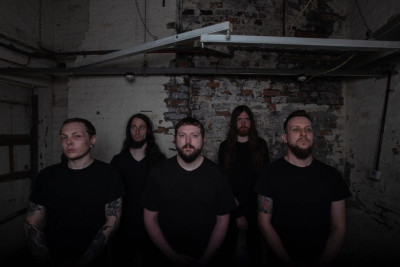
In the four years since Ba’al’s debut full-length Ellipsism was unveiled, a lot has happened. While Ba’al hit the stage with the likes of Ofnus, Sunken and Woe, the world at large went from bad to worse, every new day bringing with it fresh injustice, which makes the blackened post-metal mob’s latest EP Soft Eyes that little bit more of a balm for the soul. Tempering the darkness with moments of light, hope and introspection, it’s a deviation for the genre that lies completely in keeping with the band’s trajectory to date. David Bowes spoke to founding guitarist Nick Gosling, bassist Richard Spencer, vocalist Joe Stamps, drummer Luke Rutter and latest addition, guitarist Chris Mole, to discuss the record’s message and construction.
E&D: Welcome back with the new EP, it sounds absolutely fantastic. How did these three songs come together?
Nick: We’d been working on quite a lot of material throughout lockdown, which obviously is a couple of years ago now, and those ideas formed a lot of songs, which we have since developed and turned into finished songs. The three songs on the EP were basically three tracks which thematically and musically fit together quite nicely.
Chris: Richard and Nick had obviously been writing a lot. I joined the band during the lockdown so I came in after they’d all released Ellipsism and put that out there and was like, “Cool, you’ve already got a ton of stuff written.” Everything went into a big folder, we went through and picked things out that we thought fit together and I threw some ideas in as well. It’s not just a ton of stuff that had been written before I joined the band.
Nick: Yeah, sorry. That wasn’t my implication.
Chris: But yeah, it was that thing of writing a bunch of stuff in isolation and then getting back in the room and going, right, how does this fit together?
Richard: Nothing was finalised until we were all in the room together. The ideas that me and Nick had were the starting points but we carried on writing until we’d all felt like we’d used up all of our best ideas and then saw what we had at the end of that. And these three were, like Nick said, the ones that fitted together.
E&D: As these were put together during lockdown, was it a matter of all of you passing bits and pieces back and forth and building on that?
Richard: The genesis of most of the songs were written in isolation and we did pass a few back and forth over the internet and stuff, added to them and jammed them a little bit. But like I said, nothing was finalised or fully written until we all got in the room and Chris had joined the band as well. The germs of the idea were written in lockdown, but everything was then fleshed out in full in person when all five of us were there. We were all writing it together. So it was really just the beginnings of the ideas came from lockdown, but we wrote a lot. We wrote everything fully together from that point.
Chris: There were a ton of isolated ideas, a massive folder of recordings on a Google Drive. So it was like, here’s this idea, here’s that idea. and then piecing together what worked.
E&D: Given the fact that your debut album came out in 2020, so not really the best of timing for promoting it, did that have any effect on the direction of this material given the fact that you had to sit with the material from the debut before you could really take it out and tour it?
Luke: It gave us a lot of time where we were just able to focus on writing while we weren’t effectively able to go out and play any music. A lot of the time we’re quite focused on just being in the room together, refining the songs that we’re going to play live and making sure that we’re going to bring our best performances out. But over that time, we were a lot better able to focus that on the writing and creative process.
Chris: Yeah, I think that helped, It’s fair to say the songs were a lot more ambitious; just in general, there’s a lot more going into them. I think you can tell that it’s because we had that time to really sit with them, go over them and throw things in and see what worked.
Richard: Part of it was when the album came out, we couldn’t play any of the songs. But then when we came to play any of it live, we had Chris join the band as a new member, so he had to learn the songs, we had to practice them, and then we had a good chunk of time where we needed to gig those songs before we fully finalised doing all the writing for the new stuff. So that added to the amount of time it’s taken us to finish them, but that also just brought us more time to just fiddle with them and make them more fleshed out.
E&D: Am I right in thinking that since Chris joined the band, this has been the longest steady line-up that you guys have had?
Richard: I think I worked out we had at least one line-up change every calendar year from ~2016 until Chris joined in 2021 but we haven’t had anything change since then. This is by far the longest, most stable, and I think most comfortable and solid line-up that we’ve had.
E&D: What is it you feel about this particular lineup that’s been working so well for you?
Chris: I was just about to joke about how I have something to tell you guys! I knew Joe before I joined the band as me and Joe were in a side project together. I think I knew pretty much everyone except Nick so it was just that level of familiarity. Plus we’re just all quite chill. It’s a chilled environment where we can all just try and push ourselves to be as good as we can.
Luke: Chill, but also quite professional in the regard that we’re quite good at distributing responsibilities between each of us. We all turn up, we all contribute and there’s no resentment between anyone. We’re all in this together and we all contribute creatively as much as we can.
Nick: We’ve all got the same vision of what we want the band to be and what we want to get out of it, which hasn’t necessarily been the case in the past. Within our current lineup, there’s never really been any conflicts of interests. We pretty much agreed on where we want to go and what we want to do with it.
Richard: Nick’s technically the only original member left, I joined pretty much at the start, but a few months later, I didn’t know anybody in the band at that point. Obviously, I’ve now known Nick for a long time through the band, but every time we’ve had a member change, we’ve basically filled the gap with someone that one of us already knew or was friends with from something else. Like Chris was saying, he was in another band with Joe, I was in another band with Luke. The gaps have been filled by friends or people that we know already so that helps smooth the transitions and make the line up feel much more cohesive.
E&D: One thing you’d mentioned earlier that you really do feel with the new material is that level of ambition. You’ve never been lacking it before, but it does feel like you’ve really pushed it forwards. Given the fact that you’ve never really been held back by particular genres, how much self-control and self-editing was involved with song construction? When do you know enough is enough?
Richard: It’s really hard. That’s one of the things that I think we can all agree takes us the longest to work out and that’s another reason why it takes us such a long time. The songs are really long for a start, which makes them take a long time to write, but knowing when they’re done, when we’ve finished messing about with them and adding extra layers, especially now when we’ve got extra instrumentation in there and stuff, can easily snowball quite a lot. I’m sure Joe will attest when he’s trying to write lyrics that it can be a bit frustrating, but in a way that ultimately comes up with something really good.
Chris: There is a point where it’s like, “How long do we do this for? How long can we do this? Is it four times or three times?” Chopping things down as much as you can, just because this feels slightly too long or this feels like it could be longer – and it is just a feel thing a lot of the time.
Nick: There is an ongoing eight year long joke where we’ve on so many occasions tried to write a song that’s three to five minutes and then it’s just out of nowhere, we barely even noticed that it’s already become eight, nine, 10 minutes. I’m not sure that we’re capable of writing a sub seven minute song.
Chris: Was there a thing where we kept getting given 30 minute sets and it was like, “Oh yeah, great. That’s two, three songs?”
Richard: I think with the extra instruments we got on this one as well, that’s also part of the pushing outside the box kind of thing. We’ve always been interested in those kinds of things, like the strings and stuff. I did a little bit on Ellipsism and I think we just needed the confidence of doing a little bit of it, or at least I did anyway. Speaking as the one who did the strings, we needed to test the waters a little bit on previous releases, see how people found it and liked it. then push it out a bit further. That goes for all of us with the synths and the extra stuff we’ve all added in, the samples and the sound effects. I think it basically was just that we felt confident enough this time and we had the time to do it that we just thought, “Let’s just try it out.”
Nick: The big thing as well that we’re pushing the boat out with is using some of those extra layers when we play live, which obviously means playing to a click track. It’s something that we’d thought about on occasion but I’ve never played live to a click track before; it’s completely new to me. As much as I wanted to do it, as it gives you the opportunity to add quite a lot more, I was still quite apprehensive about it. I was quite worried about myself. Am I good enough to be able to play that tight for half an hour whilst sweating and concentrating really hard?
Chris: It’s also about keeping the organic nature of the performances. I know that’s something that Luke’s done when he’s looking at looking at the click tracks and getting that all together. I think it’s fair to say Luke is the tech guy of the band. There’s an ebb and flow to what we do live. We could drag sections out, we can have big, long feedbacky bits where we just let the audience sit with it for a bit. But it’s trying to find a way to marry that with it being a click track. It has to be a certain length. It’s trying to make sure that we’ve still got space for things to breathe but also have all the extra, big shit going on in the background.
E&D: Have you had the chance to try out any of the new material live so far?
Richard: We have been but we’ve not played any with the backing tracks. That stuff we were just talking about has yet to be tested, but we’ve been playing ‘Ornamental Doll’, which is going to be the lead single, for a little while. We tried out ‘Yearn To Burn Bright’ a couple of times at small shows just to see how it would be received. But ‘Bamber Bridge’ we have yet to play live at all, but we will be bringing it in.
E&D: I was actually really curious about ‘Bamber Bridge’. Is that about the Battle of Bamber Bridge?
Joe: Yes, to an extent. I wanted to write a song that was about prejudice and hatred, poisoning the vessel in which it’s contained. These are emotions and things that hurt the person who has them as well as the people that they have prejudice towards. I wanted to have a bit of a different take on something like that. I’d read a lot about the Battle of Bamber Bridge and I used that as a frame when writing the lyrics, almost like a set piece. I was really inspired by the story, so why not? But I didn’t want to do that thing where I was doing the, “Oh, hey, everyone, by the way, racism is bad because…” I liked to think that the people listening to this will already feel that. I’m optimistic like that, so I didn’t want it to come across as at all patronizing. I wanted to give it a bit of a different swing.
E&D: I think that sense of hope does really seem to shine through in a lot of your work. How difficult is it to maintain that given the fact that you are, in a sense, a black metal band, which is normally focused on negativity?
Joe: I think if you don’t have hope, everything’s hopeless, and bringing things like that into black metal helps you to stand out a little bit. Black metal is meant to be challenging. A lot of people come on stage with this big brutal demeanour with the corpse paint, the bullet belts and taking photos with that mid-sneeze kind of facial expression. I feel like we do something a bit different. We’re not saying, “Oh, everything’s terrible and that’s good. And I’m an emperor of darkness” or anything like that. We’re saying, “Well, there are all these awful things, but there is like a light at the end of the tunnel. And there are things that you can do, things that have practical application for change.” It’s empowering in that sense; it’s actually quite realistic.
Chris: The way I’ve always felt about it is that you’re giving people this deep emotional, possibly, horrible, awful things to think about, but then saying, “Look, we’re here with you. We’ll get through this.” You have that light and shade of you going to the really dark, heavy places, but you can’t stay in the really dark, heavy place forever, because that’s just horrible. It’s telling people that, yes, it’s going to be awful, but you will get through it.
Joe: I think there’s a sense within a lot of this kind of music that fetishizes misery to an extent. It’s like this negativity is actually a good thing and it’s cool. It’s almost in vogue. I like us to fight against that a bit. It’s not like we’re saying, “Oh, we’ve gone through all this and we’re so sad and we’re so depressed and that makes us cool”. It’s more that we’ve gone through this and we know that a lot of other people go through this as well. That’s the challenging bit – we can provide people this area in which they can actually engage with those negative feelings in a constructive and safe way in which they can come to terms with them and move on from it. It’s almost like a therapy session for us, but for the people who are listening to us as well.
Richard: Even going right back to the start of Ba’al, we’ve always had the contrast musically to an extent, There’s the black metal and the sludge and the horrible riffs that’s always been there but we’ve always equally wanted to put in pretty post-rock bits and little nice ambient clean things. I think when Joe joined the band and wanted to write lyrics with that much care and consideration for the emotional side of it and the contrast in that as well, that really just pushed us further down that road, so now we’re writing with that in mind from the start really. It was a nice convalescence of both of us already going in that direction, just pushing us to do it even more basically.
E&D: Can I ask about the other two songs then, ‘Ornamental Doll’ and ‘Yearn to Burn Bright’. Are they both coming from a historical basis?
Joe: Both those songs actually come more from personal experience, not necessarily directly my own personal experience, but sometimes people that I know and people that I’ve met in the past. I like to keep it a little bit more vague because I like to retain an element of privacy about my own personal experiences. ‘Ornamental Doll’ is about growing up on the autism spectrum, and specifically going through school with those kinds of experiences and ‘Yearn to Burn Bright’ is very much about being more of an artistic person and not fully appreciated by our more modern society. It was partly influenced by an interview that I saw with the comedian Stuart Lee, who was talking about Margaret Thatcher. She was talking about people who were studying things like ancient Norse literature and saying that it was a privilege to do so and that the arts weren’t really important. That one was more my frustration raging against that and insisting that artistic people are a little bit more sensitive, can push through and be successful by their own standards, even if we live in a society that doesn’t openly recognise that sometimes.
E&D: How do you feel that the metal scene is at the moment in Sheffield? I remember how it used to be back in the early 2000s, but do you think it’s still that strong?
Chris: I think it’s pretty solid – there’s a lot of very good bands. There’s a lot of buzz around it. I One part of it is that there’s the Metal to the Masses thing for Bloodstock. Obviously, a lot of places in the country do have those competitions, but the Sheffield one I think is particularly well run. You know, it’s well run. There’s a really good diversity of bands that are in it and I think the quality level is generally really high. There are a lot of bands that know each other, talk to each other and go to each other’s shows; we support each other and help each other out. I’ve been here for a while, and I’ve been in bands for most of that time. With my old band, we were active for 10 years and I remember the scene definitely not being as strong then as it is now.
Joe: I think the scene now is really well connected. I’m actually one of the judges for the Sheffield Metal To The Masses so I get to see and experience all the bands. There’s been a real change in attitude recently. I think before that things could be a little bit fractured in that there was a lot of very separate groups that existed within the scene, but also just supported themselves and didn’t really cross over too much, whereas now it feels like there’s one big collective and there’s a really positive feel to it. Everyone’s rooting for everyone else.
Nick: There’s an old adage about Sheffield, which I’m sure is probably shared in other cities as well – people say it’s like the world’s biggest village because everyone seems to know each other, or at least everyone is maybe one or two degrees of separation from everyone else. If there’s a new band in Sheffield, you’re usually only one or two people away from members of that band so there’s definitely a collective feeling within Sheffield.
Richard: Around the time that we started in 2016-17 there was a slightly booming scene, at least in the North of the UK, for like doom, sludge and stoner stuff, which we benefited from slightly. Holy Spider, a promotions company in Sheffield, who do the Doom Lines Festival, were part of that, but like Joe was saying, it didn’t necessarily have the full wide spectrum of stuff all under one community like it does now. Cause from that point, Holy Spider are still doing their thing and that’s great. We’ve played for them a lot of times, but it feels like a lot more things have sprung up in between. Heel Turn, another promotions company that we’re friends with, we play with them a lot. It just feels like everyone’s friendly and all part of the same community now. And we’re starting to get some bigger names coming through as well who you might otherwise sometimes have to travel outside of Sheffield to see, which is great as well.
E&D: What else do you have in the works? Have you been working on any other material yet or that bit too early?
Nick: The answer that I started giving to your first question pertained a bit to that in that we do have quite a lot of material which is going to be released at some point, It’s early days as to how it’s going to be released or when. A large amount of stuff that we worked on through lockdown and then developed heavily with Chris has also been put together in a similar way to the three songs on the EP. So yeah, we are sitting on quite a lot of stuff which will be released at some point. And we’ve just recently now that we’ve like got all the admin for the EP sorted, looking at starting to write again, new stuff for in the future as well.
Luke: I think needless to say, there’s a lot we would like to talk about there, but to do so now would be jumping the gun a bit.
E&D: Yeah, fair.
Richard: Yeah. If you like what you hear on the EP, you can just be assured that there’s plenty more of it coming.
E&D: A bit of a trite question, but where did that title Soft Eyes come from? It’s striking and I can never quite figure out why.
Joe: That was from me. I had a close friend to me who actually works in the police force. We’re both fans of The Wire and I’d seen the phrase soft eyes used in that. My friend told me that they do actually use that phrase in the police, albeit differently where she works. She said that it’s to do with viewing things with a sense of empathy in order to see more of what’s there which ties into all of these songs. They’re all subjects in which we’re viewing something with a sense of sensitivity and compassion.
E&D: Okay, that’s a… it’s quite a beautiful connection. If it’s okay, I think I might try and tie things up, but I was just wondering, is there anything that any of you wants to add or all of you?
Chris: I mean, I’ll just say that I’m really excited for people to hear the EP. Because I think generally I think it’s some really strong music. I know I wasn’t in the band when Ellipsism was written and came out so I had that thing of listening to it going, “This is awesome.” And I get to play the songs live! It’s great. But I think it’s just been really cool to develop some stuff that builds on Ellipsism, adds a bunch of new textures and new elements and pushes the whole thing further. I’m really excited for people to hear it and hopefully it’ll go down well.
Richard: I think pretty much the same. It’s the same thing that all bands say in these situations, but it’s taken us a long time to get to the point of releasing this stuff. For us, we’re itching for people to actually hear it, hear what the reaction’s like and see how the songs go down live when people have heard them – just get people to hear what Ba’al sounds like no. So yeah, we do hope that people check it out and enjoy it and follow us for plenty more to follow after that.
Nick: Like you said, this is the longest that we’ve had a stable lineup and because we all come from similar, but still quite varied musical backgrounds, there’s always been a lot of different angles being thrown around. It’s nice to be able to hone that a bit now that we’ve got a solid lineup. There’re not really any changes or fractures which can harm our musical progression. We’re all in the same boat heading towards the same destination. I hope and believe that means that our music’s just going to get better from here on out.
Luke: Yeah. And I think on top of that as well, like a bit cliche too, but considering how long it’s been since we released Ellipsism now, we’ve just got to be really grateful to all the people who are stuck around waiting for new music and the people who have found us along the way as well. It’s great that so many people are connecting to it. It’s just really humbling and we’re really grateful for the people that are finding it as empowering as we do.
Joe: I think it’s really cool just how many people seem so excited that there’s something coming out as well. This is something that we’ve really seen gradually grow very organically and it’s really cool to see that it’s connecting the way that it is.